
Home Blog Page 66

El-Rufai Live Volunteer for Digital Political Engagement Community

0

Application is now open for volunteers to join El-Rufai Live Political Community, a growing digital platform focused on governance conversations, leadership awareness, and political engagement among citizens.

El-Rufai Live has expanded its online political engagement community and scaled its virtual political events and podcast conversations aimed at promoting informed dialogue and civic participation.

The initiative is designed to create stronger platforms where young people and interested citizens can actively engage in national discussions and contribute to responsible public discourse.

El-Rufai Live is currently seeking dedicated volunteers to support its activities across several focus areas. These include podcast production and content planning, political research and policy analysis, digital media and community engagement, virtual event moderation and hosting, audience engagement and feedback coordination, as well as content writing and political communications.

This is an opportunity to be part of a vibrant political community that promotes responsible engagement, supports youth inclusion in governance conversations, and contributes to building informed public discourse.

The volunteer programme is open to individuals with varying levels of experience. Passion for national development and political awareness is highly valued.

Whether you are experienced or simply passionate about national development and political awareness, your voice and contribution are welcome.

There are several benefits of volunteering, including the chance to be part of meaningful national conversations, gain experience in political communication and leadership, and expand professional networks.

Those eligible to apply include youths and professionals who are passionate about governance and political awareness, individuals interested in civic engagement, digital media enthusiasts, content creators, and persons willing to contribute ideas and time. While experience is considered an advantage, it is not compulsory.

Together, we can build a stronger political conversation platform and empower citizens through knowledge and engagement.

Interested volunteers are required to apply by sending a short introduction containing their name, location, area of interest, and any relevant experience to WhatsApp via 0808 213 1009.


Advertisement

Ignore Claims FG Postponed N22,500 TVET Stipend

0

There is a fake circular currently circulating on social media claiming that the Federal Government has postponed Technical and Vocational Education and Training (TVET) stipends nationwide. Trainees are advised to ignore the circular.

A careful review of the document shows that it is fake and poorly generated, likely using ChatGPT AI. Nigeria Startup News can confirm that the circular did not originate from any official government source.

The Federal Ministry of Education (FME) has not issued any announcement regarding the postponement of TVET stipends.

The circular falsely claims to originate from the “Federal Secretariat Complex, Phase II, Abuja,” and contains several spelling and grammatical errors that immediately raise red flags.

It also carries a fake reference number, FME/TVE/ACT/VOL.1/145, dated 9 February 2026.

In addition, the document falsely addresses the Director-General of the National Board for Technical Education (NBTE), Kaduna, further exposing its lack of authenticity.

The content of the fake circular includes numerous errors and claims that payments for July 2025 and August 2025, as well as January 2026, have been postponed, stating that cumulative payments would be made in February 2026. These claims are entirely false.

Nigeria Startup News has deliberately retained the original typographical errors from the fake circular in this report to clearly show how poorly the document was produced.

Meanwhile, all TVET trainees are encouraged to complete their biometric verification, which commenced on Monday across many training centres nationwide.

Trainees who fail to complete the biometric thumbprinting exercise will not be paid the approved monthly stipend of N22,500. Likewise, training centres that fail to comply with the biometric verification process risk being removed from the programme.

CAC approves free business name registration for 3,500 SMEs

0

The Corporate Affairs Commission (CAC) has approved free Business Name Registration for 3,500 Small and Medium Enterprises (SMEs) across all the states of the federation as part of activities marking its 35th anniversary.

The Registrar-General and Chief Executive Officer of the Corporate Affairs Commission, Hussaini Ishaq Magaji, announced this on Monday at the opening ceremony of the Commission’s 35th Anniversary Celebration in Abuja.

Magaji explained that the free business name registrations would be distributed across the 36 states of the federation and the Federal Capital Territory, Abuja, to support small businesses and promote formal registration across the country.

He also announced scholarships for six outstanding corporate law students from each of the six campuses of the Nigerian Law School for the 2026 academic year, saying the initiative would support corporate law education.

As part of the anniversary activities, Magaji disclosed that the Commission donated 120 mattresses to an Internally Displaced Persons (IDP) camp and provided support to orphanages as part of its corporate social responsibility.

In recognition of staff contributions to reforms, he approved a commemorative staff bonus of 25 percent of one month’s gross salary for February, alongside special car and housing loan schemes.

Reflecting on the Commission’s journey, Magaji said the CAC had transformed from a manual, paper-based institution into a digital organisation delivering services beyond physical borders.

He said, “When the Corporate Affairs Commission was established in 1991, our story began humbly, but with a bold mandate. At the time, CAC operated from a single office in Area 11, Garki, Abuja, serving the entire nation.

“To register a business or an association in Nigeria, citizens had to travel from every part of the country to Abuja. Processes were manual, records were paper-based, and service delivery was limited by geography and time.

“Yet, that single office laid the foundation for what has become one of Africa’s most dynamic and reform-driven corporate registries.”

Magaji noted that access to CAC services has expanded.

“Fast-forward to 2026, and the CAC story has evolved dramatically. Today, our services are no longer confined to one location. They are accessible across Nigeria and around the world, anywhere, anytime, 24 hours a day, seven days a week,” he said.

Describing the transformation, he stated, “This is our evolution. From Paper to Portal. From Queues to Clicks. From Stress to Seamless. From One Office to the World.”

Magaji revealed that the Commission has deployed Artificial Intelligence (AI) to improve turnaround time and service delivery in line with global best practices.

While acknowledging that the transition to an AI-driven portal caused temporary disruptions and productivity challenges in some areas in 2025, he appreciated stakeholders and customers for their patience.

According to him, “Let me state clearly: The deployment of AI at CAC is not optional; it is necessary.

“Business registration volumes have grown exponentially, driven by tax reforms, the monetisation of social media and digital businesses, and policies promoting the formalisation of informal enterprises.

“To put this into perspective, CAC now receives close to 10,000 business registration requests daily, compared to only hundreds in the past.

“In addition, our complaint management system, through emails and call centres, now handles an average of 5,000 inquiries every single day.

“Imagine the number of staff required to manage this volume manually. Only AI can effectively complement human capacity with the required speed, accuracy, and precision.”

He further disclosed the signing of a Letter of Collaboration between the Commission and Google to strengthen its technology framework and improve service delivery.

“Google brings global expertise and technological support that will further strengthen our systems, enhance portal performance, and deepen the ease of doing business in Nigeria.

“As we celebrate the past, we are inspired by a future driven by technology, efficiency, transparency, and global standards,” Magaji said.

NITDA Targets 50 Million Digitally Skilled Nigerians by 2027

Director General of NITDA, Kashifu Inuwa CCIE, has unveiled a bold roadmap to ensure that 50 million Nigerians are digitally skilled by 2027, positioning the nation as a global powerhouse at the Tech Revolution Africa 2026 conference.

Addressing Africa’s leading innovators at the Landmark Event Centre, Inuwa outlined a future anchored on rapid infrastructure development and a world class digital workforce aimed at closing the gap between local talent and global demand in the fast evolving technology space.

He was represented by the Director of Stakeholder Management and Partnerships, Dr Aristotle Onumo, who delivered a fireside chat titled “Building Nigeria’s Digital Journey: Policy, Infrastructure, and the Road Ahead.” The session detailed NITDA’s strategic approach to national digital transformation built on enabling policies, resilient infrastructure, and people focused innovation.

Emphasising the role of the digital economy in national development, Inuwa said “the digital economy is fundamental for job creation, global competitiveness, and economic growth,” adding that Nigeria is making steady progress despite existing infrastructure gaps. He explained that progress recorded in recent years has been driven largely by policies that support innovation rather than restrict it.

Speaking on data sovereignty, he disclosed that NITDA is collaborating with global hyperscalers to ensure that Nigeria’s data remains hosted locally and managed within the country.

“Talent can be anywhere in the world, but data infrastructure must be built here,” he said, explaining that localising data centres is critical to Nigeria’s data economy and digital sovereignty. He added that the Nigeria Data Protection Act has created a strong legal foundation for safeguarding personal data and strengthening trust across the digital ecosystem.

On talent development, Inuwa reaffirmed NITDA’s ambitious digital literacy target, stating that “our vision is to ensure that 50 million Nigerians are digitally skilled by 2027.” He noted that the target is being pursued through partnerships with the National Youth Service Corps (NYSC), educational institutions, universities, the civil service, and private sector partners to drive nationwide digital skills acquisition.

He also highlighted the 3 Million Technical Talent (3MTT) programme, describing it as a transformative initiative designed to build globally competitive technology professionals for the future economy.

Stressing that exporting skills should not be viewed as a loss, Inuwa said “digital talent is global talent, and when our talents go global, the economy benefits through remittances, experience, and reputation.”

He further pointed to the Nigerian Startup Act as a key policy milestone reshaping the innovation landscape by providing incentives, recognition, and structured support for startups. He reiterated that public private collaboration remains central to NITDA’s strategy, noting that “regulation is not meant to stifle innovation, but to amplify it and create new markets.”

Expressing confidence in the country’s digital future, he said “in the next few years, Nigeria’s digital economy will be an engine for growth, and it will be robust, scalable, and globally competitive.”

Lagos agripreneurship programme creates 15,000 jobs, trains 5,000 youths

The Lagos State Government has created over 15,000 jobs through the Lagos Agripreneurship Programme (LAP), an initiative designed to equip youths with modern agricultural skills and promote food security across the state. The programme targets youths between the ages of 18 and 30 and provides structured training, internship, and mentorship opportunities that expose participants to different areas of the food system and agribusiness value chain.

The Director of the Agricultural Training Institute, Araga, Epe, Folake Ogunlana-Lawal, disclosed this at the closing ceremony of the four-week training for the 26th cohort of the programme. She described LAP as a major platform for youth empowerment and capacity building in modern agriculture, noting that it aligns with the Ministry of Agriculture and Food Systems’ mandate under the THEMES+ developmental agenda of the Lagos State Government.

Ogunlana-Lawal said that over 5,000 youths have so far been trained under the programme, adding that beneficiaries have collectively generated thousands of additional jobs across various agricultural enterprises. According to her, each graduate of the programme has gone on to empower an average of two to three other persons through farming, processing, and related agribusiness activities.

She announced that the next batch of trainees will commence training on February 22, 2026. The director explained that the programme was designed to build a resilient and sustainable agricultural sector in Lagos State by equipping young people with practical agripreneurial skills, reducing unemployment, and promoting climate-smart farming practices.

She said LAP was modelled after Israel’s Arava International Centre for Agriculture Training (AICAT) and is built on the principle of hands-on learning. “The programme, conceptualised in 2020, involves a four-month training cycle consisting of one month of intensive on-site demonstration at the Lagos State Agricultural Training and Entrepreneurial Centre, Araga-Epe, followed by a three-month internship and mentorship phase with agro-allied companies,” she said.

Ogunlana-Lawal added that participants are trained, accommodated, fed, and provided with training materials and safety kits free of charge by the state government. According to her, the final stage of the programme involves enterprise activation, where successful participants undergo an incubation period at the Lagos Food Production and Entrepreneurial Centre, Songhai, Badagry.

She commended Governor Babajide Sanwo-Olu for his sustained commitment to youth empowerment and agricultural development in the state. She lauded stakeholders and partners for their roles in ensuring the success and continuity of the programme.

“I want to appreciate the Commissioner for Agriculture and Food Systems, Ms Abisola Olusanya; the Permanent Secretary, Mr Emmanuel Audu; and other directors in the ministry for their unwavering support,” she said.

She urged beneficiaries to remain committed to transforming agriculture and leveraging innovation to grow the sector. “Over the past month, you have learnt the fundamentals of agripreneurship, innovative farming practices, and the importance of market linkages. Now is the time to put theory into practice,” she told the trainees.

Two beneficiaries, Ayodeji Oyindamola John and Balogun Saheed Ololade, commended the state government for the opportunity provided through the programme. Ayodeji, a graduate of Agricultural Extension and Rural Development from the University of Ilorin, said the training exposed him to the practical aspects of agriculture and enhanced his entrepreneurial skills. Balogun said the programme broadened his knowledge in aquaculture and pig production, adding that he plans to establish an agribusiness.

EDUFORGE Trains Over 2,000 Educators in Kano

0

Over 2,000 educators converged in Kano State for a large-scale training organised by EDUFORGE aimed at advancing inclusive, learner-centred teaching practices in Nigerian classrooms. The event marked the second edition in the EDUFORGE series, following its inaugural training held in Abuja on January 10, 2026, and brought together teachers, school principals, school proprietors, and education leaders from across Kano State.

The programme was led by renowned education trainer and Lead Facilitator, Phrank Shaibu, and was described by participants as timely and practical. The Kano State Commissioner for Education was officially represented by the Director of Schools, Sagir Umar Danbare, whose attendance highlighted the institutional importance of the training and the state government’s commitment to continuous teacher development.

Speaking during the sessions, Shaibu explained that the core focus of the training was access, not language display. “Today is not about speaking big English,” he said. “It is about reaching every learner.” He noted that effective teaching must prioritise understanding and participation rather than complexity of language.

Throughout the day-long programme, participants remained actively engaged, taking part in discussions, responding to live classroom scenarios, and participating in hands-on demonstrations. Observers noted high levels of enthusiasm, curiosity, and sustained attention, which many attributed to the relevance of the examples used and the practical nature of the sessions.

Shaibu facilitated the training alongside a team of experienced educators, including Godwin Adugba, Maria Oche, Jerry Tialobi, and Sifon Akpan. Their coordinated delivery and shared classroom experience were said to have contributed to the smooth flow and depth of the sessions.

A major focus of the training was the Universal Design for Learning (UDL) framework, which encourages teachers to design lessons that accommodate diverse learners. According to Shaibu, this includes learners who grasp concepts quickly as well as those who need repetition or alternative explanations.

Using familiar local metaphors, he explained that teaching design must be inclusive. “If only motorcycles can pass on a road, the road has failed,” Shaibu said. “A good road allows okada, keke, cars, buses, and trailers to move safely. That is what UDL demands of teaching.”

The sessions also examined how everyday classroom language can unintentionally exclude learners. Through practical and humorous examples drawn from common Nigerian English usage, participants explored how small adjustments in wording, instructions, and feedback can increase student confidence and participation.

By the end of the training, many participants agreed that the experience went beyond grammar or teaching methods, reframing teaching as a deliberate design process where language plays a key role in equity and access. The Kano training stands as one of EDUFORGE’s largest single-day engagements in Northern Nigeria, reflecting growing interest in professional learning that is practical, culturally grounded, and immediately applicable.

FG Reopens GEEP 3.0 Loan Portal in 2026

0

The Federal Government has reopened the application portal for the Government Enterprise and Empowerment Programme (GEEP) 3.0 loan in 2026, renewing access to a scheme created to support small businesses and farmers across Nigeria. The programme is implemented under the National Social Investment Programme Agency (NSIPA) and offers zero-interest, collateral-free loans to Nigerians at the grassroots level.

The GEEP 3.0 portal is now open for applications. The programme is designed to reduce poverty, improve livelihoods, and strengthen local enterprises that contribute to growth. It has coverage across the six geopolitical zones, allowing eligible beneficiaries to apply.

The loan scheme operates through three windows: TraderMoni, MarketMoni, and FarmerMoni. TraderMoni is targeted at petty traders and artisans who need small starter loans to grow businesses. MarketMoni focuses on market women and small-scale business owners, while FarmerMoni is structured to assist smallholder farmers with funding for agricultural inputs such as seeds, fertilizers, and equipment. Each window is designed around the needs of its target group and follows flexible repayment terms.

Under GEEP FarmerMoni, eligible smallholder farmers can access interest-free loans of up to ₦300,000. Beneficiaries are given a three-month moratorium before repayment begins, allowing time to invest the funds into productive activities. All GEEP loans attract zero interest and do not require collateral.

For eligibility requirements, applicants must be Nigerian citizens within categories such as smallholder farmers, petty traders, artisans, or market women. Basic requirements include valid identification like BVN and NIN, an active mobile phone number, and proof of an existing business or farm. Priority is given to women, youth, and vulnerable individuals.

Applications are submitted online at no cost. Applicants must register, choose the TraderMoni GEEP programme, and complete the form.

To apply for N300k GEEP 3.0 loan, interested applicants should visit https://geep.nsipa.gov.ng/ and apply.

African Startups Raise $174m in January 2026 as Deals Hit New Low

Africa’s startup funding opened 2026 on a slow note, with just 26 ventures raising $174 million in January, according to Africa: The Big Deal. The figure is well below January 2025 levels, despite marking a rebound from earlier January slumps.

According to the Africa: The Big Deal report titled January 2026: a muted start of the year, “a relatively slow start of the year doesn’t make a bad year” and “neither does it signal a downward trend.” The report added that a month-on-month dip between December and January is not unusual.

Data showed that start-ups across Africa raised $174 million in January 2026 through disclosed deals of $100,000 and above, covering equity, debt and grants, excluding exits. This is lower than the $276 million raised in January 2025 and below the 12-month monthly average of $263 million, but higher than January 2023 at $106 million and January 2024 at $85 million.

The report said the more concerning issue is the low number of funded ventures. Only 26 start-ups announced funding of at least $100,000 during the month. Africa: The Big Deal described this as “very low,” adding that the figure is just above half of both the January 2025 count and the average monthly deal volume. It said this is “the lowest monthly tally on record since at least 2020.”

Among the top fundraisers was Egyptian fintech valU, which secured $64 million in debt from the National Bank. Nigerian mobility financing start-up MAX raised $24 million through equity and asset-backed debt. Four others raised $10 million in equity: NowPay in Egypt with $20 million, Morocco-based proptech firm Yakeey with a $15 million Series A, Terra Industries with $12 million, and Côte d’Ivoire fintech Cauridor.

On the exit front, not included in the totals, Flutterwave acquired Mono in Nigeria for around $30 million, while Savannah and Qotto were also acquired. The report ended with, “Now: Bring it on, February,” for Africa.

EU to begin STI agreement with Nigeria, unveils €600m research plan

The European Union has announced plans to begin negotiations with Nigeria on a Science, Technology and Innovation (STI) Agreement, alongside new initiatives aimed at expanding access to global research funding for Nigerian researchers, innovators, institutions and startups.

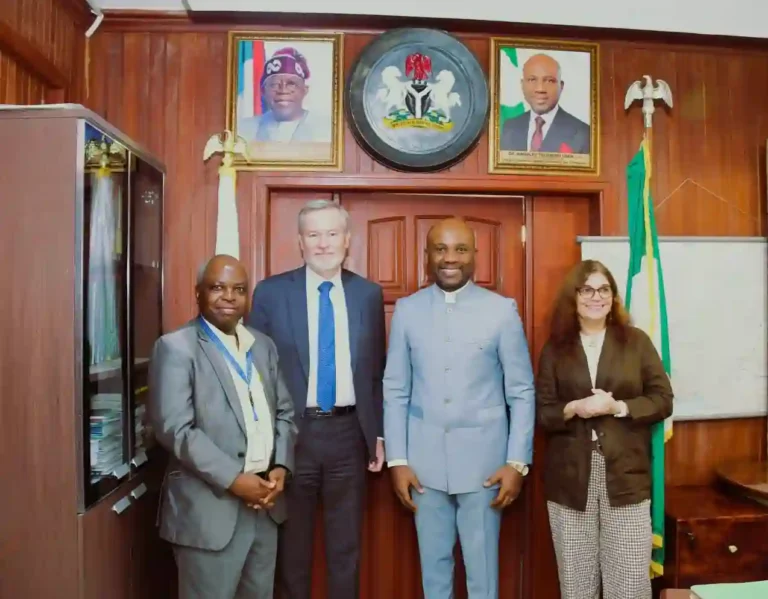
The disclosure was made during a courtesy visit by the Ambassador of the European Union to Nigeria, His Excellency Gautier Mignot, to the Honourable Minister of Innovation, Science and Technology, Dr. Kingsley Tochukwu Udeh, SAN, at the Ministry’s headquarters in Abuja.

During the meeting, Dr. Udeh reiterated the Federal Government’s resolve to leverage strategic international partnerships to accelerate innovation, deepen research outcomes and drive sustainable national development. He said the engagement reflected the government’s commitment to using science, technology and innovation.

The visit also provided an opportunity to formally congratulate the Honourable Minister on his recent appointment and to reaffirm the long-standing partnership between the European Union and the Federal Ministry of Innovation, Science and Technology (FMIST), anchored on shared priorities in Innovation, Science and Technology (STI) development and human capital advancement.

Discussions focused on strengthening collaboration in research, innovation and technology, with both parties expressing a shared commitment to harnessing science and innovation as drivers of job creation and sustainable economic growth in Nigeria.

The EU delegation briefed the Minister on major forthcoming initiatives under the EU–Nigeria cooperation framework. These include the first-ever Nigeria–EU Science and Innovation Day, scheduled for 24 February at the Wole Soyinka Centre for Creative Arts in Lagos, and the commencement of negotiations for a Science, Technology and Innovation Agreement between the European Union and Nigeria.

The delegation also outlined the next phase of cooperation under Horizon Europe – Phase IV, which will support Africa Initiative IV with approximately €600 million. The programme is expected to expand opportunities for Nigerian researchers, innovators, institutions and startups to access global research funding and collaborative networks.

The European Union emphasised its strong interest in deepening collaboration with FMIST to deliver practical and people-centred outcomes, noting that stronger partnerships in research, digital innovation, capacity building and technology transfer would strengthen institutions and promote inclusive national development.

Dr. Udeh reaffirmed FMIST’s readiness to work closely with the European Union to accelerate the commercialisation of Nigeria’s innovation ecosystem.

Both parties expressed optimism about expanding cooperation and agreed to sustain high-level engagements to ensure effective implementation of joint programmes and initiatives aligned with the “Renewed Hope Agenda” of the administration of President Bola Ahmed Tinubu.

Women Techsters releases selected candidates for Cohort 5.0 Bootcamp

0

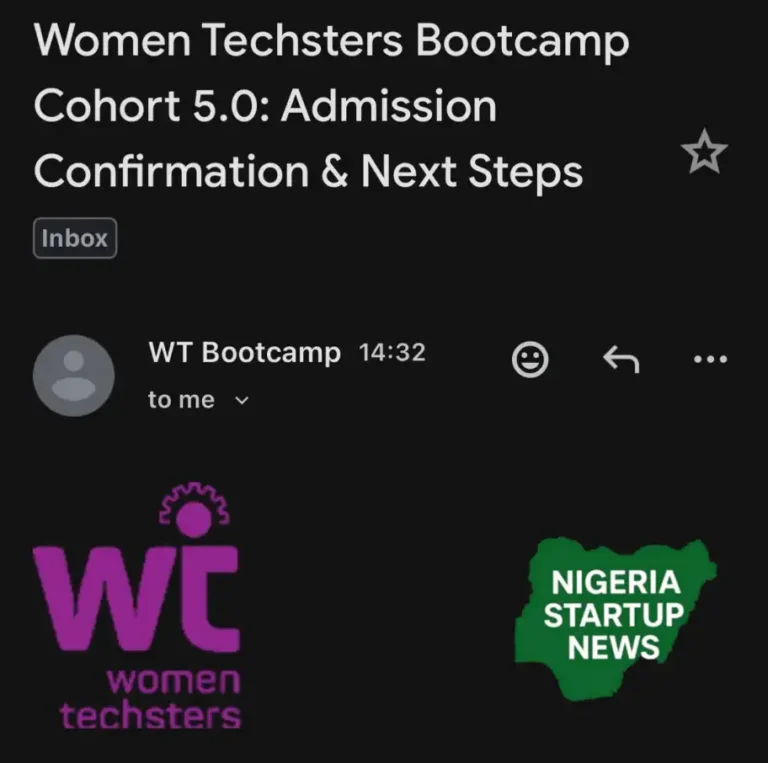
Women Techsters has selected successful candidates to participate in the Women Techsters Cohort 5.0 Bootcamp programme and has sent emails notifying applicants of their admission confirmation and next steps.

In a message obtained by Nigeria Startup News, the organisation stated: “We are thrilled to inform you that you have been selected to participate in the Women Techsters Cohort 5.0 Bootcamp programme – Data Analysis, Batch A (Weekday Classes), with Student ID: WTB/2026/5.0/0.00. This ID will be used to complete the baseline survey.”

Women Techsters received over 5,000 applications from more than 30 countries, with only applicants who successfully met the screening criteria qualifying for the next stage of the programme.

This achievement reflects the selected candidates’ passion for technology and their readiness to take bold steps toward building a thriving tech career. Women Techsters expressed excitement about partnering with the successful candidates on their learning journey.

Candidates are advised to take note of the following important dates for the Women Techsters Bootcamp training:

Acceptance Email and Baseline Affirmation
Week: 9th–15th February 2026

Baseline Applicants’ Review and Selection
16th–17th February 2026

The Women Techsters Bootcamp is an intensive three-week training programme designed to introduce women and girls to intermediate-level technology skills across five learning tracks. The programme aims to help participants kickstart their careers in tech or bridge knowledge gaps in emerging technologies. Throughout the bootcamp, participants will undergo structured training, collaborate on a group project, and receive certification upon successful completion.

Congratulations to all successful candidates.