Home Blog Page 70

NPF begins screening for 50,000 Police Constable recruitment

The Nigeria Police Force (NPF) and the Police Service Commission (PSC) have commenced physical and credential screening for applicants in the ongoing recruitment of 50,000 police constables across the country.

The screening exercise is part of the next stage of the nationwide recruitment process aimed at strengthening the manpower capacity of the Nigeria Police Force.

In Bauchi State, the Commissioner of Police, CP Sani-Omolori Aliyu, announced that applicants who successfully completed the online registration are required to report for physical and credential screening at the Police Training School (PTS), Bauchi.

The exercise will run from March 9 to April 18, 2026, and will begin daily at 7:00 a.m.

Speaking on behalf of the Inspector-General of Police, Kayode Egbetokun, CP Aliyu urged candidates to check the recruitment portal to confirm their screening status and print all required documents ahead of their scheduled date.

“Applicants are advised to log in to the recruitment portal to check their status and print the required documents, including their guarantor’s form, application submission slip, invitation slip, credentials screening form, and physical screening form,” he said.

According to him, candidates must appear at the screening venue with several documents, including their invitation slip, National Identity Number (NIN) printout or card issued by the National Identity Management Commission, O’Level certificate, birth certificate or declaration of age, and certificate of state or local government of origin.

Applicants with specialist qualifications are also expected to present relevant trade test certificates.

The police commissioner added that candidates must come properly dressed for the screening exercise.

“Applicants are required to appear at the screening venue wearing white canvas shoes, white T-shirts, white shorts, and white stockings,” he stated.

He also reminded applicants that the screening process is completely free of charge.

“Members of the public are warned that the screening exercise is free and applicants should not pay money to anyone in connection with the recruitment process,” Aliyu said.

Advertisement

Apply for YEIDEP Batch B Recruitment with ₦500,000 Grant

0

The Federal Government has opened YEIDEP Batch B recruitment to empower up to 20 million Nigerian youths with a ₦500,000 startup grant.

The Youth Economic Intervention and De-Radicalisation Programme (YEIDEP) is a Federal Government initiative powered by the Federal Ministry of Youth Development (FMYD). The programme is part of the government’s ongoing effort to empower Nigerian youths through financial support and entrepreneurship training.

The aim is to empower 20 million youths with startup capital to promote entrepreneurship and self-employment among young people, which is one of the most effective ways to create mass employment for youths.

The YEIDEP Batch B recruitment process is completely free, and applicants are advised to report any attempt by bank officials or intermediaries to demand payment during the process.

The YEIDEP grant provides between ₦50,000 and ₦500,000 to help unemployed youths become entrepreneurs, job creators, income earners, and wealth builders.

Youth entrepreneurship training and business development resources are also part of the programme.

The grant is a one-time financial support, but beneficiaries will also gain access to continuous training, mentorship, and market connections.

To qualify, applicants must be Nigerian citizens aged between 18 and 50 years, possess a valid National Identification Number (NIN) and Bank Verification Number (BVN), and have a business idea or an existing business in eligible sectors.

Applicants must also be willing to attend training and mentorship sessions and open an account with Lotus Bank, Keystone Bank, or Fidelity Bank.

Applicants should have an interest in or be involved in sectors such as agriculture, fashion, technology and ICT, entertainment, sports, renewable energy, and other productive business areas.

YEIDEP Batch B registration is no longer done through an online portal. To APPLY, interested applicants should visit any YEIDEP partner bank physically to open a YEIDEP bank account, which will make them a verified participant in the programme and a potential beneficiary of the empowerment grant.

Residents of Kano State are required to register through the state YEIDEP committee.

Authorised YEIDEP partner banks for the recruitment exercise include Fidelity Bank, Keystone Bank, Alpha Morgan Bank, Wema Bank, Union Bank, Guaranty Trust Bank, Zenith Bank, Access Bank, United Bank for Africa, Ecobank, and Lotus Bank.

FG praises Zulum’s TVET as 3,000 trainees graduate in Borno

0

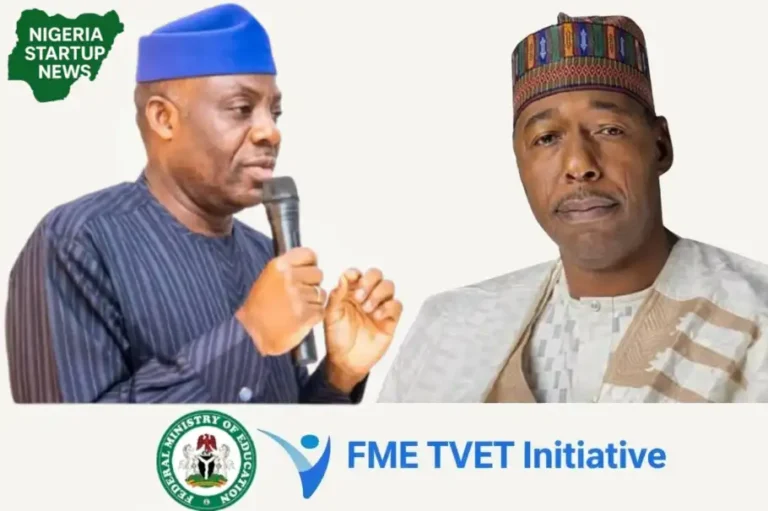
The Federal Government has praised Borno State Governor, Professor Babagana Umara Zulum, for expanding Technical and Vocational Education and Training (TVET) in the state after about 3,000 trainees successfully graduated from government-supported vocational training centres.

The trainees completed various technical and vocational programmes across nine Vocational Enterprise Institutes and Centres in Borno State. After finishing their training, each graduate received tools relevant to their trade as well as a ₦100,000 entrepreneurship grant to help them start small businesses.

Minister of Education, Dr. Maruf Tunji Alausa, commended the initiative, describing it as an important step in equipping young Nigerians with practical and employable skills.

He said the programme aligns with the Federal Government’s wider effort to strengthen skills development and reduce unemployment among young people.

“This initiative is a significant step toward empowering young Nigerians with practical and employable skills,” Alausa said.

He noted that giving the trainees starter packs and financial support would help them move quickly into productive economic activities.

According to the minister, the programme also reflects the Federal Government’s increasing focus on vocational and technical education under the Renewed Hope Agenda of President Bola Ahmed Tinubu.

He explained that the national TVET programme currently being implemented across the country is designed to expand access to practical training and entrepreneurship opportunities.

“The Federal Government is currently implementing a nationwide Technical and Vocational Education and Training programme aimed at expanding access to practical skills across the country,” he said.

Alausa added that the programme already provides about 250,000 training opportunities nationwide, with more than 180,000 young Nigerians currently undergoing training in thousands of centres across the country.

He explained that the training model focuses mainly on practical learning to ensure that trainees gain real work skills.

“The model emphasises hands-on learning, with about 80 percent practical training and 20 percent theoretical instruction,” the minister said.

The Federal Government is also developing a national TVET job portal that will help connect trained artisans and technicians with industries while supporting graduates who want to start their own businesses.

“The job portal will connect skilled graduates with industries while also supporting artisans with starter packs and access to single-digit loans to establish businesses,” Alausa added.

Speaking during the graduation ceremony in Borno State, Governor Babagana Zulum described the programme as a major milestone in the state’s efforts to empower young people and rebuild communities affected by years of insurgency.

“This programme represents a major step in empowering our youths and restoring livelihoods across communities that were affected by insurgency,” Zulum said.

He noted that the state government had invested heavily in technical training facilities to ensure that more young people gain skills that can support economic independence.

According to the governor, the state established and revitalised several vocational centres in communities including Muna, Mafa, Biu, Shani and Magumeri.

He also revealed that the government created Second Chance Skills Entrepreneurship Schools designed specifically to support women and girls who want to learn vocational skills.

Zulum disclosed that the state invested about ₦30 billion in TVET infrastructure and mobilised more than ₦2.05 billion with development partners to support the training programme.

Each beneficiary who completed the programme received tools for their trade and a ₦100,000 startup grant to help them begin their businesses.

BoI gets CBN approval to launch non-interest banking for MSMEs

The Bank of Industry (BoI) has received approval from the Central Bank of Nigeria (CBN) to launch non-interest banking services aimed at helping more Micro, Small and Medium Enterprises (MSMEs) and underserved businesses access financing across Nigeria.

The regulatory approval marks a significant expansion of BoI’s financing framework and is expected to strengthen the bank’s ability to support industrial growth by providing ethical, asset-backed funding options that do not charge interest.

The development was disclosed in a statement by the Managing Director of BoI, Mr Olasupo Olusi, who described the approval as an important step in widening access to finance for businesses that have traditionally struggled to obtain funding.

According to Olusi, the introduction of non-interest banking services will allow the bank to reach a broader category of entrepreneurs, particularly those seeking alternative financing structures aligned with ethical or faith-based principles.

“This development marks a significant milestone in the Bank of Industry’s growth and long-term development agenda,” Olusi said.

“It positions the bank to further advance Nigeria’s sustainable and inclusive industrial development through tailored financial solutions for underserved and high-impact business segments.”

Under the new framework, BoI will be able to provide asset-backed financing solutions that focus on funding equipment, raw materials and productive assets for businesses without charging interest.

Olusi explained that the structure promotes risk-sharing between the bank and customers while ensuring that financing is tied directly to real economic activities.

“Under this framework, BoI will be able to finance assets and raw materials for customers using approved non-interest banking products,” he stated.

The new service is also expected to deepen the bank’s support for MSMEs, which remain a key driver of employment and economic activity in Nigeria but often face difficulties accessing traditional credit.

By introducing non-interest banking, BoI aims to expand its financial offerings and attract new categories of investors and entrepreneurs who prefer ethical and partnership-based financing models.

Olusi also noted that the approval reflects the Central Bank of Nigeria’s confidence in BoI’s governance structure and its commitment to responsible financing practices.

The bank believes the initiative will allow it to scale its operations, introduce innovative financial products and improve access to funding for businesses that are critical to Nigeria’s industrial development.

Sterling Bank, MREIF Launch ₦100m Mortgage Loan Scheme

0

Sterling Bank has partnered with the Ministry of Finance Incorporated Real Estate Investment Fund (MREIF) to launch a new mortgage scheme that allows Nigerians to borrow up to ₦100 million at an interest rate of about 9.75 per cent to buy homes.

The initiative is designed to expand access to affordable housing finance and reduce the barriers that have long prevented many Nigerians from owning homes.

The partnership agreement was formalised at Sterling Bank’s headquarters in Lagos and forms part of broader efforts to address Nigeria’s significant housing deficit by making long-term mortgage financing more accessible.

Under the scheme, eligible applicants can access mortgage loans of up to ₦100 million with a repayment tenure of up to 20 years. The facility is structured with a fixed interest rate of approximately 9.75 per cent per annum, providing borrowers with predictable repayment terms over the life of the loan.

To make the scheme more accessible, the financing will cover up to 90 per cent of the property value, meaning applicants are only required to provide a 10 per cent equity contribution to secure a home.

The mortgage programme is open to a wide range of Nigerians, including salary earners with verifiable income, business owners with documented financial records, and Nigerians in the diaspora. Both existing Sterling Bank customers and new applicants across the country are eligible to apply.

Speaking on the significance of the collaboration, the Vice President of Consumer Banking at Sterling Bank, David Adebayo, said the initiative is aimed at making homeownership more attainable.

“This collaboration reflects our commitment to providing patient capital that enables more Nigerians to own homes sustainably.

“By combining competitive pricing with longer tenors and high loan-to-value ratios, we are lowering the barriers to homeownership and strengthening financial inclusion,” Adebayo said.

Mounir Bouba, Executive Director of ARM Investment Managers, the fund managers for MREIF, said the partnership highlights the role of collaboration between the public and private sectors in expanding access to mortgage financing.

“This MoU aligns with broader efforts to make mortgages more affordable and accessible at scale.

“Through strategic partnerships such as this, we can catalyse private capital, deepen the mortgage market and drive structured solutions to Nigeria’s housing challenge,” Bouba stated.

Bouba also noted that the mortgage facility is expected to expand over time as demand grows, revealing that the fund begins with an initial ₦10 billion commitment designed to support mortgage lending and strengthen housing finance across the country.

Shell, Anambra partner to supply natural gas for industries, replace diesel generators

Shell Nigeria Gas and the Anambra State Government are strengthening their collaboration to provide natural gas energy for industries across the state, a move aimed at helping factories transition away from expensive diesel generators to a cheaper, cleaner and more reliable energy source.

The initiative is designed to address the long-standing challenge faced by manufacturers in Nigeria, where unreliable public electricity supply has forced many factories to rely heavily on diesel-powered generators to sustain production.

At the Anambra Energy Stakeholders Forum held in Awka, government officials, manufacturers and energy executives discussed how expanding access to natural gas could significantly reduce industrial energy costs and improve production stability for businesses operating in the state.

Representing Governor Chukwuma Charles Soludo, the Secretary to the State Government, Solo Chukwulobelu, said the state has been deliberately developing an energy strategy that will support industrial growth by ensuring manufacturers have access to dependable power sources.

“The state has been working over the past two years to develop a strategy that will support industrialisation through improved energy infrastructure,” Chukwulobelu said.

He explained that access to affordable and stable energy is a key component of the state government’s broader economic vision to position Anambra as a major manufacturing hub in Nigeria.

According to him, the partnership with Shell Nigeria Gas will help industries gradually replace diesel-powered energy systems with natural gas solutions that are more cost-effective and environmentally sustainable.

The Commissioner for Industry, Christian Udechukwu, said the collaboration will significantly improve energy reliability for manufacturers across the state.

He noted that many industries currently spend a large portion of their operational costs on diesel fuel used to power generators, which increases production costs and reduces competitiveness.

“Transitioning manufacturers from diesel to natural gas will improve efficiency while reducing operational costs for industries in the state,” Udechukwu said.

The Commissioner for Economic Planning and Budget, Chiamaka Nnake, also noted that improving energy infrastructure is part of a broader effort by the state government to attract investors and expand industrial activities.

She explained that reducing dependence on diesel generators will help create a more favourable business environment for manufacturing companies.

“Transitioning from diesel to gas would significantly reduce operational costs and improve the state’s investment climate,” Nnake said.

From the industry side, the Managing Director of Shell Nigeria Gas, Ralph Gbobo, said the company is committed to supporting Nigeria’s industrial transformation by providing gas energy solutions that help manufacturers operate more efficiently.

Gbobo explained that natural gas offers a strategic advantage for industries because it is more stable in price compared to diesel and can deliver consistent energy for large-scale production.

“Natural gas offers industries a reliable and cost-efficient energy solution that helps reduce production costs and improve operational efficiency,” he said.

He added that Shell Nigeria Gas is expanding infrastructure that will enable factories to access natural gas for various industrial applications, including powering production lines, generating heat for manufacturing processes and fuelling boilers used in large-scale operations.

Brian Murivki also noted that the company’s broader strategy is to expand access to reliable gas energy across key industrial clusters in West Africa.

According to him, helping manufacturers switch from diesel generators to natural gas will significantly improve the competitiveness of industries by lowering energy costs and improving production stability.

Shell Nigeria Gas New Business Development Manager, Feyi Fabunmi, said the stakeholder forum provided an opportunity for manufacturers and policymakers to discuss practical solutions for improving industrial energy supply.

She explained that many factories across the region rely heavily on diesel generators because of inconsistent electricity supply.

“Natural gas provides a safer, cleaner and more reliable alternative energy source for manufacturers seeking long-term energy security,” Fabunmi said.

She added that the company recently presented a comprehensive gas master plan to the Anambra State Government outlining the infrastructure required to expand gas distribution across the state and support industrial growth.

LSETF launches female founders & funders programme for women tech startups

The Lagos State Employment Trust Fund (LSETF), in partnership with AfriGloCal Venture Capital, has commenced the third edition of the Female Founders & Funders (FFF) programme aimed at supporting women running tech startups in Lagos.

The initiative is designed to strengthen women-led innovation businesses by providing access to funding opportunities, mentorship, and specialised training that can help founders scale their ventures within the growing Lagos technology ecosystem.

The six-week programme will deliver structured masterclasses covering areas such as business modelling, product-led growth, startup finance, legal frameworks, Environmental, Social and Governance (ESG) strategy, artificial intelligence integration, and investment readiness.

Organisers say the programme is focused on bridging the persistent gap between female-led startups and available investment capital. Under the theme “Fund Her Future,” the initiative will conclude with a competitive Demo Day where selected founders will pitch their ventures to a curated audience of investors and stakeholders.

The programme is delivered through Lagos Innovates, the tech ecosystem support arm of the LSETF. It is specifically structured to increase access to capital, mentorship, and strategic networks for early-stage startups that have at least one female founder.

Now in its third cycle, the Female Founders & Funders programme aims to expand opportunities for female entrepreneurs building technology-driven solutions in Lagos.

Since its launch, the initiative has supported more than 33 female founders, trained over 24 aspiring female investors, and awarded more than nine million naira in prizes to participating startups.

More than 30 industry mentors have also contributed to the programme, providing guidance to participants on business growth, fundraising strategies, and product development.

The programme operates through a dual-track model designed to strengthen both sides of the startup investment pipeline. One pathway focuses on incubating female founders building innovative businesses, while the second pathway accelerates aspiring female investors seeking to participate in early-stage funding.

According to Feyisayo Alayande, Executive Secretary of the LSETF, the programme reflects the organisation’s broader mission of strengthening entrepreneurship and supporting inclusive economic growth in Lagos.

“For over a decade, the LSETF has deployed targeted interventions to strengthen entrepreneurs and the innovation ecosystem. As we mark ten years of impact, expanding Female Founders & Funders reflects our steadfast commitment to inclusive economic growth and supporting female-led ventures as a strategic driver of the Lagos economy,” she said.

Programme Director Oyindamola Egbeyemi also noted that the initiative is helping to address long-standing barriers faced by women seeking capital and mentorship in the technology sector.

Similarly, Mope Abudu, Managing Partner at AfriGloCal VC, emphasised the importance of improving funding access for women building scalable businesses.

“Access to capital remains one of the most significant barriers facing female founders. Female Founders & Funders tackles this challenge from both sides, equipping women to build scalable ventures while simultaneously increasing the number of women participating in early-stage investment,” Abudu said.

Women who are building or investing in tech-enabled ventures within Lagos State can apply through the official portal:
lagosinnovates.ng/female-founders-funders

Applications close on April 4, 2026.

OPEC Fund Opens 2026 Young Professional Development Program (YPDP)

0

The OPEC Fund for International Development is inviting young professionals from its member countries to apply for the Young Professional Development Program (YPDP) 2026. The programme is a two-year training and career development opportunity designed to prepare young professionals for work in international development.

The programme focuses on building the skills and experience needed to work on global development projects. It targets candidates who show strong academic performance, professional experience, and a clear interest in supporting development in emerging and developing countries.

Participants selected for the programme will undergo structured training, mentoring and professional coaching. They will also gain practical experience by working across different departments within the organisation. This rotational exposure allows participants to understand how various units contribute to the organisation’s overall development goals.

The programme also allows young professionals to build international networks and learn from experienced development professionals. Through these interactions, participants gain insight into how global institutions design and deliver projects that improve economic and social conditions in developing regions.

The OPEC Fund works with developing countries and international partners to promote economic growth and reduce poverty. Its projects support essential areas such as energy, infrastructure, water and sanitation, healthcare, education, and job creation. The programme exposes participants to these development areas and allows them to contribute to initiatives that address real challenges faced by communities.

Participants will gain hands-on experience through project work, research assignments and collaboration with teams across the organisation. This helps them develop practical skills in policy analysis, development finance, project management and international cooperation.

The programme also helps young professionals understand how global development institutions operate. By working within different departments, participants learn how policy, finance, operations and technical teams collaborate to deliver development programmes and investments.

Applicants must be nationals of an OPEC Fund member country and must be 30 years old or younger at the time of application. Candidates must also hold at least a master’s degree from a reputable university and demonstrate excellent academic performance.

Applicants are expected to have a minimum of three years of professional work experience in a relevant field. These fields may include engineering, economics, finance, business administration, information technology, law, human resources or other disciplines related to development operations.

Fluency in English is required for the programme, while knowledge of additional languages is considered an advantage. Candidates must also demonstrate the ability to work in a global and culturally diverse environment.

Applicants should also show a clear understanding of development challenges and the role international organisations play in addressing them. The programme looks for candidates who are motivated to contribute to social, economic and environmental progress in developing countries.

Selected participants will spend two years gaining professional experience through the programme. They will take part in structured learning opportunities, department rotations and mentoring arrangements designed to build their professional capacity.

At the end of the programme, participants may be offered a job opportunity at the OPEC Fund. This depends on individual performance during the programme and the organisation’s staffing needs at the time.

The application deadline for the 2026 Young Professional Development Program is 11 April 2026. Applicants must submit an online application form careers.opecfund.org, a curriculum vitae, an application essay, and academic certificates and transcripts. Only candidates who meet the eligibility requirements and submit complete applications will be considered for the programme.

Umo Eno: Akwa Ibom and Cross River brothers despite 76 oil wells dispute

0

Akwa Ibom State Governor, Pastor Umo Eno, has said that Akwa Ibom and Cross River remain brothers despite the ongoing dispute over 76 offshore oil wells between the two states, stressing that the disagreement should not destroy the long-standing relationship between their people.

The governor made the remarks during a special Sunday worship service at Liberty Gospel Church in Calabar, where he addressed Akwa Ibom indigenes living and working in Cross River State and encouraged them to continue promoting peace and cooperation.

The comments come amid renewed conversations over the ownership of 76 oil wells located in the coastal boundary area between the two states. While Cross River has continued to push for the wells to be returned to it, Akwa Ibom maintains that previous Supreme Court rulings already affirmed its ownership of the oil assets.

Speaking during the church service, Governor Eno emphasised that the historical ties between the two states go far beyond political disagreements.

“The people of the two states will continue to be brothers because of our bond. Our unity, oneness and peace have always been our goal,” the governor said.

Akwa Ibom was created out of Cross River State in 1987, a shared history that Eno said should remain a foundation for continued unity rather than conflict.

He urged Akwa Ibom residents in Cross River to contribute positively to their host state and continue working for peace.

“Akwa Ibom State was created out of Cross River State, but then, we are still brothers,” he said.

“Those of you living here must not stop praying for the peace of Jerusalem as instructed in the Bible. Cross River State is your Jerusalem because you are resident here. Continue to live in peace, love and brotherliness for our overall growth.”

The governor’s comments are widely seen as an attempt to calm tensions surrounding the oil well dispute, which has periodically generated political debate between stakeholders in both states.

Cross River leaders have argued that newer boundary interpretations support their claim to the wells, while Akwa Ibom officials insist that legal decisions of the Supreme Court have already settled the matter in favour of the state.

Despite the disagreement, Eno maintained that the relationship between the two neighbouring states must remain peaceful.

During the service, the governor also praised the founder of the church, Apostle Helen Ukpabio, describing her as a committed servant of God whose ministry has impacted many lives.

He encouraged the cleric to remain focused on her calling despite criticisms that often accompany leadership and public influence.

“As a matter of fact, I have come to learn that if people do not disagree with what you are doing, then you are not doing anything,” he said.

“They are free to disagree because God did not give them the vision but you.”

Governor Eno further commended the cleric for what he described as her consistency and dedication to drawing people closer to God through her ministry.

In her sermon titled “Commanding the Blessing,” taken from Psalms 133:3, Apostle Ukpabio told the congregation that divine blessings manifest through God’s pronouncements of multiplication and dominion.

She also urged believers to maintain personal and environmental cleanliness, describing it as part of positioning themselves to receive God’s blessings in their lives and endeavours.

Ukpabio also described Governor Eno as a compassionate leader and pastor who has shown commitment to people-centred governance in Akwa Ibom State.

Matna Foods, Ondo Govt to train 3,000 youths in cassava farming

Matna Foods Company Limited has partnered with the Ondo State Government to train 3,000 young farmers in cassava farming under the Women in Sourcing and Enterprise (WISE) Programme, an initiative aimed at creating jobs while empowering youths and women across the state.

The partnership is designed to strengthen the cassava value chain while providing young people with the skills, inputs and market access needed to build sustainable agricultural livelihoods.

The collaboration involves several key government ministries, including the Ministry of Agriculture and Rural Development, the Ministry of Women Affairs, and the Ministry of Youth and Sports Development. The programme focuses on supporting young farmers and encouraging greater participation of women in agriculture.

According to a statement released by the company in Ado-Ekiti on Sunday, the initiative will train and support about 3,000 youth outgrower farmers across Ondo State, with about 80 per cent of the beneficiaries expected to be young women between the ages of 18 and 35.

Through the programme, participating farmers will receive improved inputs, technical training and structured market opportunities. The farmers will also have access to processing facilities operated by Matna Foods, which will serve as a guaranteed off-take market for their cassava produce.

The programme is being implemented in partnership with the Partnership Initiatives in the Niger Delta Foundation (PIND), which will support farmer training, project coordination and capacity development throughout the duration of the initiative.

Officials from the participating ministries highlighted the importance of the initiative during a stakeholder engagement session held at the Matna Foods processing facility, where discussions focused on expanding agricultural participation and strengthening rural economic opportunities.

Speaking during the engagement, the Managing Director of Matna Foods Company Limited and Agbeyewa Farms, Oska Seyi Aiyeleso, said the WISE Programme was designed to build a sustainable agricultural ecosystem that benefits both farmers and agro-processing industries.

“This initiative is about building a sustainable ecosystem that empowers farmers while ensuring reliable feedstock for agro-processing. By connecting young farmers directly to structured markets, we are not only creating jobs but also laying the foundation for inclusive agricultural growth that benefits communities across Ondo State,” Aiyeleso said.

He explained that the programme would not only provide training but also create direct market links for farmers, ensuring that participants can earn stable income from cassava production.

Aiyeleso also highlighted the broader vision behind the investment, noting that the initiative aligns with the development focus of the Chairman of Cavista Holdings, Niyi John Olajide.

According to him, the investment reflects a strong commitment to job creation and economic empowerment through agriculture.

“The Chairman is passionate about creating opportunities for Nigerians. John Olajide has a clear focus — create jobs, create more jobs, and further create more jobs for Nigerians as a pathway to economic empowerment and national development,” he said.

The Ondo State Commissioner for Agriculture and Rural Development, Hon. Olaleye Akinola, described the partnership as a strong example of how collaboration between government and private investors can strengthen agricultural production in the state.

He emphasised that agriculture remains a key pillar of Ondo State’s economic development and that initiatives like the WISE Programme will help support farmers while expanding cassava production.

The Commissioner for Women Affairs, Seun Osamaye, also commended the initiative for prioritising women and vulnerable groups within the agricultural sector.

She said the programme aligns with the ministry’s goal of promoting women’s economic empowerment and ensuring greater inclusion of women in productive sectors of the economy.

The Commissioner for Youth and Sports Development, Segun Omoyofunmmi, noted that agriculture continues to provide strong opportunities for youth employment and entrepreneurship.

“Our priority as a ministry is to ensure that young people are provided with opportunities that take them off the streets and position them for self-reliance. Agriculture offers tremendous potential for employment, and initiatives like this help equip young people with the skills and opportunities needed to become productive members of the economy,” he said.

Providing further details about the programme, Project Coordinator Ayo Obe explained that the WISE initiative will run for 39 months and will support participants through two cassava cultivation cycles.

According to him, beneficiaries will begin with 0.4 hectares of farmland and will have opportunities to expand their production capacity as they gain more experience and build their farming operations.

Obe said the programme will combine farmer training, extension support and structured market access through Matna Foods’ processing operations, creating a pathway for young farmers to participate sustainably in the cassava value chain while contributing to economic growth in Ondo State.