Home Blog Page 86

IOM invites Nigerian businesses to submit price quotes for supplies

0

The International Organization for Migration (IOM) is inviting companies to submit quotations for the supply of branded visibility materials for its operations in Nigeria. This is a business opportunity for printing, branding, and promotional material companies that can deliver quality products based on the specifications provided.

The categories of goods and services required include pull-up banners measuring 33 by 81 inches made with flex material such as 300-micron polypropylene or PVC for durable print quality. IOM also requires standard backdrops in sizes 6, 8, 10, and 16, made with flex material and branded with logos and wordings.

Other items include A4 certificate printing on card paper with logos, round neck branded T-shirts in pure cotton or jersey material in sizes S to XXXL, and softback notepads with 150 to 200 pages using perfect binding. Nigerian, UN, or IOM flags are also needed in outdoor and table sizes.

Interested companies are expected to send their price quotations by email to iomlagostenders@iom.int on or before 2nd March 2026. Late submissions may not be considered, so applicants are advised to meet the deadline.

Advertisement

NYFF $50,000 youth leadership development fund 2026 grant cycle opens soon

0

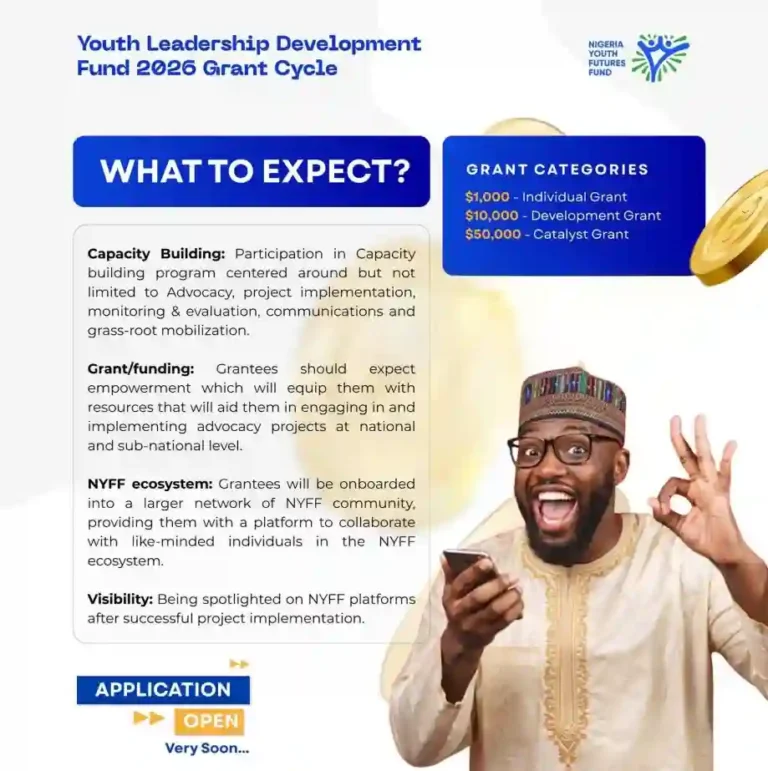
The Youth Leadership Development Fund 2026 Grant Cycle under the Nigeria Youth Futures Fund (NYFF) is set to open very soon, with up to $50,000 in grants, offering fresh funding and support opportunities for young Nigerians working in leadership, advocacy and social change.

The application portal will host submissions once the process officially begins. The fund is designed to strengthen youth-led movements across the country by providing both technical and financial backing to help them scale their impact at national and sub-national levels.

Under the 2026 cycle, selected grantees will take part in a structured capacity building programme. The training will focus on advocacy, project implementation, monitoring and evaluation, communications, and grass-root mobilization. Participants are expected to gain practical skills that will improve how they design, execute and measure the impact of their initiatives.

In addition to training, grantees will receive direct funding to support their advocacy projects. The grant categories include a $1,000 Individual Grant, a $10,000 Development Grant, and a $50,000 Catalyst Grant. The funding is structured to empower recipients with the resources needed to engage effectively and implement projects that address critical issues affecting young people and communities across Nigeria.

Beyond financial support, beneficiaries will be onboarded into the NYFF ecosystem. This network connects youth leaders and change-makers, giving them access to collaboration opportunities with like-minded individuals within the NYFF community. The platform is expected to strengthen peer learning and collective impact among youth-led initiatives.

Grantees who successfully implement their projects will also receive visibility by being spotlighted on NYFF platforms, helping to amplify their work and extend their reach to broader audiences.

The application portal, www.nigeriayouthfund.org, will go live shortly as applications open very soon.

The Nigeria Youth Futures Fund was established as a response to what it describes as an urgent need to provide technical and financial support to emerging youth-led movements in Nigeria. The goal is to sustain their work while creating opportunities for continuous learning and growth.

Seeded by the MacArthur Foundation, Ford Foundation and Luminate Group, and implemented by LEAP Africa, NYFF states that its mission is to strengthen, support and enable youth in leadership, activism and social change. The fund focuses on outcome-driven policy engagements and inclusive resourcing aimed at helping young people shape and support medium and long-term national development.

Tiwa Savage Launches Music Foundation, Brings Berklee to Nigeria

Nigerian Afrobeats star, Tiwa Savage, has unveiled the Tiwa Savage Music Foundation, a new initiative aimed at nurturing emerging African creatives in partnership with Berklee College of Music, which will be coming to Lagos for the first time.

The 46-year-old singer announced the development on her social media platform on Wednesday, declaring, “After years of building globally… It’s time to build at home.”

She introduced the Tiwa Savage Music Foundation as “a new initiative dedicated to empowering emerging African creatives through access, mentorship and world-class music education.” She added, “For the first time ever, Berklee comes to Lagos with the Tiwa Savage Intensive Music Programme empowering Africa’s next generation of talent.”

Berklee College of Music, based in Boston, Massachusetts, is the world’s largest independent college of contemporary music. The institution is widely known for its programmes in jazz, modern American music and other genres such as rock, hip hop and reggae.

In an interview with CNN, the “Ma Lo” singer explained that although Afrobeats has achieved global recognition, the industry still needs stronger structures to remain sustainable in the long term.

“Afrobeats has captured the world’s attention, but attention alone is not enough to sustain an industry. Talent is universal — but access is not,” she said.

According to CNN, the Tiwa Savage Music Foundation is designed to close that access gap by creating opportunities for African creatives who may not have the financial means or exposure required to advance their careers.

Beyond supporting vocalists and performers, the foundation will also focus on producers, composers, sound engineers and music business professionals. Savage believes these areas are essential to building a strong and durable creative economy across Africa.

The foundation’s first major project, titled Berklee in Nigeria: Tiwa Savage Intensive Music Programme, will see Berklee faculty travel to Lagos from April 23 to 26, 2026. During the four-day period, they will host a fully funded training for 100 emerging Nigerian music creators.

The programme marks Berklee’s first-ever event in West Africa.

Savage highlighted the value of short but focused training sessions, noting, “You’d be surprised how much you can learn in four days. It gives you a taste of what’s possible and exposes you to parts of music you may not even realise you’re drawn to.”

The intensive programme will combine music theory with practical, real-world applications. Participants will receive training in music production, songwriting, harmony, ear training and sound engineering. There will also be sessions on music publishing, copyright and aspects of entertainment law.

The four-day initiative will end with live ensemble performances by participants, allowing them to showcase what they have learned during the programme.

Outstanding participants may also be considered for future scholarships to study at Berklee in Boston or to enrol in its online courses. This positions the Lagos training as a gateway to long-term global opportunities rather than a one-off workshop.

Savage told CNN that the idea for the foundation was inspired by her personal journey and a sense of urgency to create more access for young Africans.

She noted that tuition at leading international music schools can range between $40,000 and $60,000 per year, excluding living expenses. According to her, this financial burden makes formal music education inaccessible to many talented young Africans.

“It’s been something I’ve wanted to do for years,” she said.

Savage herself once benefited from a scholarship to Berklee as a young artist, an opportunity she said reshaped her understanding of the music industry.

“That experience changed how I saw music,” she said. “It made me realise that talent alone isn’t enough. Structure, education, and exposure are what allow creatives to compete globally.”

With the launch of the Tiwa Savage Music Foundation and the upcoming intensive programme in Lagos, the award-winning singer is now focused on building sustainable structures at home while extending global-level opportunities to the next generation of African creatives.


Aurora Tech Award selects Top 10 female founders from 3,400 applications

0

The Aurora Tech Award, a global award dedicated to supporting outstanding female tech founders from emerging markets, has unveiled its Top 10 Finalists for 2026 after a rigorous multi-stage evaluation process. A record 3,400 applications were submitted from 127 countries, highlighting growing global interest and participation.

The organisers said the Top 10 finalists were selected from an initial Top 100 shortlist. The final selection reflects what the award described as the continued rise of female entrepreneurship in emerging economies and the increasing quality of women-led startups building scalable solutions in high-growth markets.

According to the organisers, the 2026 Top 10 includes founders from Nigeria, Kenya, Brazil, Chile, Mexico, Colombia, and Panama, among others. The award noted that the finalists showcase the depth of innovation across emerging markets and are tackling real, local challenges. These include improving access to credit and healthcare insights, digitising recycling value chains, strengthening agricultural supply chains, and expanding financial inclusion for underserved communities.

Among the 2026 Top 10 Finalists is Adeola Ayoola, Founder of Famasi in Nigeria. Famasi is a seed-stage healthtech platform that enables pharmacies to manage operations and track stock in real time across a connected network. By improving visibility of medicine availability, the platform allows prescriptions to be routed to nearby pharmacies where medication is in stock. This, according to the company, improves access and efficiency for patients.

Also selected is Penny Musengi, Founder of Pesira Technologies in Kenya. Pesira Technologies is a seed-stage agritech platform bridging Africa’s agricultural digital divide by connecting farmers, agribusinesses, and finance providers within a unified ecosystem. The platform expands access to financial services and digital marketplaces, supporting farm growth and strengthening agricultural supply chains.

The organisers stated that the Top 10 Finalists will pitch at a global event later in the year. Winners will receive non-dilutive funding, direct access to Aurora’s Global VC Network, and continued support designed to help them scale sustainably.

Aurora said this year’s cohort represents a diverse mix of regions and sectors, with strong representation from Latin America, Africa, and other emerging ecosystems. The selected startups operate across key industries including Artificial Intelligence, Fintech, HealthTech, Sustainability, Agritech, HRTech, and Enterprise Software. All finalists are at either pre-seed or seed stage, demonstrating strong early traction and high potential for scalable impact.

Powered by inDrive, Aurora explained that its selection process is built on investor conviction. Each year, thousands of applications are reviewed through what it described as a structured, multi-layered framework that combines independent assessments by venture capital partners with Aurora’s own execution benchmarks.

The award collaborates with a curated network of more than 40 venture capital firms across Latin America, the MENA region, Africa, and South Asia. According to Aurora, startups are evaluated by investors with direct experience in the relevant regions, sectors, and growth stages, ensuring informed and sector-specific assessments rather than generic scoring.

Beyond quantitative evaluation, investors signal which founders they would actively engage with, making demonstrated investor interest a core determinant of selection. To determine the Top 10 Finalists, Aurora said three key factors are considered: independent VC evaluations, expressed investor conviction, and overall performance during its initial assessment stages.

The organisers noted that the outcome offers more than recognition, stating that it provides founders with enhanced visibility, credibility, access to capital, and strategic positioning to accelerate their next stage of growth.

inDrive, which powers the award, is a global mobility and urban services platform. The inDrive app has been downloaded more than 400 million times and was the second-most-downloaded mobility app for the fourth consecutive year. In addition to ride-hailing, inDrive provides intercity transportation, delivery, and financial services. In 2023, inDrive launched New Ventures, its venture and M&A arm.

Plateau BPO Initiative Opens Remote Job Recruitment in Jos

0

Governor Caleb Manasseh Mutfwang has launched a new workforce development initiative as part of his “Time Is Now” administration’s commitment to talent discovery and youth empowerment. In partnership with global players, the state government is establishing the pilot phase of a Business Process Outsourcing (BPO) initiative designed to create employment opportunities for thousands of young Plateau graduates from institutions within and outside Nigeria.

The initiative is focused on positioning Jos as a hub for remote and digital jobs. Through this programme, qualified young people will have the opportunity to work on international projects while remaining based in Plateau State. The goal is to equip participants with relevant global skills and connect them to structured, growth-oriented career paths.

Applications are now open for remote job roles based in Jos. The programme is seeking young, vibrant graduates with strong communication skills and a confident, polished accent. Ideal candidates should be tech-savvy, comfortable working online, professional in conduct, energetic, and reliable. Applicants must also be eager to grow within a dynamic and supportive work environment.

Successful candidates will work from a modern and inspiring workspace in Jos, collaborating on global assignments and building valuable professional experience. The initiative aims to foster world-class skills, promote digital competence, and create a positive, high-energy environment where young professionals can thrive.

Interested and qualified individuals are encouraged to apply through the Google Form provided link https://forms.gle/ZaxQGhmp7SMUHJvMA

AGILE Enrolls 12,133 Students for CCT in Bauchi

The Adolescent Girls Initiative for Learning and Empowerment (AGILE) project has announced that no fewer than 12,133 students have been enrolled as beneficiaries of its Conditional Cash Transfer (CCT) programme across 100 secondary schools in Bauchi State.

The Project Coordinator, Ladi Mohammed Hamma, disclosed this while briefing journalists on the progress of the project’s implementation in the state. She stated that each beneficiary has already received N40,000 as part of the support package.

According to Hamma, the beneficiaries began enjoying the scholarship fund last term, and payments were successfully credited into their individual bank accounts.

“We have credited the money to their accounts and they have accessed the funds, except for a few who are yet to receive their ATM cards. My team and I are working tirelessly to ensure all beneficiaries receive their ATM cards by the end of this week,” she said.

Hamma explained that the ATM cards are being issued through FCMB, Jos branch, while members of the project team are currently in the field distributing the cards directly to students.

She clarified that each beneficiary is entitled to a total of N60,000 under the Conditional Cash Transfer scheme, depending on their transition and attendance in school.

“When a student transits from primary school to JSS1 or from JSS3 to SS1, she receives N15,000 as registration fee and N25,000 as transition fee, making N40,000 in the first term. Subsequently, if she maintains at least 70 percent attendance, she will receive N10,000 every term until she completes JS3 or SS3,” she explained.

The coordinator further revealed that AGILE has expanded the programme from 100 to 200 schools and is targeting 40,000 beneficiaries in its second cohort.

“Our staff have been on the field for the past three to four months enumerating students and capturing their data for the next phase. We are hoping to enroll 40,000 beneficiaries across 200 schools,” she said.

Hamma identified lack of National Identification Number (NIN) as a major challenge affecting enrollment. She urged parents to ensure their wards obtain NIN and birth certificates, while parents should also provide their own NIN and Bank Verification Number (BVN) to facilitate account opening for the students.

She emphasised that the forms for the programme are given directly to beneficiaries and appealed to parents to ensure that the funds are used strictly for educational purposes to achieve the objectives of the AGILE project.

On other components of the project, Hamma disclosed that AGILE is set to train 156 Technical Service Providers on environmental and social safeguards ahead of renovation works in 1,203 secondary schools across the 20 local government areas of Bauchi State.

She noted that the training, recently cleared by the World Bank, will equip civil engineers, architects, quantity surveyors and environmental experts who will support School-Based Management Committees in executing renovation projects under direct labour arrangements.

Hamma added that processes for the construction of new schools across the 20 local government areas are ongoing, with the project awaiting approval of prototype designs and site specifications before proceeding to advertisement and bidding stages.

IDEAS–TVET to Train 1,000 Kaduna Youths Under Cohort Two Flag-Off

0

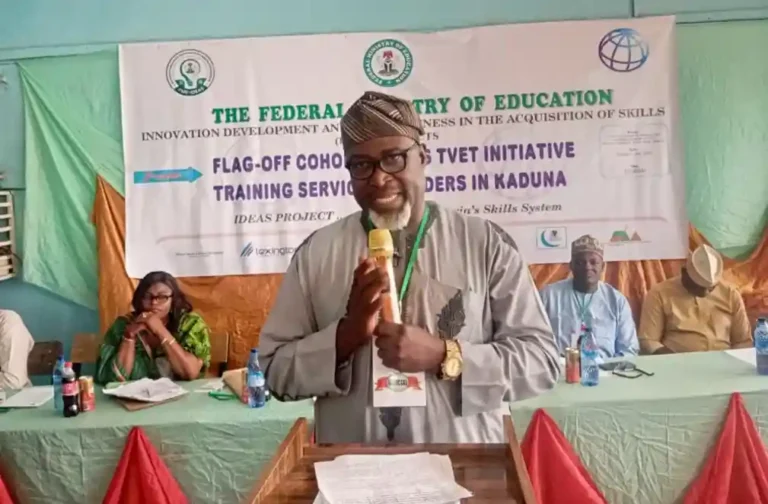
The Innovation Development and Effectiveness in the Acquisition of Skills (IDEAS) project, an initiative of the Federal Ministry of Education supported by the World Bank, has commenced plans to train more than 1,000 youths in Kaduna State.

The National Project Coordinator of IDEAS, Mrs Blessing Ogwu, disclosed this at the flag-off of Cohort Two of the IDEAS–Technical and Vocational Education and Training (TVET) training for service providers. The ceremony was held at the College of Technical and Vocational Education, Kaduna Polytechnic.

Mrs Ogwu, who was represented by the World Bank Environmental Consultant to the IDEAS–TVET project, Dr Marcus Idoko, said the second phase of the programme would train more than 40,000 young people nationwide over a six-month period.

She explained that 13 Training Service Providers (TSPs) had so far been selected in Kaduna State, with each expected to train about 100 youths in different technical skills. According to her, the focus will be on skills capable of producing goods and services with commercial value.

Mrs Ogwu urged both the service providers and trainees to take the programme seriously. She warned that there would be strict monitoring and evaluation during and after the training to ensure quality delivery and measurable impact.

The IDEAS project aims to equip young Nigerians with market-relevant and entrepreneurial skills in priority sectors, improve employability and promote self-reliance as part of efforts to tackle youth unemployment across the country.

Speaking on behalf of the Training Service Providers in Kaduna State, Dr Akoh Salifu of Optimal Consults and Resource Development thanked the Federal Ministry of Education and the project team for the opportunity. He added that more youths in the state could still enrol and assured that all providers were committed to delivering measurable results.

In his remarks, the Rector of Kaduna Polytechnic, Dr Suleiman Umar, who was represented by Dr Abubakar Salihu, said that providing practical skills alongside academic certificates had helped to narrow the unemployment gap in Nigeria. He commended the ministry and the IDEAS project for selecting the institution to host the event in Kaduna State.

The selected service providers are expected to train participants in fishery, animal husbandry, construction, plumbing, tiling, electrical installation and digital skills.

The IDEAS Project is a federal government initiative implemented by the Federal Ministry of Education with support from the World Bank, focusing on enhancing employability and reducing youth unemployment.

NPF Lists Required Documents for 2026 Screening Exercise

The Nigeria Police Force (NPF) has released detailed guidelines for candidates taking part in the 2026 Police Constable screening exercise across the country.

According to the guidelines, applicants are expected to present the following required documents:

  1. Guarantors Form
  2. Application Submission Slip
  3. Invitation Slip
  4. Credentials Screening Form
  5. Physical Screening Form

In addition, candidates must come to the screening venue with the following items:

  1. Invitation Slip (showing assigned table)
  2. Credentials Screening Form
  3. Original National Identity Number (NIN) printout or NIMC-issued card
  4. O’ Level (GCE/SSCE) Certificate
  5. Birth Certificate or Declaration of Age
  6. Local Government/State of Origin Certificate
  7. Trade Test/Certificate (for specialist applicants only)
  8. Duly completed and signed Guarantors Form, with photocopies and passport photographs of referees attached
  9. Original and duplicate copies of credentials, neatly arranged in two separate white flat files with recent passport photographs attached

The NPF also stated that applicants “are required to appear at their designated screening centres dressed in white canvas shoes, white T-shirts, white shorts, and white stockings.”

The screening exercise will take place at approved venues across all states of the federation and the Federal Capital Territory (FCT), as indicated on each candidate’s invitation slip. Applicants are advised to strictly follow all instructions to avoid disqualification.

Borno Approves Special Training Fund for Resident Doctors

0

The Borno State Government has approved a special training fund for 56 medical doctors currently undergoing residency training under its sponsorship scheme.

Governor Babagana Zulum announced the approval during a meeting with the resident doctors at the Government House in Maiduguri. The session was convened to assess the progress of their training and address challenges affecting their seamless performance at their various primary assignments across the state.

Beyond the approval of the training fund, the government also sanctioned the immediate implementation of promotional benefits for all resident doctors due for career advancement in the health sector.

Zulum directed that the promotions be effected without delay and that all arrears be paid to the beneficiaries, backdated to the effective dates of their promotions in the civil service.

He further instructed the Borno State Hospital Management Board (BOHMB) to organise a similar interactive session with other medical doctors in the state who are not part of the residency training programme.

The governor reiterated that the welfare of health workers remains a priority for his administration, stressing that a motivated workforce is critical to delivering quality healthcare services to the people of Borno State.

“My administration is committed to creating an enabling environment for our health professionals. We understand that without their dedication, we cannot achieve the needed health coverage for our citizens,” Zulum said.

GSMA launches £200,000 Green Transition Innovation Fund

0

The GSMA has globally launched a new Innovation Fund aimed at supporting small and growing enterprises using mobile and digital technologies to accelerate the green transition in low- and middle-income countries (LMICs).

The GSMA Innovation Fund for Green Transition for Mobile will offer grants ranging from £100,000 to £200,000 to enterprises developing commercially viable solutions that expand access to clean energy and promote sustainable practices within the mobile ecosystem.

The initiative is funded by GSMA and supported by its member organisations as part of the mobile industry’s broader commitment to sustainable connectivity and net-zero emissions.

According to GSMA, the fund targets enterprises operating in Africa, Central and South America, and South and Southeast Asia. It focuses on solutions that improve digital inclusion, affordability and socio-economic empowerment while delivering measurable environmental benefits.

GSMA stated that the fund will prioritise innovations using mobile-enabled technologies to expand access to renewable energy and improve energy efficiency. These include smart metering systems, renewable energy deployments, device refurbishment models and responsible electronic waste management.

The initiative aligns with the goals of the United Nations Sustainable Development framework, which recognises the role of digital technologies in enabling inclusive and sustainable economic growth.

A key component of the Innovation Fund is promoting circular economy approaches in the mobile sector. The programme aims to extend the lifespan of mobile devices through repair, refurbishment and reuse, helping to reduce electronic waste while improving handset affordability.

Supported solutions may include trade-in and take-back programmes, leasing models, refurbished device marketplaces, traceability platforms and responsible e-waste collection and recycling systems.

By extending the useful life of mobile devices, the initiative seeks to reduce environmental impact while lowering the cost of connectivity for underserved communities.