Home Blog Page 94

GTBank Launches Quick Airtime Loan with 2.95% Monthly Interest

0

Guaranty Trust Bank Ltd (GTBank) has launched a Quick Airtime Loan to provide eligible customers with instant access to between N100 and N10,000 airtime when they run out of call credit and have limited funds in their bank accounts.

The bank described Quick Airtime Loan as a convenient loan offering that enables qualifying customers to access airtime on credit whenever their account balance is low. The service is designed to help customers stay connected at all times, even without sufficient funds, as the borrowed amount will be automatically deducted from the customer’s account upon the next funding.

The product is available across all major mobile networks in Nigeria. GTBank also announced that the service will soon expand to include data loans, strengthening its position as a reliable on-demand platform for customers.

For years, the airtime credit market has been dominated by Telcos, where charges for the service are around 15 percent. GTBank’s Quick Airtime Loan comes with an interest rate of 2.95 percent per month, approximately 35.4 percent per annum. The loan tenor is 7 days, and pre-liquidation is allowed without penalty.

The loan is strictly for financing the purchase of airtime, allowing customers to repay later. Repayment is automated and triggered either weekly at the end of the 7-day tenor or upon the next credit inflow into the customer’s account. The borrower shall make a single due date repayment of principal and interest, subject to the selected tenor not exceeding 7 days.

The bank noted that if the account is not funded, a block will be placed on the account to recover funds from future inflows. A 1 percent flat one-off charge applies as credit insurance. As part of the security requirement, borrowers are expected to domicile their salary with GTBank.

Commenting on the product launch, Miriam Olusanya, Managing Director of Guaranty Trust Bank Ltd, said: “Quick Airtime Loan reflects GTBank’s continued focus on delivering digital solutions that are relevant, accessible, and built around real customer needs. The solution underscores the power of a connected financial ecosystem, combining GTBank’s digital reach and lending expertise with the capabilities of HabariPay to deliver a smooth, end-to-end experience.”

Customers can apply by dialling *737*90#.

Advertisement

FG Commissions Women Palm-Oil Collective, Launches SARC in Abia

Nigeria’s Minister of Women Affairs and Social Development, Hajiya Iman Sulaiman-Ibrahim, has commissioned two landmark projects in Abia State aimed at advancing women’s economic empowerment and strengthening protection systems for survivors of gender-based violence (GBV).

The Minister inaugurated the Nigeria for Women Programme, “Osusu Abaala Women Palm-Oil Collective” in Isialangwa North Local Government Area. She also launched the state’s Sexual Assault Referral Centre (SARC), describing both initiatives as key milestones in deepening women’s economic inclusion and reinforcing Nigeria’s protection architecture.

Speaking at the commissioning ceremony, which was attended by Governor Alex Otti and other dignitaries, Sulaiman-Ibrahim reflected on progress made in promoting women’s economic inclusion under the administration of President Bola Tinubu.

“What we are witnessing today is not accidental; it is the result of deliberate policy, sustained partnerships, and the resilience of Nigerian women, while we are not there yet in terms of our ambition, the Nigeria for Women Project continues to push us closer to that reality,” she said.

She described the palm-oil collective as a practical example of organised women moving from fragmented informal activities to coordinated, market-oriented production that strengthens household incomes and supports local economies.

According to the Minister, “The Nigeria for Women Programme was designed to address longstanding structural barriers limiting women’s access to finance, markets, skills, and social capital.”

She explained that the programme’s Scale-Up phase, recently launched by President Tinubu, is targeting at least five million women nationwide. The effort forms part of a coordinated national strategy focused on livelihoods, food security, and inclusive growth.

The Minister added that the expansion is being implemented under the Renewed Hope Social Impact Interventions – 774 framework, which integrates women’s economic empowerment, food security, social protection, and family resilience.

“To the women of Osusu Abaala, this facility is an economic asset and a collective responsibility. It must be governed transparently, managed efficiently, and sustained through accountability, reinvestment, and disciplined group leadership,” she charged.

Commending President Tinubu, subnationals, development partners, and other stakeholders for their support, the Minister formally commissioned the collective. She expressed hope that it would serve as a replicable model of organised women’s enterprise, local value addition, and inclusive agribusiness development.

At the launch of the Sexual Assault Referral Centre in Abia State, Sulaiman-Ibrahim said that under the Renewed Hope Social Development Agenda, the Ministry is repositioning protection services as a core pillar of national stability, human capital development, and social justice for women and girls.

“Gender-Based Violence is a pervasive and deeply underreported threat to human security, public health, and social stability,” she said. She noted that the centre provides a safe, confidential, and integrated platform for medical care, psychosocial support, legal referral, and justice services for survivors.

The Minister appreciated the Abia State Government for prioritising the protection of women and children and for creating an enabling environment for the centre’s establishment. She said this demonstrates strong sub-national leadership and a clear understanding that safe communities are foundational to sustainable development.

She also thanked President Tinubu for declaring 2026 as the year for Social Development and Families. She disclosed that as of November 2025, Nigeria had fifty Sexual Assault Referral Centres across twenty-four states, collectively assisting over 58,134 survivors.

“Silence, stigma, and impunity must no longer define the experience of survivors. Access to justice, care, and protection must become the national standard,” she declared.

Reaffirming the government’s commitment to strengthening the national GBV response architecture, the Minister expressed hope that the Abia SARC would serve as a safe space for healing, a gateway to justice, and a model for replication across other states of the Federation.

World Bank Senior Social Development Specialist and Task Team Leader Nigeria for Women Programme, Mr. Michael Ilesanmi, said, “The collective is an opportunity for women entrepreneurs to come together and address the issue of scale and aggregation while linking them to expanded market opportunities which results in increased income.”

Canada unveils 2026 Express Entry Categories for Skilled Workers

0

Immigration, Refugees and Citizenship Canada (IRCC) has unveiled new categories under the Express Entry system for international workers who want to come and work in the country, a move that could interest many skilled Nigerians seeking opportunities abroad.

According to IRCC Minister Lena Metlege Diab, the announcement of the 2026 Express Entry categories is to allow Canada to invite candidates who have the required skills and experience. She explained that the new categories are Canada’s way of keeping immigration at sustainable levels while continuing to support the economy.

Express Entry is Canada’s flagship application management system for people who want to permanently relocate through the Federal Skilled Worker Program, the Federal Skilled Trades Program, the Canadian Experience Class, and part of the Provincial Nominee Program. Canada says its immigration system is designed to attract highly skilled workers who can contribute to national growth.

In Canada’s 2025–2026 Immigration Plans, the government is focusing on the Express Entry class to invite candidates who already have work experience in Canada so they can apply for permanent residence. Authorities also want to keep permanent resident admissions at less than 1% of Canada’s population annually beyond 2027, while still attracting talented international workers from countries such as Nigeria.

The new plan has set overall temporary resident targets of 673,650 for 2025. It has also temporarily set targets of 516,600 for 2026 and 543,600 for 2027 as part of efforts to manage population growth responsibly.

The newly announced Express Entry categories are expected to provide clear pathways for top international talent who want permanent residency. Canada is seeking to invite foreign medical doctors who have Canadian work experience. New categories have also been introduced in the field of research and for senior managers who also have Canadian experience.

Other categories include candidates with experience in aviation, transportation, and foreign military officers. IRCC says it will continue selecting candidates who have strong French language skills and those who have work experience in the area of health care and social services.

In Canada, immigration accounts for almost 100% of labour force growth, helping the country address shortages in key sectors. According to the immigration minister, the government is working to attract and retain the best talent in the country.

She added that the Express Entry announcement will help strengthen Canada’s economic power “through targeted measures for medical doctors, graduate students and researchers, as well as Canada’s Defence Industrial Strategy.”

Under the 2026 Express Entry categories, Canada is seeking top talent including medical doctors, researchers, and senior managers with Canadian work experience, workers with French-language proficiency, health care and social services professionals, tradespersons, educators, professionals in science, technology, engineering, and mathematics occupations, professionals in transport occupations, pilots, aircraft mechanics, and inspectors, as well as highly skilled foreign military applicants recruited by the Canadian Armed Forces for key roles such as military doctors, nurses, and pilots.

For 2025, Canada announced new categories for the Express Entry draw for workers and added to the list of occupations where people can apply to work and obtain permanent residence. At that time, IRCC said the new categories were introduced to address labour skill shortages in Canada’s economy. In that same year, 2025, Canada launched four new permanent residency (PR) pathways even while trying to reduce the country’s annual immigration targets.

LIFE-ND trains 655 Edo agribusiness entrepreneurs on export standards

0

The Livelihood Improvement Family Enterprises in the Niger Delta (LIFE-ND) project has commenced training for 655 agribusiness entrepreneurs in Edo State on international best practices in packaging, branding and product standardisation.

Declaring the training open for Edo South Senatorial District, the Edo Coordinator of LIFE-ND, Mr John Omoruyi, said the initiative is designed to upscale beneficiaries’ enterprises to meet global certification and export requirements.

Represented by the State Agribusiness Promotion Officer, Mrs Grace Iredia, Omoruyi explained that the programme forms part of a broader human capacity development plan targeting 655 beneficiaries across the state.

“This programme is aimed at supporting and capacitating our beneficiaries in business.

“LIFE-ND has trained entrepreneurs from 2021 to 2025, but we need them to upscale their businesses to meet export standards and certification requirements,” he said.

Omoruyi noted that the training focuses on measurement standards, product standardisation, packaging and branding. According to him, the goal is to help participants move from selling only in local markets to accessing international markets.

He said officials from the National Agency for Food and Drug Administration and Control (NAFDAC) and the Standards Organisation of Nigeria were invited to guide beneficiaries on certification procedures, regulatory compliance and export requirements.

Omoruyi disclosed that 60 incubatees would benefit in the first phase of the training, with 20 participants drawn from each of the three senatorial districts.

“Edo South participants are being trained in cassava, fish, and poultry value chains, while Edo Central will focus on cassava and poultry, and Edo North on cassava, poultry, and rice,” he said.

He added that the training would be replicated across the other districts in the state.

Omoruyi said the programme is expected to improve livelihoods and increase income for beneficiaries, describing it as strategic for boosting the competitiveness of Made-in-Edo products.

“With the knowledge acquired, they should be able to package rice, frozen birds, and processed fish to meet export targets,” he stated.

He further revealed that 4,337 people had benefited from earlier phases of the programme, while an additional 665 entrepreneurs are being supported under the current financial cycle.

“Edo State is the first among six supported states implementing this activity, and we believe others will follow suit,” Omoruyi added.

Officials from NAFDAC and the Standards Organisation of Nigeria facilitated sessions on regulatory compliance, certification and product standardisation to ensure participants meet national and international quality benchmarks.

SMEDAN appoints Jaiz Bank for GROW Fund for 6,122 entrepreneurs

0

The Small and Medium Enterprises Development Agency of Nigeria (SMEDAN) has appointed Jaiz Bank PLC to manage a financing scheme aimed at expanding access to affordable funding for 6,122 entrepreneurs who completed training under the inspire, create, start and scale (ICSS) initiative.

The announcement was made on Tuesday during the launch of the Grow Fund scheme, designed to support micro, small and medium enterprises (MSMEs) with affordable financing for their businesses.

At the official unveiling of the GROW Fund scheme for ICSS trainees in Abuja, the Director General of SMEDAN, Charles Odii, said the programme marks a major shift from routine training to a more structured support system that directly connects capacity building with single-digit interest loans and asset financing.

He explained that many small businesses across the country have benefited from different capacity development programmes but still struggle to access funding.

“Everywhere you go, you see small businesses. Many of them have received training through several capacity development initiatives.

“To ensure that training meets capital, SMEDAN took the ICSS scheme to find solutions to the complaint by the banks that they have money, but our trainees have not been equipped enough to unlock the funding,” Odii said.

He added that other partners supporting the scheme include the German Cooperation through GIZ, Kaduna Business School, and GOPA worldwide consultants.

The representative of the Embassy of Germany in Abuja, who also serves as the First Secretary and Head of Cooperation, Dr Karin Jansen, commended SMEDAN for its leadership in developing and implementing the ICSS programme across Lagos, Edo, Ogunye, Niger, Plateau States and the Federal Capital Territory, Abuja.

Jansen described the initiative as a modular entrepreneurship pathway tailored to meet the needs of small businesses at different stages of development, from inspiration and business creation to sustainable growth and scaling.

The Chief Executive Officer of Jaiz Bank Plc, Dr Haruna Musa, described the scheme as a catalyst for innovation, job creation and sustainable economic development.

Represented at the event by the General Manager of the bank, Idris Ahmed, Musa said the fund goes beyond financial support and reflects a renewed commitment by the bank and its partners to empower entrepreneurs and promote inclusive growth.

“At Jaiz Bank, we firmly believe that sustainable economic growth must be inclusive. Empowering small businesses remains central to our non-interest banking model,” he said.

Youth Empowerment: NDDC to host Sports Festival 2026 with 3,000 athletes

0

The Niger Delta Development Commission, NDDC, is set to host the Niger Delta Sports Festival 2026, themed “Beyond Oil: Harnessing Talents,” bringing together 3,000 athletes and coaches from across the region.

The Chairman of the Niger Delta Sports Festival, Hon. Alabo Boma Iyaye, disclosed this during a press briefing held on Tuesday.

According to him, the championship will gather over 3,000 athletes and coaches in a grand celebration of sporting excellence, youth empowerment, and regional unity.

Activities will begin with the Opening Ceremony on the 20th, while the Closing Ceremony will take place on the 26th. Participants are scheduled to depart on the 27th.

He added that the state of readiness stands at 95 percent, with facilities, logistics, and game preparations fully on course to deliver a successful and memorable event.

NDDC CNG autogas conversion training: selected trainees Lucky

0

Selected trainees of the NDDC CNG autogas conversion training programme have been described as lucky to be part of a transformative initiative designed to build practical skills and long-term careers for young people in the Niger Delta.

The 2026 training is part of the NDDC Training Of Niger Delta Youths in Compressed Natural GAS (CNG) Vehicle Conversion Programme Across the Nine States in the Region.

In line with its mandate to build human capacity and enhance Skills Development in the Niger Delta Region, the Niger Delta Development Commission (NDDC) has concluded arrangements to train youths on Compressed Natural Gas (CNG) Vehicle Conversion Programme.

Speaking on the initiative, Engr. Saidu Hamdullahi of Viedenburg Energy Resources, the Training Consultant, said, “Selected trainees are lucky to be part of this game changing program. Its about creating professionals who can think, diagnose, build, repair, manage, and lead.

“This opportunity offers lifetime jobs and entrepreneurship skills. CNG training aligns with Nigeria’s energy transition, economic resilience, and youth empowerment priorities. Practical approach will be on equipment handling, and safety culture. We produce not just technicians, but future employers.”

The Compressed Natural Gas (CNG) Vehicle Conversion Training Programme aligns with the mandate of the NDDC and is aimed at providing beneficiaries with veritable skills in Autogas Conversion Technology.

The programme is expected to contribute to the development of a more reliable and sustainable transportation sector. It will also stimulate economic growth through job creation and increased demand for Autogas specialists, while helping to reduce harmful emissions in line with NDDC’s commitment to environment conservation and sustainability.

Nigerian Army 2025/2026 fallen heroes children sponsorship screening and verification

0

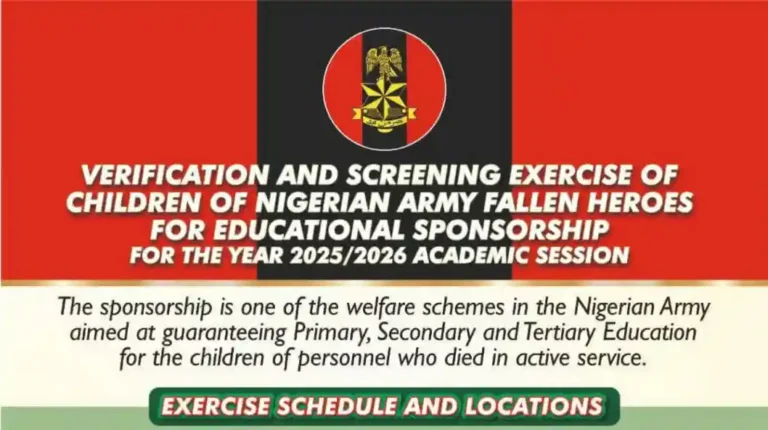
The Nigerian Army has announced the verification and screening exercise for children of fallen heroes for the 2025/2026 academic session.

This sponsorship programme is one of the welfare schemes of the Nigerian Army. It is designed to support the children of officers and soldiers who died in active service. The goal is to guarantee access to Primary, Secondary and Tertiary education for eligible beneficiaries.

If you are a parent, guardian, or beneficiary, it is important to take note of the schedule, locations, and required documents to avoid missing out.

EXERCISE SCHEDULE AND LOCATIONS

The screening will take place across the six geopolitical zones as follows:

South South
Date: 23–26 February 2026
Location: Headquarters 6 Division, Port Harcourt, Rivers State.

South East
Date: 28 February – 3 March 2026
Location: Headquarters 82 Division, Enugu, Enugu State.

South West
Date: 5 – 8 March 2026
Location: Headquarters 2 Division, Ibadan, Oyo State.

North East
Date: 11 – 14 March 2026
Location: Headquarters Nigerian Army Armour Corps, Bauchi, Bauchi State.

North West
Date: 16 – 20 March 2026
Location: Headquarters 1 Division Nigerian Army, Kaduna, Kaduna State.

North Central and Abuja
Date: 23 – 27 March 2026
Location: Army Headquarters Command Officers’ Mess, Asokoro, Abuja.

Beneficiaries are expected to attend the screening exercise at the designated centre for their geopolitical zone on the specified dates.

DOCUMENTS REQUIRED

Applicants must come along with the following documents for verification:

• Handwritten letter of application containing the names of the children.
• Admission letter, including JAMB admission letter for tertiary beneficiaries.
• Last school report card or result of the beneficiary.
• Letter of confirmation of pupil or studentship.
• Birth certificate of the children.
• Part II Orders of birth of the children.
• Death certificate of the deceased Nigerian Army personnel.
• Part II Order of death.
• Condolence letter.
• Notification of Casualty (NOTICAS).
• Two recent passport photographs each of the beneficiaries and the deceased officer or soldier.
• Account number details.
• Telephone number of the beneficiary.
• School fee receipt.
• Bank Verification Number (BVN).
• First page printout of statement of account showing account name and account number.

All documents should be properly arranged and presented for screening. Incomplete documentation may delay or affect the verification process.

This exercise is strictly for children of Nigerian Army personnel who lost their lives in active service. The screening is part of efforts to ensure transparency and proper documentation before educational sponsorship is granted for the 2025/2026 academic session.

Beneficiaries and guardians are advised to attend early and ensure that all required documents are complete and authentic.

Rockefeller Foundation, Partners launch clean cooking accelerator initiative

0

The Rockefeller Foundation, Global Energy Alliance for People and Planet Inc. (Global Energy Alliance), The Clean Cooking Alliance, and Energy Corps have launched the Clean Cooking Accelerator Initiative to expand access to modern cooking technologies in Africa.

The project was announced at the High-Level Dialogue on Advancing Energy Access and Cooking Solutions during the International Energy Agency (IEA) 2026 Ministerial. The session was chaired by IEA executive director Dr Fatih Birol, Kenya’s Minister of Energy and Petroleum James Opiyo Wandayi, U.S. secretary of Energy Christopher Wright, and Norway’s Minister of Energy Terje Lien Aasland.

The Initiative reflects what the organisations described as a renewed commitment to achieving universal access to clean cooking. They said the effort is aimed at improving health outcomes, saving lives, empowering women and children, creating local jobs, reducing forest degradation, and building economic opportunity across the continent.

According to available data, approximately one billion people in Africa still rely on traditional fuels such as wood and charcoal for cooking. The World Health Organisation associates household air pollution from these fuels with more than 810,000 premature deaths annually.

These fuels and cooking appliances significantly increase indoor air pollution in Sub-Saharan Africa, especially affecting women and children who spend more time near cooking areas. The health risks linked to this exposure include respiratory illnesses and other long-term conditions.

The IEA has identified clean cooking as a defining challenge for Africa’s prosperity. It estimates that closing the global clean cooking gap will require more than $2 billion per year in investment. Although progress has been made in some parts of the world, access remains uneven.

In Sub-Saharan Africa, population growth has outpaced improvements in clean cooking access. The gap continues to widen by an estimated 14 million people each year, as the number of those without clean cooking solutions increases.

Modern clean cooking solutions include electric stoves, biogas, bioethanol, liquid petroleum gas (LPG), and efficient biomass stoves. These technologies produce far fewer harmful particles compared to traditional fuels like wood or charcoal.

Expanding access to clean cooking is also considered an important part of Mission 300, an initiative led by the World Bank and African Development Bank, with support from The Rockefeller Foundation, Global Energy Alliance, Sustainable Energy for All, and others. Mission 300 aims to provide 300 million Africans with electricity by 2030.

The Clean Cooking Accelerator Initiative will initially start in about half a dozen countries, which are expected to be announced in the coming month. It plans to expand to additional Sub-Saharan African countries that request support and demonstrate readiness and momentum toward universal access to clean cooking.

The organisations said the overarching goal is to improve health, save lives, empower women and children, reduce forest degradation, create local jobs, and build economic opportunity across Africa.

The Initiative seeks to accelerate access to cleaner cooking methods by coordinating technical expertise, catalytic capital, and implementation support. While each participating organisation already has ongoing clean cooking programmes, the new Initiative is designed to bring them together around shared priorities and enable information sharing to maximise collective impact.

In countries that express interest and show readiness, the Initiative will support efforts to strengthen supply chains and invest in infrastructure needed to scale modern cooking solutions.

In select markets, The Rockefeller Foundation, through its Mission 300 Accelerator housed within RF Catalytic Capital, its charitable spin-off, and Energy Corps, are providing support to CoAction Global. The aim is to develop a cohort of Clean Cooking Fellows to strengthen institutional capacity and build investable project pipelines. CoAction Global, an independent nonprofit impact accelerator focused on innovation and investment in hard-to-reach places, manages the Mission 300 Fellowship programme.

Andrew Herscowitz, CEO of the Mission 300 Accelerator, RF Catalytic Capital, Inc., said, “The Rockefeller Foundation and its Mission 300 Accelerator are thrilled to be working with these organizations to take on an incredible development opportunity: expanding access to clean, modern cooking methods. There are smart, easy solutions that can prevent hundreds of thousands of people needlessly dying from indoor air pollution each year, and we are excited to try to drive investment into solving this problem.”

Dymphna van der Lans, CEO of the Clean Cooking Alliance, said the focus must now shift from commitments to delivery. “We’re seeing real momentum behind clean cooking across Africa, but momentum alone doesn’t deliver solutions to households, schools and institutions. What matters now is building the capacity, partnerships, and market foundations that allow countries to move from targets to implementation. This collaboration is an important step in making that shift possible,” she said.

Energy Corps, a nonprofit organisation working to end energy poverty by connecting local leadership with global energy expertise, philanthropy, and NGO organisation, said it will channel philanthropic capital to mobilise private-sector investment and industrial capacity. The organisation noted that the support will strengthen capacity building and boost investment in bankable projects aimed at addressing supply-chain and infrastructure bottlenecks.

Toby Rice, CEO and Founder of Energy Corps, said the Initiative is designed to move beyond pledges. “This Initiative is built to turn commitment into real projects, real infrastructure, and real access by mobilising more capital,” he said.


UNESCO, UAPP launch study abroad fund for secondary school students

0

The UNESCO Read and Earn Federation (UNESCO REF) has taken a major step to reduce the financial pressure faced by Nigerian students who want to study abroad, following the signing of a Memorandum of Understanding with the United Kingdom Global University Application Portal (UAPP) in Abuja on Wednesday.

The agreement focuses on the creation of an educational financing facility designed to provide structured financial support for qualified Nigerian students seeking higher education outside the country. The initiative aims to close funding gaps that often stop talented students from accessing global academic opportunities.

According to the parties, the pilot phase of the programme will benefit students of Police Secondary Schools across Nigeria. Plans are already in place to expand it to all senior secondary schools nationwide by September this year. The current application window is presently open to students in SS1 through SS3 in Police Secondary Schools.

Speaking at the event, the President of UNESCO REF, Abdulsalami Ladigbolu-Oranmiyan, said the collaboration was structured to complement existing student financing programmes in the country. He explained that while the Nigerian Education Loan Fund (NELFUND) focuses mainly on students studying within Nigeria, the new financing facility is specifically designed to remove monetary barriers for students who secure admission into overseas institutions.

He disclosed that the programme maintains partnerships with more than 250 universities worldwide, creating a wide range of academic pathways for beneficiaries. According to him, the intervention aligns with broader educational strategic priorities and national development objectives aimed at expanding access to quality learning.

Ladigbolu-Oranmiyan added that eligibility cuts across all levels of study, including undergraduate, master’s, and doctoral candidates, regardless of the institution or country of choice. He announced that the admission application costs for the first 40 students from Police Secondary Schools selected under the scheme would be fully sponsored.

He further stated that the rollout of the programme would begin immediately, with designated financial partners responsible for managing payment arrangements to ensure proper structure and accountability.

In her remarks, the wife of the Inspector General of Police and President of the Police Officers’ Wives Association (POWA), Dr. Elizabeth Egbetokun, described the initiative as a transformative opportunity. She said it aligns with ongoing efforts to expand educational access for children of police personnel and other Nigerian youths.

Dr. Egbetokun stressed that access to global education should not depend solely on financial strength. She noted that the financing facility would enable brilliant students to compete internationally without being limited by funding challenges.

She commended the partnership for introducing a transparent and structured funding pathway that combines guidance, application support, and financial solutions under one umbrella. She urged eligible students and their parents to take advantage of the opportunity.

“I am especially delighted that this initiative will be piloted in the Police Secondary Schools, institutions that have nurtured generations of young Nigerians. From this pilot, the programme will spread to other schools and institutions across the country, ensuring that no child is left behind in the pursuit of higher education and global opportunities,” she said.

“This MOU embodies transparency, accountability, and innovation. It is a partnership that gives confidence to parents, trust to society, and hope to our children. It is a practical demonstration of how the Renewed Hope Agenda can be translated into tangible outcomes for Nigerian families,” she added.

Also speaking, the Global Director of Business Development at UAPP, Alan Bahia, explained that the partnership is designed to simplify and secure the university application process while providing comprehensive, end-to-end support for Nigerian students.

He said the pilot phase includes application fee waivers, mentorship support, and priority processing for the first 1,000 students. According to him, these measures are aimed at lowering entry barriers and encouraging more young Nigerians to pursue international education opportunities.

Bahia reiterated the organisation’s commitment to transparency and measurable outcomes. He added that the long-term goal is to expand the programme across the country, creating wider access to global academic opportunities for Nigerian students.