

The Presidential Initiative on Compressed Natural Gas and Electric Vehicles has announced that more than 100,000 vehicles in Nigeria now use CNG. The Executive Chairman and CEO of the initiative, Mr Ismaeel Ahmed, said this on Friday in Abuja. He spoke during the unveiling of CNG products by Alfa Designs Nigeria Limited and a stakeholder engagement held in collaboration with the News Agency of Nigeria. Ahmed was represented by Mr Zayyanu Tambari, Chief Compliance Officer of the initiative.
He explained that Nigeria had only about 11,000 CNG converted vehicles as at 2023. He said the new figures show that the adoption of CNG as a transport fuel is growing among transportation companies and private vehicle owners. The event was attended by dignitaries including Malam Ali M. Ali, Managing Director of NAN, Mr Mubarak Abdul, Chief Operating Officer of Alfa Designs, and Pankaj Bohhra of Mijo AutoGas, who is an Original Equipment Manufacturer. Other officials from the PiCNG and partner companies were also present.
The products unveiled were CNG conversion kits designed by Mijo AutoGas, CNG cylinders manufactured by EKC International, a CNG Mother Station from CIMC ENRIC, and an Optical Gas Imaging Camera produced by Opgal Optronics. Ahmed said the entire programme was built around the number of vehicles on Nigerian roads that are using CNG as either an alternative fuel or a complementary option. He described the initiative as a legacy project that started over a decade ago when the first CNG facility was commissioned in 2012 by NIPCO in Benin City.
“Today, as we speak, there are over 100,000 cars that are using CNG on the Nigerian roads. Companies in the private sector and operators are refitting their fleet, especially the long haulage to move on CNG. Our target is to convert one million by 2027,” he said. According to him, the one million target covers vehicles converted locally, factory fitted, manufactured in Nigeria, or imported. He stressed that the instruction to convert at least one million vehicles by the end of 2027 was a direct presidential mandate.
Ahmed noted that the initiative is working with stakeholders and development partners to support the president’s goal to make CNG a cheaper, safer, and cleaner fuel alternative. He recalled that President Bola Tinubu inaugurated the programme in October 2023 when only 11 states had some form of CNG infrastructure. “Basically, it is only around the pipeline system that we have either a conversion center or a retail outlet. And there are only about 11 states,” he said.
He stated that the situation has changed, as “today, there are over 25 states with a CNG footprint in one form or another. And about six or eight states will join in the next few months.” He added that officials are confident that by the end of next year, the programme will cover the entire country. Ahmed said, “The target is to do 36 states plus Abuja by 2027. I believe that at the rate we are going, by the end of 2026, we will have taken the CNG footprint in every state, if not every senatorial district in Nigeria.”
The PiCNG boss described the unveiling event as a milestone in Nigeria’s transition towards cleaner and cheaper transportation and industrial energy options. He praised Alfa Designs Nigeria Limited for partnering with NAN to host the engagement meeting and present new CNG products created with leading international manufacturers. He said the initiative reflects the growing momentum nationwide as innovators, local manufacturers, and development partners support Nigeria’s Gas Expansion Programme.
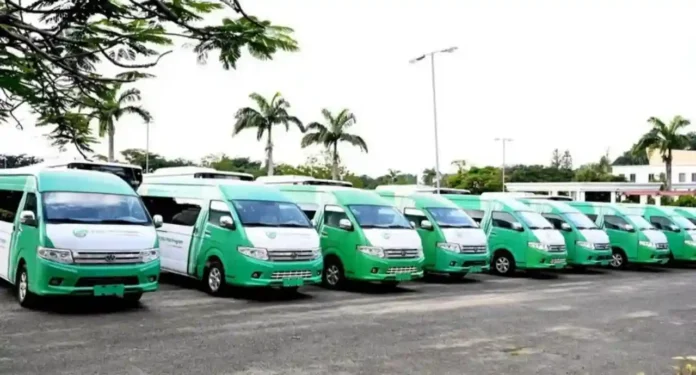
The push for CNG adoption received a major boost in April 2025. The Federal Government commissioned 2,700 new CNG-powered buses under the presidential initiative, with a focus on mass-transit operators in major cities. Officials said the buses would help reduce transportation costs, stimulate demand for conversion centres and refuelling stations, and attract more private investment into the gas mobility sector. They said the rollout would accelerate the shift from petrol to cleaner CNG solutions, further strengthening progress toward the one-million-vehicle target.

