

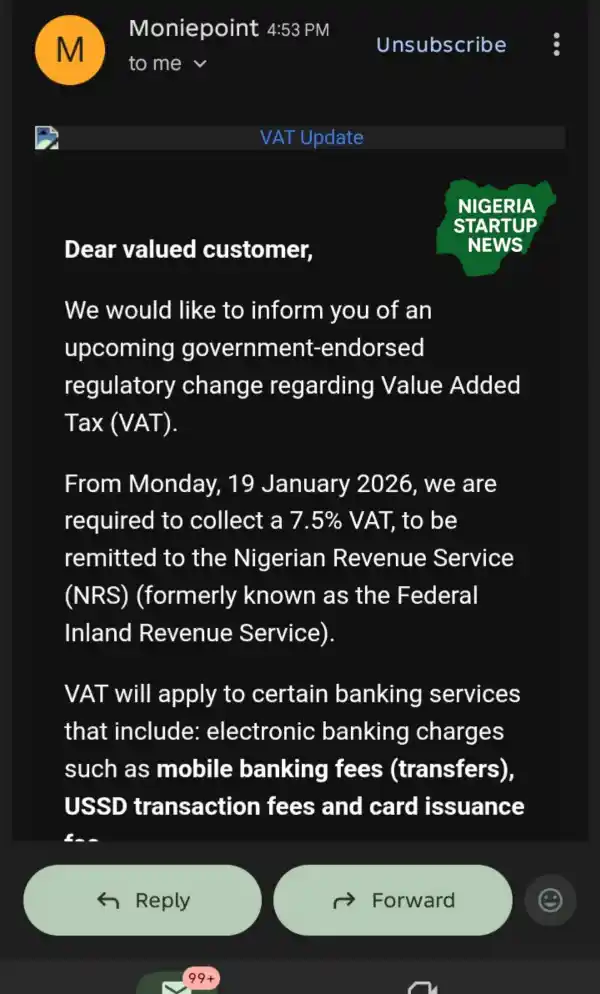
Nigerians will start paying a 7.5 per cent Value Added Tax (VAT) on fees of selected banking services from January 19, 2026, as part of a new government-backed regulatory directive aimed at standardising VAT collection across the financial sector.
The development made available to Nigeria Startup News was disclosed in a customer notice issued by Moniepoint, which explained that it has been mandated to collect and remit VAT on certain service charges in line with national tax regulations. The VAT collected will be paid to the Nigerian Revenue Service, previously known as the Federal Inland Revenue Service.
Note that the VAT will be charged on FEES and CHARGES on transfers only and NOT on amount transferred.
In the notice, Moniepoint stated, “From Monday, 19 January 2026, we are required to collect a 7.5 per cent VAT, to be remitted to the Nigerian Revenue Service. VAT will apply to certain banking services that include electronic banking charges such as POS transaction fees, mobile banking fees for transfers, USSD transaction fees, POS activation fees, card issuance fees and Moniebook subscription. It also applies to other fees such as loan processing and documentation fees.”
The company further clarified that not all financial transactions will be affected by the new VAT requirement. According to the notice, “Services that do not attract VAT include interest on loans and advances, as well as interest on deposits and savings. This means VAT applies only to banking or service fees and not to interest earned or charged.”
Addressing concerns from customers, Moniepoint emphasised that the deduction is not a unilateral adjustment. The notice read, “This is not a price increase by Moniepoint. Moniepoint is required to collect and remit VAT to the Nigerian Revenue Service. The NRS has communicated a deadline of 19 January for all financial institutions, including commercial banks, microfinance banks and electronic money transfer operators, to start collecting and remitting VAT.”
Customers were also informed that the VAT charge will be clearly reflected in their records. The company explained that VAT deductions will appear separately on transaction reports and account statements to ensure transparency and allow customers identify applicable charges.
The new VAT enforcement is expected to directly affect millions of Nigerians who rely daily on mobile banking platforms, POS services, and USSD channels for routine financial transactions, as applicable service charges will now attract the 7.5 per cent tax from the implementation date.

