
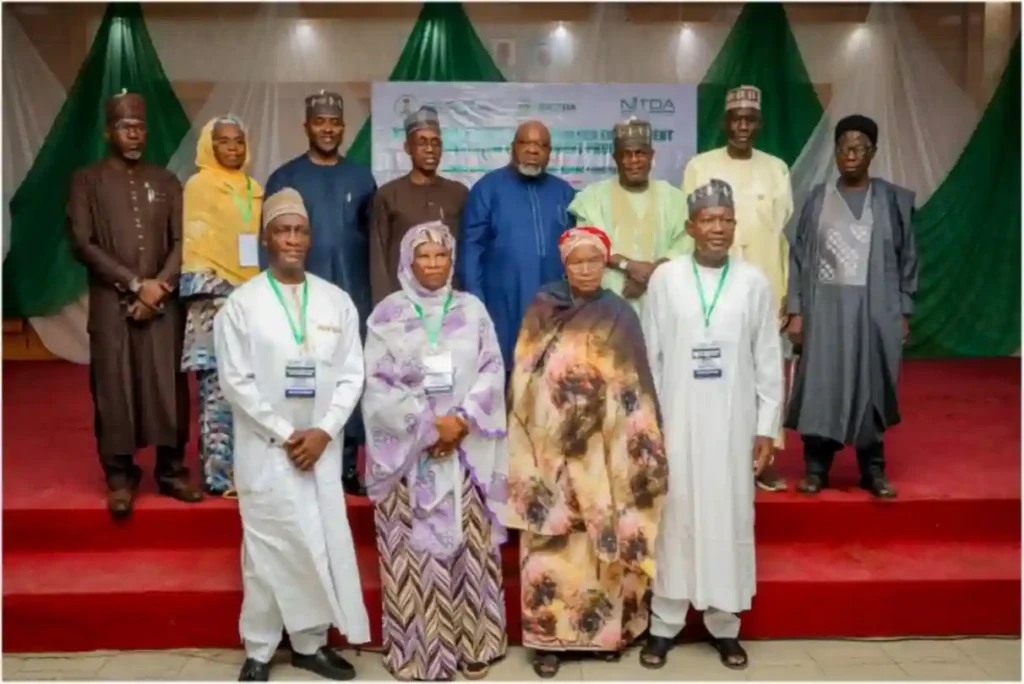
The National Information Technology Development Agency (NITDA) and the Borno State Information and Communication Technology Development Agency (BICTDA) have renewed efforts to deepen collaboration aimed at accelerating digital economy growth, expanding innovation, and improving digital inclusion across Borno State.
 Follow us on Google News
The renewed commitment was announced during the NITDA-Borno State IT Stakeholders’ Engagement and ICT Ecosystem Development Programme held in Maiduguri with the theme, “Creating Opportunities, Breaking Boundaries: Towards Digitalization and Entrepreneurial Evolution.”
The engagement brought together government officials, technology stakeholders, entrepreneurs, academics, and development partners to discuss how digital transformation can support economic growth, improve governance, and create opportunities for young people in the state.
Speaking at the event, the Director-General of NITDA, Kashifu Inuwa, represented by the Director of Zonal Office Coordination, Mr. Ajayi Babajide, said Nigeria’s economy is at a stage where technology and innovation have become critical to national development and competitiveness.
According to him, digital transformation is no longer optional as countries now rely heavily on digital infrastructure, innovation, and technology-driven systems to drive productivity, create jobs, and strengthen economic resilience.
He said NITDA’s Strategic Roadmap and Action Plan (SRAP 2.0) and the National Digital Literacy Framework (NDLF) are helping to expand digital skills and access to technology across the country, especially in underserved communities.
“In today’s economy, digital capacity is directly linked to national growth and competitiveness. This is why collaboration between federal and state institutions is important to ensure no region is left behind,” he said.
Babajide noted that NITDA has continued to expand ICT centres and digital training initiatives nationwide while supporting innovation and entrepreneurship through different capacity development programmes.
He explained that stronger state-level partnerships are necessary to sustain the impact of these initiatives, adding that Borno State remains strategic in the agency’s broader digital inclusion agenda.
According to him, the partnership between NITDA and BICTDA will focus on improving community digital literacy, strengthening startup ecosystems through mentorship and support programmes, and encouraging stronger collaboration between government institutions, academia, and the private sector.
He also highlighted the contributions of the Office for Nigerian Digital Innovation (ONDI) and the National Centre for Artificial Intelligence and Robotics (NCAIR), saying both institutions are helping Nigerian startups through incubation, training, research, and acceleration programmes.
Babajide said Nigeria’s innovation ecosystem is gradually producing globally competitive startups and technology entrepreneurs capable of contributing meaningfully to the country’s economic growth.
For Borno State specifically, he said digitalisation presents an opportunity to diversify the economy, create jobs for youths and women, improve governance systems, and reduce the widening digital gap between urban and rural communities.
Delivering the keynote address on behalf of Governor Babagana Umara Zulum, the Permanent Secretary, Administration, Parastatals and General Services, Barrister Garba Musa Chibok, said technology has become central to rebuilding institutions and achieving sustainable development.
He said Borno State is moving beyond recovery from years of insecurity and is now focused on redesigning governance and public service delivery through innovation and digital systems.
“Digital transformation is no longer a luxury. It is now necessary for effective governance, economic participation, and long-term development,” he said.
Chibok added that sustainable digital growth can only happen through collaboration involving government agencies, private sector operators, civil society organisations, and development partners.
He highlighted several achievements recorded by the state in the area of digital inclusion, including the use of technology to improve access to education, healthcare, and public services.
The state government, according to him, has also invested in training programmes aimed at improving digital literacy and increasing economic participation among residents, particularly young people.
Despite the progress, he acknowledged the challenges facing digital expansion in the state, including infrastructure deficits, connectivity gaps, and cybersecurity concerns.
He called for sustained investments and stronger partnerships to address these issues and ensure broader digital access across rural and urban communities.
Also speaking, the Executive Secretary of BICTDA, Engr. Mohammed Kabir Wanor, described the engagement as an important platform for translating digital policies into measurable economic and social outcomes.
He stressed that ICT must become fully integrated into governance and service delivery systems if the country intends to achieve meaningful digital transformation.
Wanor commended NITDA for supporting digital literacy and innovation programmes in the state, noting that thousands of youths, women, and civil servants have benefited from training initiatives designed to improve employability and productivity.
He added that the state is also investing in ICT infrastructure, innovation hubs, and e-learning platforms as part of efforts to build a stronger and more sustainable digital ecosystem.
On cybersecurity, Wanor warned that digital growth must be supported with stronger protective frameworks capable of safeguarding public data and maintaining trust in digital systems.
The programme ended with renewed commitments from stakeholders to strengthen partnerships, expand digital inclusion, and accelerate the growth of an innovation-driven digital economy in Borno State and across Nigeria.