President Bola Tinubu on Monday in Abuja reaffirmed his administration’s full commitment to improving Nigeria’s electricity supply through the Presidential Power Initiative (PPI) being handled by Siemens Energy. He said the project would enhance the nation’s economy and improve the livelihoods of citizens.
 Follow us on Google News
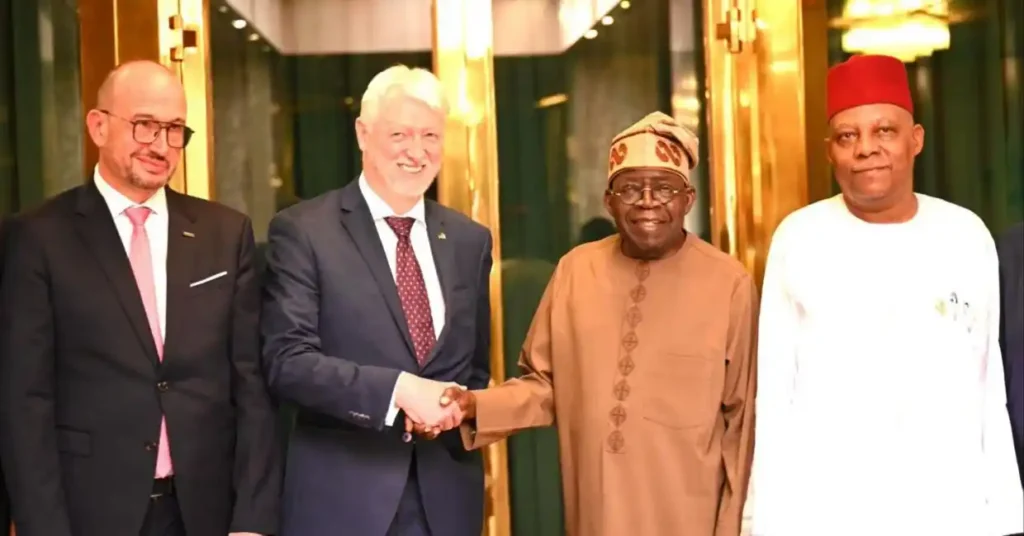
During a meeting at the State House with a delegation from Siemens Energy, led by Dietmar Siersdorfer, Managing Director for the Middle East and Africa, Tinubu said the power sector remains central to stimulating the economy, especially in the industrial, educational, and healthcare sectors.
The meeting was attended by Vice President Kashim Shettima, the Coordinating Minister of the Economy Wale Edun, the Minister of Power Adebayo Adelabu, and the Special Adviser on Energy Olu Verheijen.
The President said that completing the power project will place Nigeria among the leading nations in Africa by harnessing its human and material resources for economic growth.
“There is no industrial growth or economic development without power. I believe that power is the most significant discovery of humanity in the last 1,000 years,” Tinubu stated.
“I appreciate the partnership on the initiative. The progress of the project to date is notable, and we can feel it. But it is not where we want it to be. We appreciate the support and commitment of the German government and Siemens. The investment you are making and your commitment align with the future of this country,” he added.
The President emphasized that energy is the foundation for national development, saying, “Our education, our health care and our transportation all depend on energy and without power, it is an impossible objective. We are taking it very seriously.”
Tinubu directed that some major transformer substations under the project be expanded from two to three phases to boost national power supply.
“We are all inspired and happy. This is what we want to achieve on the continent. We want everyone to see the glory of our economic recovery and banishment of poverty,” he said.
He also assured the Siemens delegation that his administration would continue to provide the required resources to ensure the project’s successful implementation.
The Minister of Power, Adebayo Adelabu, highlighted the progress made in the sector, noting several key milestones, including the decentralization and liberalization of Nigeria’s electricity industry.
He recalled that President Tinubu signed the Electricity Act 2023, followed by the development of the National Integrated Electricity Policy, which had attracted more than $2.2 billion in fresh investments and resulted in the activation of fifteen state electricity markets.
“Since the signing of the Accelerated Agreement at COP28 in Dubai in December 2023, an event you personally attended alongside the German Chancellor Olaf Scholz, the PPI has recorded notable milestones across its implementation phases,” Adelabu said.
“Under the Pilot phase (Phase Zero), we have achieved significant infrastructure upgrades and capacity enhancements that are already impacting grid stability and reliability across the country. Siemens Energy has successfully delivered and commissioned 10 units of 132/33kV mobile substations, three units of 75/100MVA transformers, and seven units of 60/66MVA transformers across key load centres nationwide, which have added 984MV of transmission capacity to the grid,” he stated.
Adelabu added that in December 2024, the Federal Executive Council approved the start of the Engineering, Procurement, and Construction (EPC) contract for Phase One, Batch One of the PPI.
He explained that the first batch includes upgrading and commissioning five major substations located in Abeokuta, Offa, Ayede-Ibadan, Sokoto, and Onitsha.
“I am pleased to report that plans for civil works mobilisation across all five locations have been finalised, concurrent manufacturing of the required equipment is ongoing, and two of the five substations are targeted for completion by the end of 2026,” he said.
“As we consolidate the gains from the Pilot Phase and Phase One-First Batch, we are also preparing to advance to Phase One-Batch Two, which has a scope for the construction of new substations and the upgrade of existing ones across key load centres nationwide. Collectively, Phase One-Batch Two of the PPI comprises a total of six Brownfield and ten Greenfield substations with a cumulative impact of 4,104MW,” Adelabu added.
Speaking on the economic benefits, the Minister of Finance and Coordinating Minister of the Economy, Wale Edun, stated that the completion of the PPI will improve Nigeria’s ease of doing business, create jobs for young people, and reduce poverty across the country.
“The power initiative is vital to our economic growth because it strengthens industrial production, encourages private investment, and supports small businesses,” Edun said.
Dietmar Siersdorfer, the leader of the Siemens Energy delegation, commended the federal government for its support and cooperation, saying that two out of the five substations under construction are expected to be completed by December 2026.
He explained that Siemens has also begun constructing a training centre to build local capacity in electrical engineering and create more job opportunities.
“The PPI is not just a project but a platform for long-term development and prosperity,” Siersdorfer said. “The initiative will transform Nigeria into a regional power hub, reflecting the strong partnership between Germany and Nigeria.”
He added that Nigerian professionals would be directly engaged in all five project sites under Batch One, while thousands of indirect jobs would be created through local procurement, logistics, and support services.
“Nigerian professionals will be engaged directly in the five project sites in Batch 1 for the site works, while thousands of jobs will be enabled in the local communities through purchased services, accommodation, and transportation, among others. These will further reflect the strength of our partnership and the viability of the roadmap we have built together,” Siersdorfer noted.
Also speaking, the representative of the German Ambassador to Nigeria, Johannes Lehne, reaffirmed Germany’s continued partnership with Nigeria. He said the German government will keep supporting the project to ensure its success and further strengthen bilateral relations.