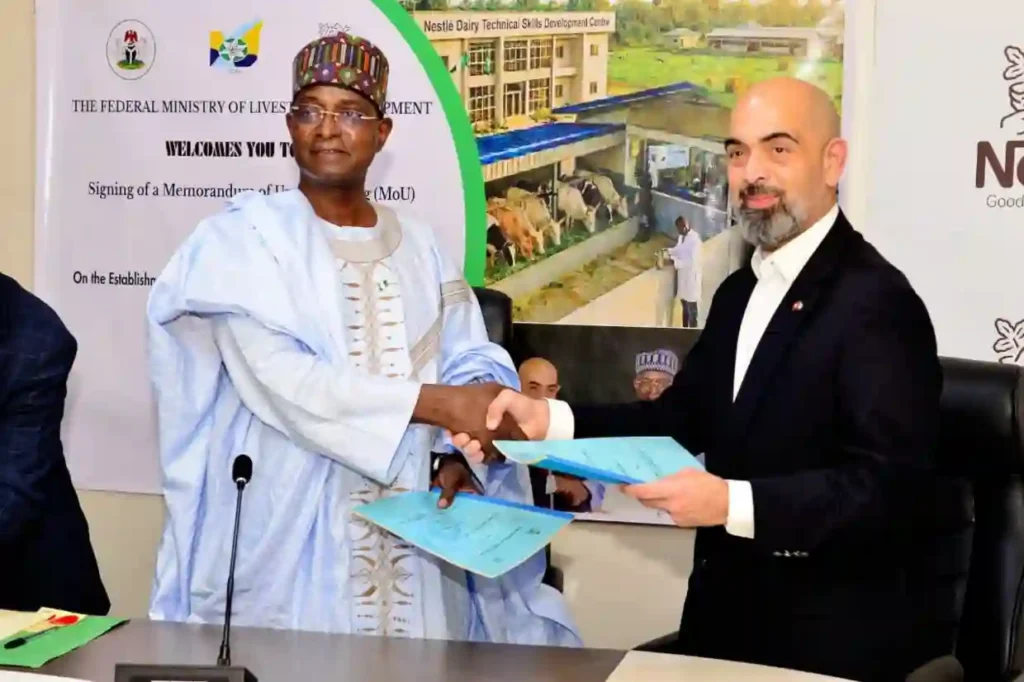
The Federal Government has entered into a strategic partnership with Nestlé Nigeria Plc to establish a Dairy Technical Skills Development Centre in the Federal Capital Territory, as part of efforts to transform Nigeria’s underperforming dairy sector into a modern, competitive industry.
 Follow us on Google News
The agreement, formalised through a Memorandum of Understanding (MoU), was disclosed on Wednesday, April 8, 2026, in Abuja by the Minister of Livestock Development, Idi Mukhtar Maiha. According to the Minister, the initiative goes beyond a ceremonial partnership and represents a deliberate intervention to address longstanding structural challenges in the dairy value chain.
Addressing Nigeria’s dairy productivity gap
Maiha noted that Nigeria’s dairy sector continues to struggle despite its large livestock population, describing the situation as a paradox of “immense potential and stark underperformance.” He attributed the low productivity levels to a critical shortage of technical expertise and modern farm management practices.
He explained that traditional pastoral systems in Nigeria currently yield an average of one to two litres of milk per cow daily. This, he said, falls significantly below global benchmarks and is largely due to poor feed formulation, inadequate access to clean water, weak animal health management systems, and the effects of climate change.
The Minister also highlighted gaps in key technical areas such as artificial insemination, herd health monitoring, and milk hygiene. These deficiencies, he noted, contribute to significant post-harvest losses and undermine the overall efficiency of the sector.
As a result, Nigeria continues to spend an estimated $1.5 billion annually on dairy imports, a figure the government considers unsustainable given the country’s domestic potential.
Skills centre to drive modern dairy practices
The proposed Dairy Technical Skills Development Centre is expected to serve as a practical training hub aimed at bridging the knowledge and capacity gap in the sector. According to Maiha, the centre will focus on equipping farmers and industry participants with hands-on skills required for modern dairy farming.
He emphasised that the curriculum will adopt a 70:30 ratio of practical to theoretical learning, ensuring that trainees gain real-world experience in farm operations. The training will cover critical areas such as breeding techniques, assisted calving, calf management, milk handling and hygiene, feed optimisation, and record keeping.
The Minister stressed that the programme would be benchmarked against global best practices to ensure that graduates are well-positioned to operate within a competitive dairy ecosystem.
Nestlé’s investment and impact on local dairy communities
Speaking at the event, the Managing Director and Chief Executive Officer of Nestlé Nigeria Plc, Wassim Elhusseini, stated that the partnership aligns with the objectives of Nigeria’s National Dairy Policy under the broader National Development Plan.
He disclosed that Nestlé has invested over N1.8 billion in dairy development initiatives, particularly in communities around Pai-Konkore and the Luger grazing reserves. According to him, these investments have significantly improved the livelihoods of participating farmers.
Elhusseini noted that milk producers involved in Nestlé’s programmes recorded an increase in monthly income from N70,000 to N250,000 between 2021 and 2024. He added that the company has established more than 83 dairy cooperatives, collectively producing over one million litres of raw milk.
In addition, Nestlé has trained over 2,000 pastoralists and vaccinated more than 36,000 cattle. The company has also invested in essential infrastructure, including boreholes, water troughs, milk collection centres, and cooling facilities to improve both productivity and product quality.
Demonstration farms and productivity gains
The CEO further revealed that in 2025, Nestlé launched a Dairy Demonstration Farm designed to showcase the impact of improved breeding, feeding, and herd management practices. The model farm has demonstrated the potential to increase milk production from an average of one litre per cow per day to as much as 10 litres.
He said the initiative also underscores the importance of proper animal health management, milk hygiene, and the transition towards more settled and sustainable farming systems.
Stakeholders highlight importance of capacity building
In her remarks, the Permanent Secretary of the Ministry of Livestock Development, Chinyere Ijeoma Akujobi, emphasised that the success of the partnership would ultimately be measured by tangible outcomes across the dairy value chain.
She stated that the collaboration is designed to translate investment and technical knowledge into real improvements for farmers, leading to higher incomes, improved nutrition, and more resilient rural livelihoods.
Representatives of the Commercial Dairy Ranchers Association of Nigeria also identified capacity building as a major constraint in the sector, expressing optimism that the new skills centre would help address this gap.
Other stakeholders present at the event included former Speaker of the House of Representatives, Yakubu Dogara, as well as representatives from the Food and Agriculture Organisation and the Bank of Agriculture.
Outlook for Nigeria’s dairy sector
The establishment of the Dairy Technical Skills Development Centre marks a significant step in Nigeria’s efforts to reduce its dependence on imported dairy products and strengthen local production capacity.
By focusing on skills development, technology transfer, and public-private collaboration, the initiative is expected to lay the foundation for a more efficient and commercially viable dairy industry.
Analysts note that sustained implementation, alongside supportive policies and infrastructure development, will be critical to ensuring that the sector achieves long-term growth and contributes meaningfully to national food security and economic diversification.