
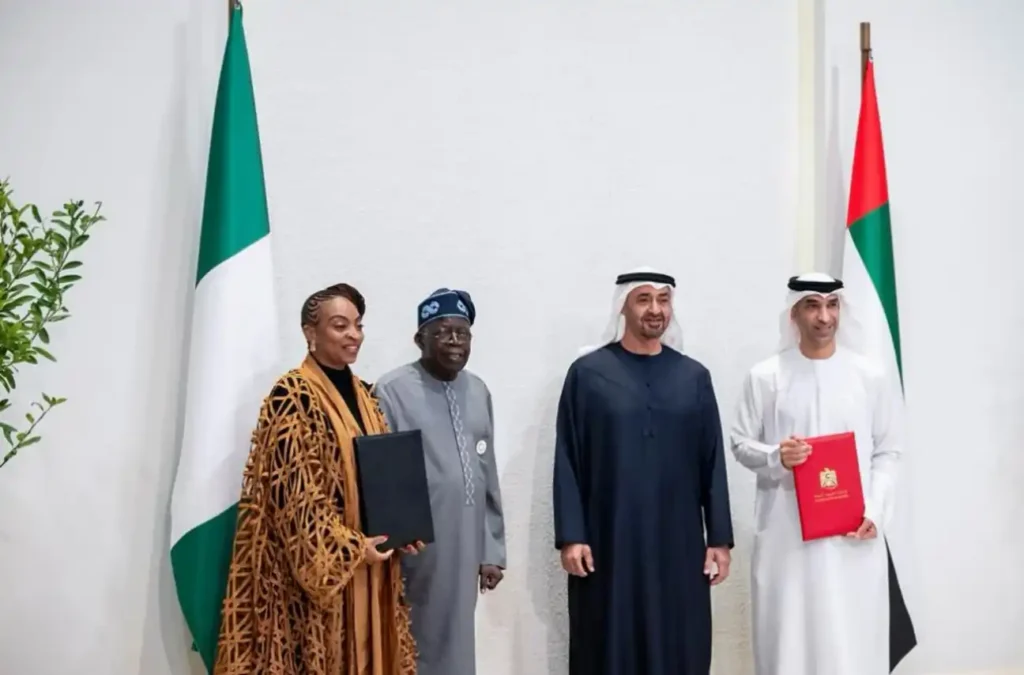
The Federal Republic of Nigeria and the United Arab Emirates formally signed a Comprehensive Economic Partnership Agreement CEPA aimed at transforming economic ties between both countries and delivering tangible benefits for Nigerian businesses, professionals, and workers.
 Follow us on Google News
The Agreement is the product of focused and determined negotiations led by the Federal Ministry of Industry, Trade and Investment under the direction of the Honourable Minister and Chief Negotiator for Nigeria, Dr Jumoke Oduwole MFR. It prioritises expanded market access for Nigerian goods and services, facilitates quality investment inflows, and advances Nigeria’s national economic diversification drive under the Renewed Hope Agenda of President Bola Ahmed Tinubu GCFR.
Speaking on the significance of the deal, Nigerian officials described the CEPA as a forward-looking trade framework that aligns with the country’s broader reform agenda and positions Nigerian enterprises to compete more effectively in global markets.
What This Agreement Delivers for Nigeria
For Nigerian exporters, the CEPA provides immediate and phased market access into the UAE. Under the Agreement, the UAE will eliminate tariffs on over 7,000 products originating from Nigeria. With immediate effect, Nigerian agricultural and industrial products including fish and seafood, oil seeds, cereals, cotton, pharmaceuticals, chemicals, and related goods will enter the UAE market duty-free. Over a three to five-year transition period, the UAE will also remove tariffs on Nigerian machinery, vehicles, electrical equipment, apparel, and furniture.
Officials said this creates “a clear and competitive pathway” for Nigerian industrial exports into one of the world’s most dynamic trading hubs. Beyond goods, Nigerian businesses will be able to establish operations in the UAE through new corporate entities, branches, and subsidiaries. Business visitors from Nigeria can enter the UAE for up to 90 days within a 12-month period to explore trade and investment opportunities. In addition, intra-corporate transferees including managers, executives, and specialists can relocate alongside their companies for renewable three-year periods.
For Nigeria’s investment climate, the Agreement addresses long-standing barriers to foreign direct investment. UAE investors are now provided with improved clarity and confidence to invest in Nigeria’s productive sectors. According to officials, this is expected to support Nigeria’s industrialisation agenda, strengthen transport and logistics connectivity, and contribute to the creation of quality jobs for the country’s youthful population.
Nigeria’s Commitments Under the Agreement
On its part, Nigeria will eliminate tariffs on around 6,000 products under the trade in goods component of the CEPA. Tariffs on approximately 60 percent of these products will be removed immediately, while the remaining lines will be phased out over a five-year period. These imports are largely focused on industrial inputs, capital goods, and machinery that are expected to enhance Nigeria’s productive capacity. Authorities emphasised that Nigeria’s Import Prohibition List remains fully in effect.
In trade in services, Nigeria’s commitments cover 99 specific services across 10 sectors. These include business services, communication, transport, financial services, construction, distribution, health, environment, recreational and sporting services, as well as tourism. Officials said the scope of commitments reflects Nigeria’s intention to open priority sectors while safeguarding national development objectives.
A Strategic Agreement for a Diversified Economy
The CEPA is being positioned as a strategic instrument for economic transformation. With expanded market access secured for value-added and industrial goods, the Agreement is expected to incentivise Nigerian manufacturers to scale up production for export markets. The framework also positions Nigeria as a gateway for international investors seeking access to the African Continental Free Trade Area and its estimated market of 1.4 billion people.
Nigeria has already recorded unprecedented participation from UAE institutional investors, including First Abu Dhabi Bank, particularly in infrastructure financing. Notably, this includes support for the construction of the Lagos–Calabar Coastal Road, which officials described as “a strong vote of confidence” in Nigeria’s macroeconomic trajectory and reform agenda. Sky Capital has also been instrumental in supporting the CEPA and in projecting Nigeria’s investor readiness. The signing of the Agreement is expected to accelerate deals across agriculture, real estate, digital banking, retail, and infrastructure financing.
The government stated that the CEPA is fully consistent with Nigeria’s obligations under the World Trade Organisation, the African Continental Free Trade Area, and ECOWAS.
Swift Implementation
The Federal Ministry of Industry, Trade and Investment, working with key MDAs such as the Nigeria Customs Service, alongside FMITI agencies including the Nigerian Export Promotion Council, the Nigerian Investment Promotion Commission, and the Standards Organization of Nigeria, will drive implementation. According to the Ministry, these institutions will ensure Nigerian businesses and hosted investors receive the information, support, and facilitation required to take full advantage of the Agreement in line with the President’s “Nigeria First” directive.
“I would like to appreciate the Nigerian negotiation team, including the Lead Technical Advisers, FMITI, the Nigerian Office for Trade Negotiation, the Nigerian Customs Service and the Ministry of Justice, among several other MDAs, who played a critical role in this milestone Agreement,” the statement said.
Collectively, the institutions are expected to equip Nigerian businesses with the tools needed to leverage the opportunities created by the CEPA.
“I would like to seize this opportunity to appreciate Dr Thani bin Ahmed Al Zeyoudi, Minister of Foreign Trade, and the UAE negotiation team for this strong collaborative effort,” the statement added.
Addressing the private sector directly, the government said, “This Agreement was negotiated for you. I urge you to identify your opportunities with enhanced market access and move with confidence into the UAE market with the protections we have secured for you.”
The statement concluded by affirming that Nigeria is open for business, noting that Nigerian businesses now have open access to the UAE, the Middle East, and global markets.