
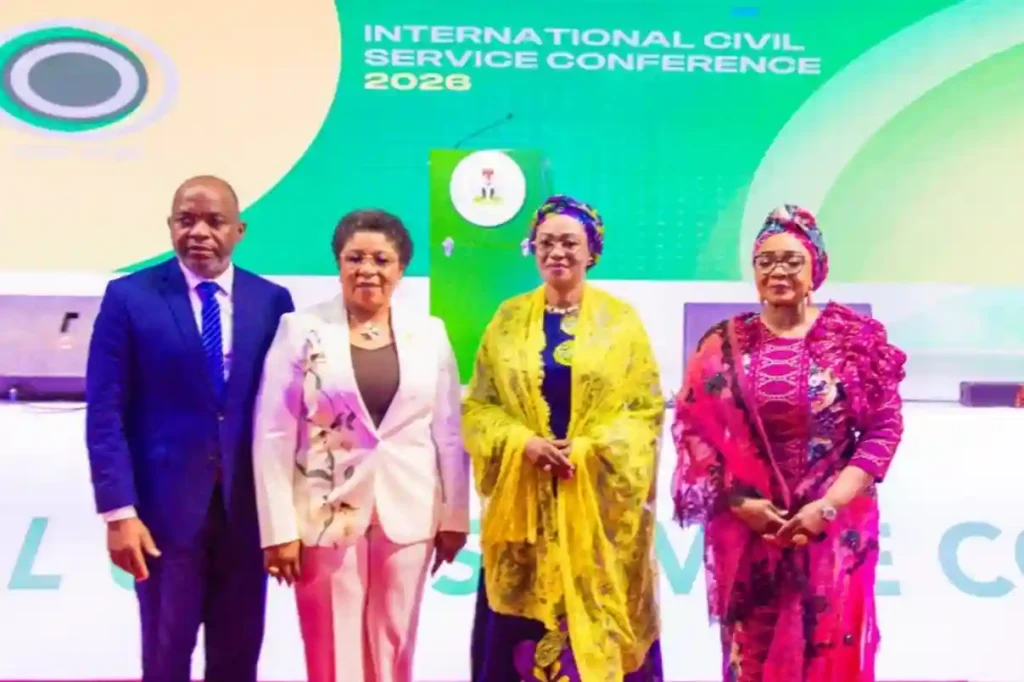
The Federal Government has launched the INSPIRE Programme, a major leadership and inclusion initiative aimed at helping more women rise into senior government positions across Nigeria’s civil service.
 Follow us on Google News
The programme, officially unveiled as INSPIRE Nigeria — Inclusive Network for Supporting Progressive Leadership, Innovation, Reform and Equity for Women — was launched by First Lady Oluremi Tinubu during Day Two of the International Civil Service Conference (ICSC) 2026 held under the theme, “Reforms, Resilience and Results.”
The initiative immediately positions itself as one of the Federal Government’s biggest institutional efforts focused on fixing the long-standing gap between the large number of women working within the public sector and their low representation in top leadership positions.
Speaking before more than 5,000 delegates from 16 countries, the First Lady said the INSPIRE Programme was created to ensure women within the civil service are not locked out of leadership opportunities because of structural barriers, weak mentorship systems or workplace limitations.
According to her, the programme aligns directly with President Bola Tinubu’s Renewed Hope agenda and wider government reforms focused on inclusion, productivity, accountability and institutional transformation.
“This initiative speaks to the kind of civil service we must continue to build — one that supports its workforce, rewards competence, promotes fairness, encourages innovation, creates opportunities for professional growth and truly reflects equity and excellence,” she said.
Oluremi Tinubu explained that one of the major goals of the programme is to create a leadership pipeline for women from entry level positions up to the highest levels of government service.
She noted that leadership development should not start only when women are close to becoming permanent secretaries or heads of agencies, stressing that mentorship and leadership exposure must begin much earlier.
“I am pleased to learn that this initiative is designed to reach women across different levels of the civil service, from junior officers to executive level, and this is most important because leadership development should not begin only when a woman becomes a permanent secretary,” the First Lady said.
“A young officer who is properly mentored today may become the permanent secretary, head of service, minister, or a national leader tomorrow.”
The INSPIRE initiative forms part of broader federal policy commitments tied to the National Gender Policy 2021–2026 and the Women’s Economic Empowerment Policy 2023–2028. Government officials say the goal is to move gender inclusion beyond public statements and turn it into measurable institutional practice across ministries, departments and agencies.
The First Lady linked women’s advancement in public service directly to national development outcomes, arguing that stronger female representation in leadership positions would improve governance and strengthen institutions.
“When women are empowered, institutions become stronger, governance improves and citizens benefit from better service delivery,” she said.
“That is why initiatives like INSPIRE are not just important for women alone, they are vital for national progress.”
She also called on men within the civil service to actively support inclusive workplace reforms and equal opportunities for women.
“I encourage you to continue your partnership in building workplaces that promote fairness, respect and equal opportunity for all,” she added.
Head of the Civil Service of the Federation, Didi Walson-Jack, described the INSPIRE Programme as a strategic intervention designed specifically to tackle the institutional barriers slowing down women’s career progression within the Nigerian public service.
According to her, the initiative will focus heavily on mentorship, institutional support, leadership training, peer learning and professional development opportunities.
Walson-Jack said many women within the civil service continue to face challenges including weak sponsorship structures, limited access to mentorship and systemic barriers that affect promotion and leadership opportunities.
She explained that INSPIRE would create a structured framework to address those issues through continuous engagement and long-term professional support systems.
Under the programme, participants will gain access to leadership development initiatives, career advancement support, policy engagement opportunities, peer mentoring structures and performance-based evaluation systems.
Women across different cadres of the civil service will also be connected through a sustained professional network aimed at supporting collaboration, visibility and leadership growth beyond one-off conferences and workshops.
“Building institutional capacity, strengthening professional confidence, and creating structured opportunities for mentorship and leadership development are central to the programme,” Walson-Jack said.
She added that meaningful public service reform cannot happen without inclusive participation across leadership structures.
“Institutional effectiveness depends on the full participation of both men and women in governance and policy implementation,” she stated.
According to the Head of Service, the programme also aligns with Nigeria’s broader public sector reform agenda focused on efficiency, accountability and results-driven governance under the Renewed Hope framework.
Minister of Women Affairs and Social Development, Imaan Suleiman-Ibrahim, said the launch of INSPIRE comes at a critical moment for Nigeria’s public institutions.
Delivering a goodwill message on behalf of the Federal Government, the minister said the country can no longer ignore the leadership gap affecting women within the federal workforce.
“This is not a coincidence, it is a consequence of a legacy system that has some structural weaknesses. And it is a gap we can no longer afford,” she said.
Suleiman-Ibrahim noted that despite the large number of women working across ministries, departments and agencies, representation at senior leadership levels remains low.
She argued that the issue goes beyond individual capability and reflects institutional limitations that need deliberate reforms.
The minister outlined several priorities she believes government institutions must immediately begin implementing if the INSPIRE Programme is to achieve real impact.
One of the major areas she highlighted was the need for full implementation of the six-month maternity leave policy without penalties or discrimination against female workers.
“Women must never be forced to choose between caring for their children or building a career,” she said.
She also called for stricter workplace protection systems, including zero-tolerance policies against harassment and safer work environments for women across the public sector.
Beyond workplace protection, Suleiman-Ibrahim pushed for stronger implementation of gender-responsive budgeting and enforcement of the Federal Government’s 30 percent affirmative action policy.
“We must move these commitments from policy documents into binding institutional platforms,” she stated.
The minister further stressed the need for intentional succession planning and sponsorship structures that prepare women for leadership roles long before vacancies emerge.
“Lastly, we must invest deliberately in leadership pipelines for our women through mentorship, sponsorship and succession planning that fast-track women into the senior roles this country needs them to occupy,” she added.
She pledged full support from the Ministry of Women Affairs and Social Development towards the implementation of INSPIRE and said the ministry would contribute policy support, technical expertise and institutional partnerships to ensure the initiative succeeds.
Suleiman-Ibrahim also revealed that the Federal Government is developing a national care economy strategy aimed at supporting caregivers and formalising care work, which she described as critical to reducing the disproportionate unpaid care burden carried by women.
She urged stakeholders across government, the private sector and development organisations to ensure the conference discussions translate into measurable action across institutions.
“Words spoken in conferences like this must become action felt in offices, in our homes, and in communities across Nigeria,” she said.
UN Women Regional Director for West and Central Africa, Maxime Houinato, also backed the initiative, describing the INSPIRE Programme as both timely and strategic.
He commended Nigeria’s recent efforts around gender inclusion and women empowerment but warned that structural inequalities and institutional barriers still remain major problems.
According to him, women’s political and institutional representation in Nigeria continues to remain critically low despite recent policy progress.
Houinato referenced several government-backed programmes and reforms, including the Renewed Hope agenda, the Nigeria Women Programme, the National Women Economic Empowerment Policy, domestication of the Violence Against Persons Prohibition (VAPP) Act and the third National Action Plan on Women, Peace and Security.
However, he stressed that more investment and accountability are still needed.
“These are situations that are historical, these are situations that are structural, and we commend the effort of the government of Nigeria to look for solutions that will allow women to express their potential,” he said.
On the INSPIRE initiative itself, Houinato said the programme creates an important platform for strengthening leadership capacity and accelerating institutional transformation across the public sector.
He also confirmed that UN Women and other UN agencies would continue partnering with the Office of the Head of Service and the Ministry of Women Affairs to support gender-responsive reforms and implementation across government institutions.