
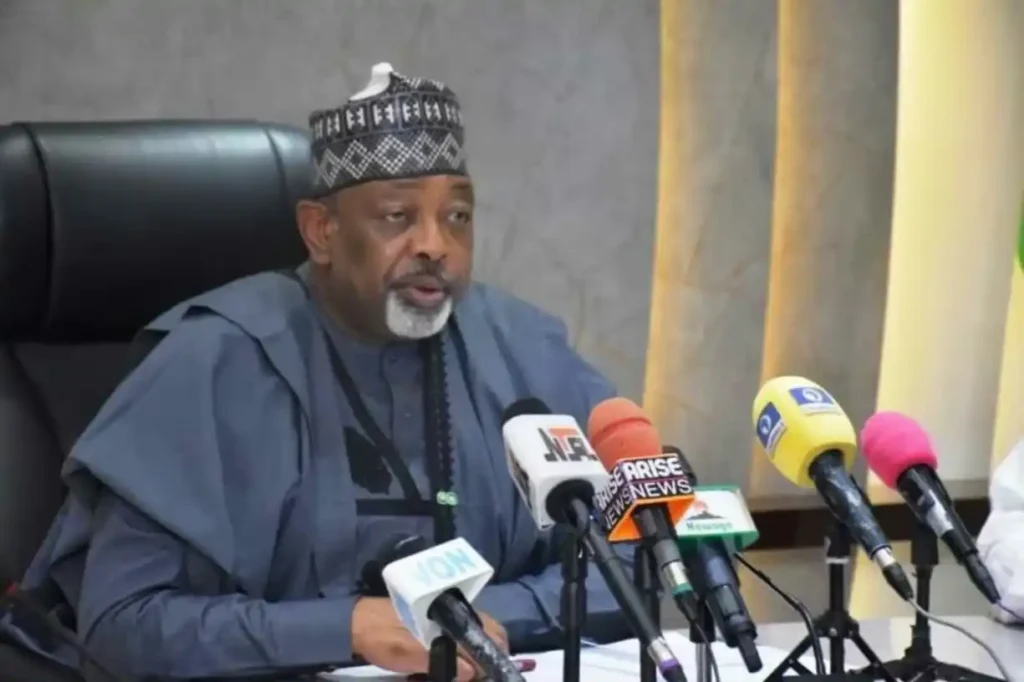
The Federal Government has announced major reforms and financing initiatives to accelerate Nigeria’s journey toward food sovereignty and agricultural transformation. This includes the recapitalisation of the Bank of Agriculture (BOA) with ₦1.5 trillion and the creation of a ₦250 billion credit window to support smallholder farmers across the country.
 Follow us on Google News
Speaking at the 47th National Council on Agriculture and Food Security (NCAFS) in Kaduna, themed “Food Sovereignty and Food Security in an Era of Renewed Hope,” the Minister of Agriculture and Food Security, Abubakar Kyari, said the new financing plan marks “a decisive step in repositioning agricultural finance as the anchor of national food production.”
Kyari emphasized the government’s commitment to modernizing agriculture, noting that “Mr. President’s charge remains clear: our farmers must transition from hoes and cutlasses to tractors and harvesters. Food sufficiency is the first currency of national stability,” quoting President Bola Ahmed Tinubu.
The Minister explained that the government’s intervention agenda, which includes input delivery, mechanisation, post-harvest management, and market access, aligns with Nigeria Vision 2050, the National Development Plan (2021–2025), and the National Agricultural Technology and Innovation Policy (NATIP).
He revealed that the National Agricultural Growth Scheme-Agro-Pocket (NAGS-AP), supported by the African Development Bank, is expanding nationwide. According to Kyari, wheat production has increased from 15 states in 2023/24 to more states in the 2024/25 farming season, supported by progress in rainfed wheat cultivation in Plateau, Taraba, and Cross River states. “This innovation brings Nigeria closer to meeting national demand from within,” he said.
Addressing post-harvest losses estimated at $10 billion annually, the Minister disclosed the launch of the Nigeria Postharvest Systems Transformation Programme (NiPHaST) in partnership with the Alliance for a Green Revolution in Africa (AGRA). The programme focuses 85 percent of its interventions on smallholders through affordable storage technologies, 10 percent on cooperative-level processing hubs, and 5 percent on upgrading national silos through public-private partnerships.
Kyari also announced that the Bank of Agriculture, in collaboration with Heifer Nigeria, will implement the Renewed Hope National Agricultural Mechanisation Programme. The initiative will provide access to tractors, maintenance services, and training through six zonal mechanisation hubs to enhance productivity and youth engagement in agriculture.
In addition, the National Agricultural Development Fund (NADF) has been activated to expand investment in agricultural value chains, rural infrastructure, and agribusiness ventures to ensure long-term growth.
Minister of State for Agriculture and Food Security, Aliyu Sabi Abdullahi, stated that climate-smart agriculture is now central to Nigeria’s production strategy. “We are developing climate-resilient crops, integrated soil-crop systems and pest management strategies,” he said.
Abdullahi highlighted key initiatives such as the Dry Season Initiative covering 500,000 hectares, the “Every Home a Garden” campaign championed by First Lady Oluremi Tinubu, the Nigerian Farmers’ Soil Health Scheme, and the Renewed Hope Cooperative Reform and Revamp Programme. He said these programmes aim to improve inclusion, financing, and productivity, ultimately reducing food imports. “Our goal is simple—no Nigerian should go to bed hungry,” Abdullahi added.
Earlier, Marcus Ogunbiyi, Permanent Secretary of the ministry, described the Council as Nigeria’s foremost policy forum for agricultural coordination. He explained that food sovereignty “goes beyond availability; it is about our collective capacity to produce, process and distribute food sustainably.” Ogunbiyi emphasized the need for a resilient food system that empowers rural communities and sustains livelihoods.
The 47th NCAFS brought together federal and state government officials, development partners, and agribusiness stakeholders to create a unified framework for achieving agricultural self-sufficiency and ensuring food security nationwide.