Home Blog Page 128

NNPC launches Valentine promo for customers to win ₦5,000 free fuel

The Nigerian National Petroleum Company Limited (NNPC) Retail has announced a Valentine promotion tagged “Fuel the Love this Valentine with NNPC Retail,” offering customers rewards for fuel purchases and gifts. This Valentine, customers can fuel up, share the love, and get rewarded.

Customers who buy ₦40,000 or more fuel on the NNPC Fuel App between February 1 and 13 can win ₦5,000 free fuel. Users who gift ₦10,000 or more fuel to loved ones using the Me-2-You feature also stand a chance to win ₦5,000 free fuel.

A physical activation will hold on February 14 at Wuse SS in Abuja and Alfred Rewane SS in Ikoyi, Lagos, from 10am to 1pm, while stocks last, and added T&Cs apply.

To participate, download the NR Fuel App by visiting tinyurl.com/retail-app and win the prize.

Advertisement

JAMB Opens 2026 UTME, DE Registration With Dates, Rules and Steps

0

The Joint Admissions and Matriculation Board (JAMB) has opened the registration window for the 2026 Unified Tertiary Matriculation Examination (UTME) and Direct Entry (DE), officially kicking off the admission process for the 2026/2027 academic session. The move signals the start of another admission cycle for candidates seeking placement into universities, polytechnics, colleges of education and other tertiary institutions across Nigeria.

For many candidates, the registration stage is where avoidable mistakes happen, ranging from wrong biodata entries to National Identification Number (NIN) issues and incomplete documentation. These early errors often affect the entire admission journey. In this article, Tribune Online explains the confirmed dates, mandatory NIN requirements, and the step-by-step registration process candidates must follow to complete their registration successfully.

JAMB: Official UTME 2026 Registration Dates
Before making a final decision on this year’s UTME, candidates are advised to understand the official timeline released by JAMB to avoid missed deadlines.

UTME Registration
Candidates registering for UTME are expected to take note of the approved schedule. The sale of e-PINs begins on Monday, January 19, 2026, while registration officially opens on Monday, January 26, 2026. Registration will run until Saturday, February 28, 2026. The sale of e-PINs will end on Thursday, February 26, 2026.

JAMB confirmed that the optional Mock UTME will hold on Saturday, March 28, 2026. The Board said the mock examination helps candidates get familiar with the CBT environment. The main UTME examination is scheduled to take place between Thursday, April 16, and Saturday, April 25, 2026.

Direct Entry (DE) Registration
For Direct Entry candidates, JAMB announced that sales and registration will run from Monday, March 2, to Saturday, April 25, 2026. Unlike UTME candidates who register at accredited CBT centres, Direct Entry registration is done only at JAMB State and Zonal offices. The Board warned DE candidates not to attempt registration at CBT centres.

NIN: Mandatory Requirement for All Candidates
For the 2026 registration exercise, a valid NIN remains compulsory. JAMB stated that no candidate can register without it. According to the Board, every candidate’s biodata, including full name, date of birth, gender and state of origin, must match the information in the NIN record managed by the National Identity Management Commission (NIMC).

Once a candidate generates a profile code, JAMB’s system retrieves the candidate’s details directly from the NIMC database. Candidates are advised to confirm that their NIN information is correct before starting registration, as any mismatch can cause delays, failed attempts or rejection at the CBT centre.

Step-by-Step Guide: How to Apply for JAMB 2026
The registration process follows specific steps that candidates are expected to complete carefully.

  1. Prepare Before Registration
    Before starting registration, candidates should ensure they have the basic requirements ready. This includes having a valid NIN and confirming that the attached information is accurate. It is also important to use a personal and active mobile phone number, as the number will be linked to the candidate’s JAMB profile and future communication. Officials noted that this preparation step helps prevent common issues at CBT centres.
  2. Generate Your JAMB Profile Code
    The profile code links a candidate’s NIN to JAMB. To generate it, candidates must send an SMS in this format, NIN 12345678901, to 55019 or 66019, replacing the digits with their 11-digit NIN. Candidates should ensure there is enough airtime and that the SMS is correctly typed. After sending, the candidate will receive a 10-digit profile code via SMS.

JAMB advised candidates to use a SIM card that has not been previously used to generate another profile. Since the profile code is tied to the phone number used, candidates are urged to keep it safe and avoid sharing it.

  1. Buy Your JAMB e-PIN
    After receiving the profile code, the next step is to purchase the JAMB e-PIN. Candidates can buy the e-PIN through approved channels such as commercial banks, licensed online vendors and accredited CBT centre vendors. JAMB disclosed that there are three categories of e-PINs for the 2026 admission exercise. Direct Entry applicants will pay N5,700, UTME candidates opting out of the mock examination will pay N7,200, while those who choose the optional mock UTME will pay N8,700. The Board explained that the charges cover the application fee, reading text, CBT centre registration services, UTME service charges, bank processing fees and mock examination fees.
  2. Register at an Accredited CBT Centre
    JAMB registration is not meant to be completed at home or through cyber cafés. Candidates are required to complete registration only at JAMB-accredited CBT centres. At the centre, candidates will enter their profile code and e-PIN, upload a passport photograph, capture fingerprints and other biometric data, and select their exam town, preferred institutions and course choices. After registration, the CBT centre will print a JAMB registration slip, which serves as proof of successful registration. JAMB advised candidates to keep all SMS messages and printed slips safely, noting that they may be required during examinations, result checking and admission screening stages by institutions. The Board also urged candidates to rely only on official information channels to avoid misinformation and fraudulent registration claims during the 2026 admission exercise across the country nationwide this year.

NLNG opens 2026 Nigeria Prizes for Science, Literature, Creative Arts Entries

The Nigerian Liquefied Natural Gas (NLNG) company has announced that the Nigeria Prizes competition has officially kicked off, calling for entries for the 2026 cycle. The announcement was made in a statement issued in Port Harcourt on Sunday and sent to newsmen.

According to the company, this year’s edition focuses on Artificial Intelligence and Information and Communication Technology for The Nigeria Prize for Science and Innovation, poetry for The Nigeria Prize for Literature, and documentary filmmaking for the newly introduced The Nigeria Prize for Creative Arts.

NLNG’s Manager of Corporate Communication and Public Affairs, Anne-Marie Palmer-Ikuku, disclosed that the Prizes remain Nigeria’s foremost platform for rewarding excellence in science and innovation, literature, and the creative arts.

The company noted that for the 2026 cycle, the Nigeria Prize for Science and Innovation retained the theme “Innovations in Information and Communication Technology, Artificial Intelligence, and Digital Technologies for Development,” following a “no winner” verdict recorded in the 2025 cycle.

Speaking on the commencement of the prizes cycle, NLNG’s General Manager of External Relations and Sustainable Development, Sophia Horsfall, emphasised the relevance of the selected themes in a rapidly evolving global environment.

She said extensive research has shown the strong potential of ICT, artificial intelligence, and digital technologies to reshape industries and societies across different sectors.

“The themes for the 2026 cycle reflect the realities of a world being reshaped by digital intelligence and creative expression,” Horsfall stated.

“Through The Nigeria Prizes, NLNG continues to reinforce its commitment to innovative ideas and talents that are rigorous, relevant, and capable of shaping long-term national outcomes,” she added.

She explained that the introduction of the Creative Arts Prize further strengthens this commitment by recognising creativity as a critical component of development.

Also speaking on the call for entries, the Chairman of the Advisory Board of the Science and Innovation Prize, Prof. Barth Nnaji, urged scientists and innovators from across the world to submit quality entries that go beyond theory and demonstrate deployable, scalable, and practical solutions.

“The Nigeria Prize for Science and Innovation is founded on the principle that science must move beyond abstraction into solutions that work,” Nnaji said.

“The Prize recognises innovations grounded in rigorous research, demonstrating technical maturity and clear potential for application within Nigeria’s development landscape,” he added.

With the prize valued at $100,000, NLNG said the Science and Innovation competition is open to scientists and innovators worldwide and invites pioneering digital and artificial intelligence based solutions that can enhance systems, improve efficiency, and support informed decision making in critical sectors of Nigeria’s economy.

Similarly, the Nigeria Prize for Literature will spotlight poetry for the 2026 cycle, with Nigerian authors both at home and in the diaspora invited to participate.

According to the statement, poets are expected to submit poetry collections that were published from 2023 onwards.

“The prize, also worth $100,000, recognises literature’s enduring capacity to interrogate society, preserve memory, and articulate both personal and collective experience,” the company stated.

The Chairman of the Advisory Board for The Nigeria Prize for Literature and The Nigeria Prize for Creative Arts, Prof. Akachi Adimora-Ezeigbo, expressed excitement over the establishment of the new Prize for Creative Arts, describing it as a major addition to NLNG’s more than two decades of celebrating excellence.

“It reaffirms our belief that excellence transcends form, whether written, spoken, or filmed,” she said.

“The Creative Arts Prize challenges creators to confront truth, explore memory, and translate lived experience into meaningful work,” she added.

She noted that the focus on poetry for The Nigeria Prize for Literature recognises the genre’s enduring role as a tool for reflection, resistance, and social inquiry.

The Nigeria Prize for Creative Arts debuts with Documentary Film under the theme ‘Identity’ and is valued at $20,000.

NLNG explained that the Prize is targeted at emerging Nigerian filmmakers aged 18 to 35 and challenges young creatives to produce documentary films that explore individual, communal, and cultural identities, while reshaping global perceptions of Nigeria through rigorous storytelling, creativity, and visual excellence. The company encouraged wide participation.

FUNAAB to deploy technological innovation to cut cost of poultry feeds

The Federal University of Agriculture, Abeokuta (FUNAAB) has announced plans to deploy a home-grown technological innovation aimed at reducing the high cost of poultry feeds, a major challenge affecting Nigeria’s livestock sector and protein supply.

The Vice-Chancellor, Prof. Olusola Babatunde Kehinde, disclosed this while briefing journalists ahead of the university’s 33rd convocation ceremony scheduled to hold next week at the institution’s campus in the Alabata axis of Odeda Local Government Area, Ogun State.

Prof. Kehinde explained that the innovation focuses on reducing dependence on maize and soya beans, which have become expensive due to rising production costs. He noted that higher prices of these feed ingredients have continued to drive up poultry feed prices nationwide.

“The cost of producing maize and other conventional feed ingredients has become extremely high,” he said. “Our approach is to replace maize and soya beans with viable alternatives, and substantial work is ongoing in the animal production sector.”

According to him, FUNAAB is equipping students with alternative feed-production technologies that will enable them to manufacture poultry feed at lower costs.

The Vice-Chancellor also disclosed that 104 students out of 4,141 graduands would be graduating with First-Class Bachelor’s degrees at the forthcoming convocation. A breakdown of the results showed that 1,771 graduands earned Second-Class Upper Division degrees, while 1,896 obtained Second-Class Lower Division degrees.

In addition, 285 students graduated with Third-Class degrees, while two earned Pass degrees. He announced that Osianu Joy, of the Department of Food Science and Technology, emerged as the overall best graduating student with a CGPA of 4.85.

Prof. Kehinde further revealed that 69 graduands completed their studies under the Part-Time Degree Programme, while 41 students earned the Doctor of Veterinary Medicine (DVM) degree, which is not classified.

“Graduation symbolises triumph over challenges, the fulfilment of dreams, and the opening of new horizons,” he said. “We are releasing into society a new generation of innovative entrepreneurs and skilled professionals ready to contribute to national development.”

He described the convocation ceremony as a celebration that brings together stakeholders to honour individual excellence and institutional achievement. The Vice-Chancellor also commended the Federal Government, led by President Bola Ahmed Tinubu, for its consistent and timely release of funds, which he said has been central to FUNAAB’s progress and growth nationwide today.

Airtel Africa to list Airtel Money in IPO by June 2026

The chief executive of Airtel Africa Plc, Mr Sunil Kumar Taldar, has disclosed that the company remains on course to list its mobile money business, Airtel Money, before the end of June 2026. He made this known while speaking on the company’s latest financial performance, noting that preparations for the planned listing are progressing despite the absence of final decisions on key details.

Business Post had reported in March 2024 that the mobile network operator was considering selling shares of Airtel Money to the public through an initial public offer, with the transaction expected to raise $4 billion. At the time, the company was exploring different options for the listing, including markets in London, the United Arab Emirates, or other parts of Europe.

Although discussions have been held with potential advisers, the firm has not yet concluded on the timing, location, or size of the IPO. However, progress was recorded in September 2025 when the telco reportedly selected Citigroup Incorporated as advisers for the transaction. The planned IPO is expected to result in Airtel Money becoming a standalone entity before it eventually trades on a stock exchange.

Mr Taldar said operational indicators continue to improve ahead of the anticipated listing. According to him, Airtel Money’s customer base has grown to 52 million users, up from 44.6 million recorded as of June 2025. He also revealed that the subsidiary processed transactions worth more than $210 billion within a year, based on the company’s nine-month financial results released on Friday.

“Our push to enhance financial inclusion across the continent continues to gain momentum with our Mobile Money customer base expanding to 52 million, surpassing the 50 million milestone. Annualised total processed value of over $210 billion in Q3’26 underscores the depth of our merchants, agents, and partner ecosystem and remains a key player in driving improved access to financial services across Africa,” he said.

Mr Taldar added, “We remain on track for the listing of Airtel Money in the first half of 2026.”

The projected valuation of Airtel Money at $4 billion represents a significant increase from its $2.65 billion valuation in 2021. That year, the business attracted major investments, including $200 million from TPG Incorporated and $100 million from Mastercard. An affiliate of Qatar’s sovereign wealth fund also acquired an undisclosed stake later in 2021 globally

Nigeria, Japan Seek New Trade Deals Under AfCFTA

Nigeria and Japan are working to unlock new trade and investment flows under the African Continental Free Trade Area (AfCFTA) following a two-day capacity building and investment dialogue organised by the United Nations Development Programme (UNDP) under the Japan Business Support (JBS) Programme.

The forum, titled “Unlocking Trade and Investment Opportunities in the Context of AfCFTA,” was held in Lagos on January 28 and 29. It brought together government officials, regulators, financiers, Japanese firms and Nigerian businesses to address policy alignment, market readiness, financing gaps and regulatory bottlenecks limiting cross-border trade between both countries.

Speaking at the event, Folashade Ambrose-Medebem, Lagos State commissioner for Commerce, Cooperatives, Trade and Investment, described the engagement as “timely, strategic and critical to Nigeria’s trade and investment ambitions,” especially in deepening economic relations with Japan.

She said Lagos remains Nigeria’s commercial hub and highlighted state-backed export readiness initiatives designed to prepare local businesses for international markets. According to her, “for the first time, 253 businesses were trained and equipped to meet export requirements” through a structured export readiness programme supported by the state government.

Speaking with BusinessDay at the event, Zahrah Mustapha Audu, director-general of the Presidential Enabling Business Environment Council (PEBEC), clarified that her office does not interpret AfCFTA rules for exporters. Instead, she said PEBEC focuses on ensuring that regulators deliver services efficiently and transparently.

Audu urged businesses to fully understand regulatory requirements and to rely on official escalation channels when discrepancies arise. “If the information published on regulators’ websites differs from what is being demanded of you, you can escalate to PEBEC,” she said, adding that the council also conducts quarterly “mystery shopping” exercises to independently test compliance by agencies.

She said Nigeria is well positioned to receive Japanese investment, pointing to policy consistency, fiscal reforms and ongoing regulatory streamlining. “Absolutely, Nigeria is ready for Japanese businesses,” Audu said. “This is a great time to come into Nigeria. We’re streamlining reforms, reducing regulations and holding ourselves accountable as a government.”

Providing a macroeconomic and investment outlook, Babatunde David, consulting lead at Seven Star Consultants Ltd, said recent reforms have improved Nigeria’s attractiveness as an AfCFTA gateway economy. He cited the unification of the foreign exchange market, improved transparency and external reserves at an eight-year high.

David added that Nigeria’s population of nearly 250 million people gives investors access to a large domestic market alongside AfCFTA’s $3.4 trillion continental market, making the country a strategic entry point for businesses seeking scale across Africa.

On AfCFTA implementation, Benedict Obhiosa, executive secretary of the Manufacturers Association of Nigeria (MAN) Export Group, said the agreement offers expanded market access for manufacturers but warned that weak implementation and non-tariff barriers could limit its impact.

“The best thing that has happened to Africa in terms of trade is bringing African countries into one trade room to pursue borderless trade,” he said, while stressing that “non-tariff barriers are worse than tariffs” and remain a major challenge for exporters.

A panel discussion on MSME financing highlighted structural constraints preventing Nigerian firms from scaling across borders. Foluke Alakija, managing director of Mayden Microfinance Bank, said many MSMEs remain unbankable due to weak documentation and poor compliance structures.

“Before you can get financing, it has to be presentable. The business itself has to be bankable,” she said, noting that lenders often struggle to assess risk when records and governance are weak.

From an investor perspective, Adesuwa Okunbo-Rhodes, founder of Aruwa Capital, warned businesses against taking foreign currency debt. “Every five years in Nigeria there is a currency devaluation of some sort,” she said. “If you’re taking debt, please take local currency debt. Foreign currency debt has killed a lot of businesses.”

Day two of the forum focused on sector-led deal-making and direct regulatory engagement. Clare Henshaw, UNDP head of inclusive growth, said many Nigerian exporters fail to convert international exposure into actual transactions due to poor preparation and weak follow-through.

“It’s not a case of Nigerians not having the right products,” she said. “But what happens when you come back, coordination, certification and follow-through.” Henshaw urged entrepreneurs to remain engaged despite operating in difficult conditions, describing Nigerian business owners as “heroes.”

Sector roundtables in agribusiness, cosmetics, fashion and manufacturing featured Nigerian firms seeking Japanese partnerships in machinery, automation, technology transfer and market access. Japanese participants highlighted rising demand for organic, health-focused and value-added products while stressing the importance of quality assurance and compliance.

Business-to-government clinics involving Customs, NAFDAC and logistics regulators raised long-standing concerns around samples, testing, airport access and charges. Customs officials reiterated that trade-related complaints submitted through official channels must be resolved within 72 hours, while NAFDAC officials defended local testing and labelling requirements as consumer protection measures aligned with global trade rules.

Organisers said the dialogue is part of a $1 million Japan Supplementary Budget project implemented by UNDP across Nigeria, Ghana, Kenya and Tanzania, aimed at linking African enterprises with Japanese partners and translating AfCFTA commitments into concrete trade and investment outcomes.


World Bank visits Nigeria to review reforms, jobs and energy plans

0

The Managing Director of Operations at the World Bank, Anna Bjerde, has begun a three-day visit to Nigeria as the country steps up efforts to turn ongoing economic reforms into faster growth, wider energy access and large-scale job creation.

The visit, which started on Sunday, February 1, 2026, comes at a time when the Federal Government is pushing fresh measures to stabilise the macro-economy, attract private capital and unlock productivity across major sectors of the economy.

At the centre of Bjerde’s engagements are consultations on the World Bank Group’s forthcoming Country Partnership Framework, CPF, for Nigeria, a strategic roadmap that prioritises job creation, expanded energy access and private sector-led growth.

According to the World Bank, the Managing Director will hold discussions with senior government officials, private sector leaders and civil society groups to gather inputs around four core pillars of the framework.

These pillars include improving the enabling business environment, unleashing human capital, strengthening economic and social resilience, and maximising private capital mobilisation across the economy.

The World Bank said the discussions would focus on how reforms in power, agriculture, digital infrastructure and financial markets can accelerate employment generation and support inclusive growth, as Nigeria grapples with high unemployment and rising living costs.

Nigeria’s role in advancing global development priorities is also expected to feature prominently during the engagements.

Key flagship initiatives, including “Mission 300”, a joint World Bank Group and African Development Bank programme to connect 300 million Africans to electricity by 2030, are expected to be reviewed during the visit.

Particular attention will be placed on Nigeria’s US$750 million Distributed Access through Renewable Energy Scale-up, DARES, project.

The DARES programme aims to deliver clean and reliable electricity to more than 17.5 million Nigerians through the deployment of mini-grids and solar home systems across underserved communities.

Agriculture and food security are also expected to dominate discussions, especially through the AgriConnect initiative, which seeks to transform smallholder farming into a commercially viable source of jobs, higher incomes and export growth.

Progress on power sector reforms, digital connectivity, social protection systems and human capital outcomes will equally be assessed as part of the three-day visit.

Bjerde is scheduled to meet Vice President Kashim Shettima, the Minister of Finance and Coordinating Minister of the Economy, Wale Edun, the Governor of the Central Bank of Nigeria, Olayemi Cardoso, and the Governor of Lagos State, Babajide Sanwo-Olu.

She is accompanied by senior World Bank Group executives, including Ousmane Diagana, Vice President for Western and Central Africa, Ethiopis Tafara, Vice President for Africa at the International Finance Corporation, IFC, and Ed Mountfield, Vice President of the Multilateral Investment Guarantee Agency, MIGA.

The World Bank noted that this high-level delegation underscores the Group’s coordinated approach to development finance and the mobilisation of private investment.

Nigeria currently has an active World Bank portfolio valued at over US$16 billion, supporting projects in education, health, social protection, energy and infrastructure at both federal and state levels.

The IFC’s investment exposure in Nigeria exceeds US$1.2 billion, with a focus on energy access, MSME financing, agribusiness, manufacturing and sustainable job creation nationwide.

The visit underscores sustained international engagement with Nigeria’s reform agenda, amid growing pressure for measurable gains in economic growth, employment and improved living standards.

FMN Opens Applications for Future Leader Accelerator Programme 2026

0

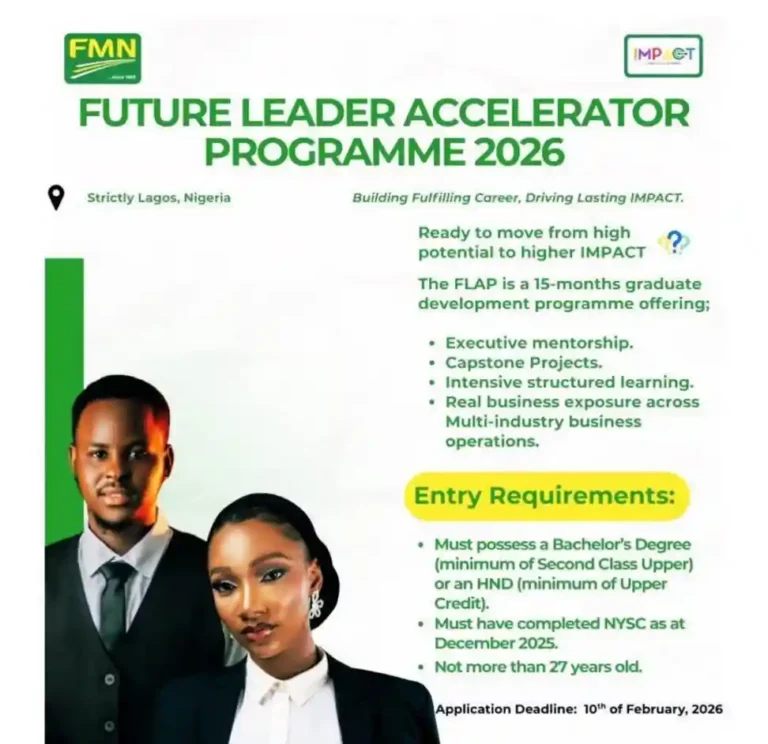
Applications are open for the FMN Future Leader Accelerator Programme 2026, a graduate development initiative by Flour Mills of Nigeria (FMN). The company, incorporated in 1960, is one of Nigeria’s leading food and agro-allied companies and is widely known for its Golden Penny brand, which delivers quality food products to consumers across the country.

The programme aligns with its commitment to national development and talent growth with a singular mission to keep feeding and enriching lives everyday. The new intake is aimed at young professionals who are ready to move from high potential to higher IMPACT.

The Future Leaders Accelerated Program, also known as FLAP, is a 15-month graduate development programme designed to provide participants with professional foundations. The programme will offer executive mentorship, capstone projects, intensive structured learning, and real business exposure across FMN’s multi-industry operations.

Participants will gain hands-on experience in an industry through what FMN described as a comprehensive development program. The training will expose successful applicants to different aspects of the business, helping them build practical skills and industry knowledge early in their careers.

Focus areas covered under the programme include Manufacturing, Technical and Engineering, Health Safety and Environment, Human Resources, Business Assurance, Finance and Account, Sales and Marketing, Corporate Communications and Legal, Supply Chain, Information Technology, and Agriculture.

To be eligible, applicants must have a first degree from an accredited university or polytechnic with a minimum of Second Class Upper or HND Upper Credit. Candidates must have completed the mandatory National Youth Service Corps with zero to two years post-NYSC work experience. Any relevant professional qualifications or certifications would be an added advantage.

Further entry requirements include that applicants must have completed NYSC by December 2025 and must not be more than 27 years old. Only candidates who meet the eligibility criteria will be contacted for the next stages of the selection process.

The application deadline for the FMN Future Leader Accelerator Programme 2026 is February 10, 2026.

Interested applicants should visit FMN FLAP 2026 application form and apply.

135 youths graduate from free ICT training at ARISE ICT Hub in Akwa Ibom

No fewer than 135 young people in Akwa Ibom State on Saturday, January 31, 2026, graduated from a free, intensive ICT training programme held at the ARISE ICT Hub in Uyo.

The graduation ceremony marked the successful completion of the capacity-building initiative sponsored by the Personal Assistant to the Governor on Volunteer Services, Ambassador Sunday Usikhifo, and hosted at the ARISE ICT Hub, No. 8 Etuk Street, Uyo.

Congratulating the graduands, Akwa Ibom State Governor, Pastor Umo Eno, commended their dedication and praised the sponsor for aligning the initiative with the objectives of his ARISE Agenda.

The Governor, who was represented by the Commissioner for Science and Digital Economy, Engr. Frank Ekpenyong, reaffirmed his administration’s commitment to strategic partnerships that will equip more youths with relevant digital skills and position them to harness opportunities in the digital economy.

He noted that the state government would continue to support initiatives that promote innovation, entrepreneurship, and technology-driven employment, adding that discussions were ongoing to expand collaborations with public and private sector players in the ICT space.

In a goodwill message, the Commissioner for Youths Development, Dr. Ekerette Ekanem, hailed the sponsor for his consistent efforts toward youth empowerment and development, describing the programme as timely and impactful.

Earlier, in his welcome address, Ambassador Sunday Usikhifo described the ceremony as a checkpoint in a journey powered by curiosity, persistence, and problem-solving. He explained that the training was designed to move participants beyond basic computer use to practical skills in building, securing, and optimising digital systems.

“ICT is not just about computers; it is about communication, connection, and turning ideas into impact,” he said.

Linking the programme to the digital transformation goals embedded in Governor Umo Eno’s ARISE Agenda, the Governor’s aide urged the graduates to see technology as a tool for solving real human problems. He cited the recently launched ARISE Youth Employment Portal as an example of how digital solutions can simplify processes and create opportunities at scale.

Ambassador Usikhifo stressed that while technologies and programming languages will continue to evolve, the most valuable asset the trainees had acquired was the mindset to keep learning and adapting.

“Use your skills responsibly. Build systems that include, not exclude. Create technology that serves people, not just profit. Protect data, respect privacy, and remember that behind every user is a human being,” he charged.

He encouraged the graduates to be bold innovators and lifelong learners, noting that while some would go on to work with global firms, others would build home-grown solutions that address challenges.

“You are not just users of technology; you are shapers of the future,” he declared.

The sponsor also appreciated parents and guardians for their support and commended the instructors and facilitators for their patience and dedication throughout the training period. He further hinted at post-training support for outstanding participants, including mentorship and linkages to internships and startup opportunities, to ensure the skills acquired translate into economic value.

High-performing students were recognised during the ceremony, while all 135 graduands received certificates of completion amid applause from families, friends, and invited guests.

The event attracted stakeholders from the technology ecosystem, government officials, and youth groups, all of whom described the initiative as a practical step toward reducing unemployment and building a skilled workforce in Akwa Ibom State.

Apply: FG EduRevamp Teacher Capacity Building Program

The Federal Government, through the Federal Ministry of Education, has opened applications for the EduRevamp Teacher Capacity Building Program for all primary and secondary school teachers across the country. The EduRevamp initiative is a professional development programme for Nigerian teachers powered by the Federal Ministry of Education, with participating teachers expected to receive paid allowances after training.

The program is open to eligible teachers nationwide and offers several benefits. Registration for the EduRevamp Teacher Capacity Building Program is completely free, while there is zero data cost required to access the training platform. Participants will receive allowances after completing the training, and certificates will be awarded after the completion of each module.

The purpose of the program is to improve the knowledge and professional skills of primary and secondary school teachers through structured and specialized training. It is meant for educators to empower themselves with the skills and knowledge to become better. EduRevamp is the government’s comprehensive training program designed specifically for teachers.

The program is delivered through five structured modules covering essential teaching methodologies and best practices. Teachers are also required to complete the NITDA digital literacy course to enhance their technology skills and improve classroom delivery in a digital learning environment. In addition, a community forum has been created to allow teachers connect with fellow participants, share experiences, and learn together.

After completing each training module, participants must upload their certificate and submit their bank account details before allowances can be paid. This process is to ensure proper documentation and transparency.

On eligibility, the program targets all primary and secondary school teachers in Nigeria, including those in public and private schools who are actively teaching. Applicants are expected to have valid teaching engagement and be willing to complete all required modules and digital literacy components as scheduled.

The initiative is timely supportive nationwide, and there is no deadline date.

To apply, interested applicants should visit the link https://edurevamp.education.gov.ng/register and apply.