Home Blog Page 328

Tinubu’s Wife urges women to use tech skills for change

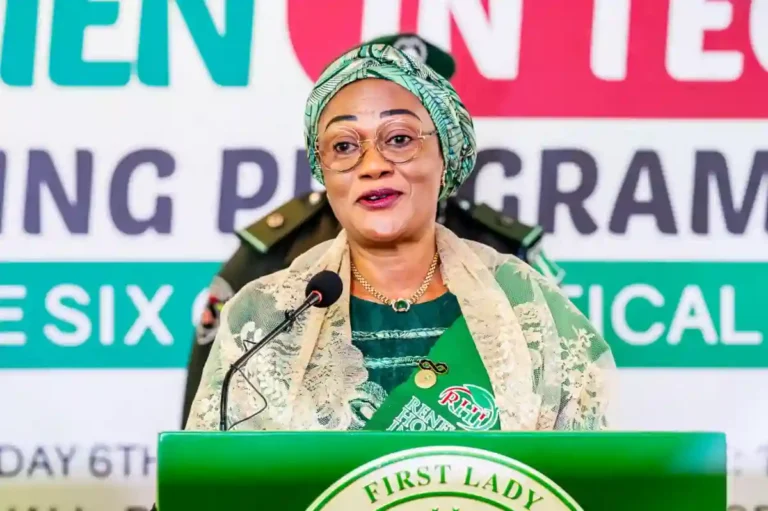
The First Lady, Senator Oluremi Tinubu, has urged the 300 participants of the Renewed Hope Initiative (RHI) and Huawei “Women in Tech” training programme to use their newly acquired digital skills to create positive change in their communities.

Speaking at the closing ceremony of the Women in Tech training programme for women entrepreneurs from the six geopolitical zones, held in Abuja on Thursday, Mrs Tinubu said the initiative was designed to empower women to thrive in the digital economy and contribute to national development.

The digital empowerment initiative, organised by the Renewed Hope Initiative in collaboration with Huawei Technologies Company, focused on equipping female entrepreneurs with practical technological skills that can help them expand their businesses and adapt to the growing demands of the digital age.

Mrs Tinubu, while addressing the women, emphasised the importance of continuous learning and adaptation in technology. “Although the training has ended, technology keeps changing. Your biggest strength is your ability to keep learning, evolving and adapting to new trends available for your growth in technology,” she said.

She encouraged the participants to apply the knowledge gained from the training to solve challenges within their communities, adding that innovation holds true value only when it improves lives. “Use your new skills to solve real problems in your various communities, because true innovation is only valuable when it improves lives. Remember, you are part of a larger network; support one another and grow together,” she stated.

The First Lady commended Huawei Technologies for collaborating with the Renewed Hope Initiative on the project and urged the participants to mentor other young women. “I thank Huawei Technologies Company Limited for this collaboration with the RHI. Finally, I charge you all to mentor others in your various businesses. Be a guide for young girls and women who think technology is not for them,” she added.

Mrs Tinubu explained that the Women in Tech training programme aligns with the Renewed Hope Agenda of President Bola Tinubu’s administration, which promotes inclusive growth and digital empowerment for all Nigerians through industrialisation and digitisation. “When women are equipped with the right tools and knowledge, they become agents of change in their families, communities, and the nation at large,” she said.

According to her, the programme, which ran between April and October 2024, successfully equipped 300 women with essential digital skills to help them succeed in today’s technology-driven world. “I congratulate all the participants, representing diverse sectors such as agriculture, fashion, catering, retail, event management and technology services, drawn from the six geopolitical zones of Nigeria,” she said.

The First Lady further highlighted the diversity of the participants, saying they represent the strength and resilience of Nigerian women, from university students eager to explore digital opportunities to business owners seeking innovation for business expansion.

Earlier, the Managing Director of Huawei Technologies Company Limited, Chris Lu, praised the partnership with Nigeria and the Renewed Hope Initiative, describing the programme as a global effort to place women at the forefront of the digital economy.

He said, “Today, we are experiencing a world of opportunities and innovation where technology defines progress. Empowering women with digital skills is not just a matter of inclusion but a necessity for national progress, and we know when women rise, nations thrive.”

Lu noted that the programme had united women from different parts of Nigeria in the pursuit of innovation and technological advancement. “Over the past one year, we have witnessed something inspiring where women across the six geopolitical zones came together to learn, innovate and to embrace technology. To our finalists, you’re all ambassadors of digital innovation and change; please go forth and impact others in your communities. Let us remember that the Renewed Hope is a reality where we all need to build together,” he said.

Also speaking at the event, the Director-General of the National Information Technology Development Agency (NITDA), Kashifu Abdullahi, described the initiative as a perfect fit for the Renewed Hope Agenda of President Tinubu.

He commended both Mrs Tinubu and Huawei for the collaboration, saying, “Mr Chris said when you empower women, a nation rises, and I want to add to it that when you empower a man, you empower an individual, but when you empower a woman, you empower a nation. Your initiative resonates deeply across the nation, and every organisation is proud to associate with you. We thank you for the leadership and partnership, and in NITDA, we don’t take it for granted.”

Abdullahi further stated that the ceremony was not just a graduation event but a celebration of women who have become ambassadors of digital transformation. “Therefore, today, we are not just celebrating the participants of women in tech training, but we are celebrating ambassadors; we are celebrating families and communities,” he said.

He appreciated the First Lady’s visionary leadership and commitment to human capital development, adding that her work through the Renewed Hope Initiative continues to empower women and youths across Nigeria. “Your Excellency, thank you for your visionary leadership. Through RHI, you are driving women empowerment, youth empowerment and Nigerian empowerment. We always want to partner with you for human capital development,” he said.

Abdullahi also described the collaboration as a “triangle of hub” involving the Renewed Hope Initiative, Huawei Technologies, and the national digital strategy. “For me today, we are creating a triangle of hub. We have the vision set by our mother, Mrs Tinubu, to ensure that no Nigerian is left behind especially the women and youth. We have our partner, Huawei Technology, empowering us with the tools and technology that are globally recognised with certificates that can be taken anywhere to succeed in life. We also have the national strategy, which is deeply rooted in our President Tinubu’s Renewed Hope Agenda. Therefore, this training aligned perfectly with the national strategy,” he said.

He encouraged the participants to see their certificates as keys to greater opportunities. “Don’t be afraid to be the first in your community and to be the best,” he advised.

During the event, certificates were presented to representatives from each geopolitical zone. For the South-East, the representative was Euphemia Augusta from Imo State; for the South-South, Chiagozie Efe-Ovirie from Delta State; for the South-West, Yusus Hats from Lagos State; for the North-Central, Amos Marvellous from the Federal Capital Territory; for the North-East, Bakari Betis from Adamawa State; and for the North-West, Binta Charanchi from Katsina State.
Advertisement

SMEDAN Save2Grow challenge application for N500,000 grant

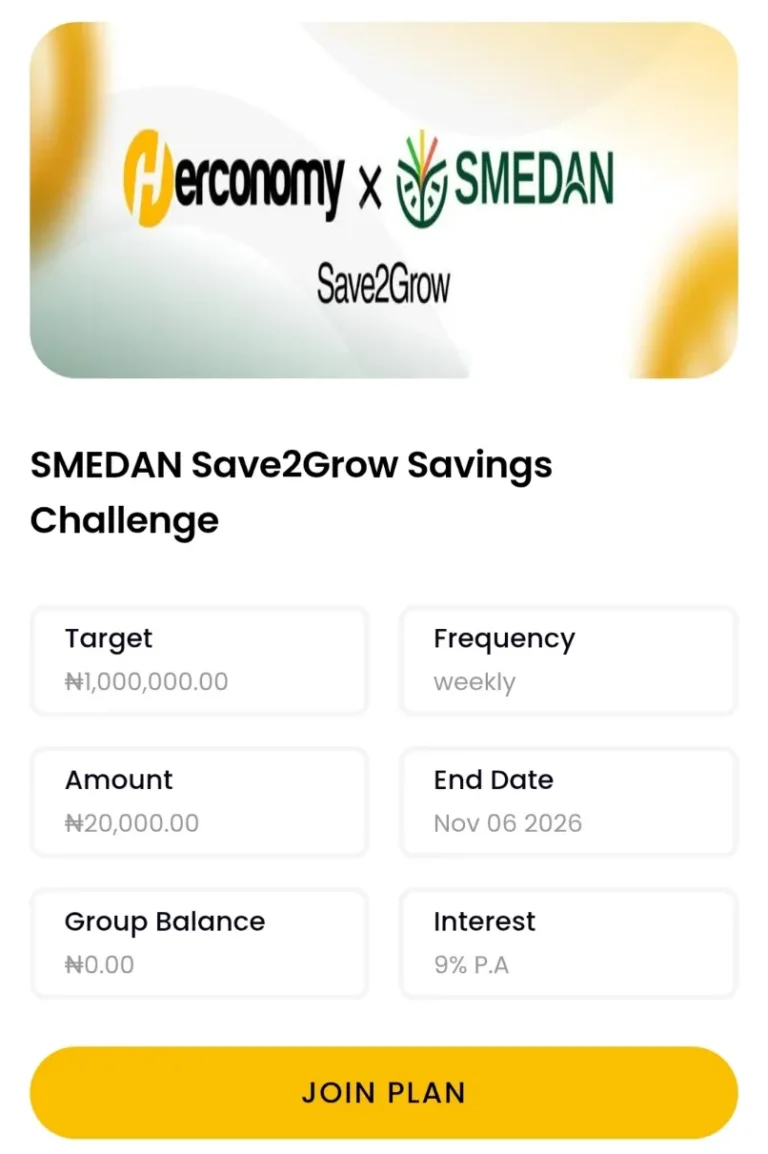
Small and Medium Enterprises Development Agency of Nigeria (SMEDAN) has announced the launch of the Save2Grow Savings Challenge, a new financial initiative designed to help entrepreneurs develop saving habits and win cash rewards. The program, organized in partnership with Herconomy, will reward participants with grants and other exciting prizes at the National MSME Conference 2025.

According to SMEDAN, the Save2Grow Challenge aims to promote financial discipline among small and medium-scale business owners across Nigeria. This is a great opportunity for entrepreneurs to build sustainable saving habits while standing a chance to win amazing rewards.

Participants can save as low as ₦1,000,000, ₦2,000,000, or ₦5,000,000 this month and qualify for various prizes, including a ₦500,000 grant, spa tickets, stocks, and other gifts.

To join, interested participants are required to download or log in to the Herconomy App on iOS or Android, select the Save2Grow Challenge under Savings Plans, choose a goal, and start saving immediately.

Winners will be announced at the National MSME Conference 2025 scheduled to hold in Lagos from November 16th to 18th. SMEDAN confirmed that all prizes will be presented live during the event. Registration is available through Form Link.

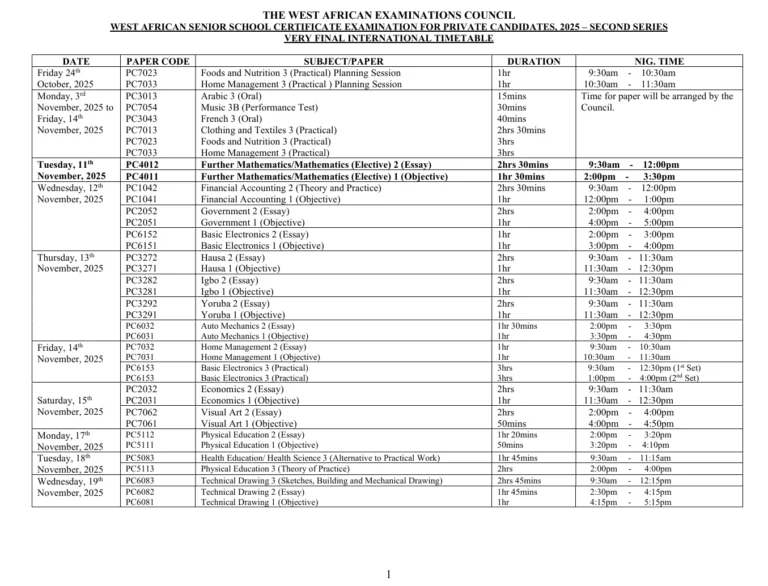
Pictures: WAEC final 2025 WASSCE timetable for private candidates

0

The West African Examinations Council (WAEC) has released the very final international timetable for the 2025 West African Senior School Certificate Examination (WASSCE) for private candidates, second series.

In a post on X on Thursday, the examination body confirmed the timetable release, noting it as the “Very Final International Timetable WAEC.” The announcement serves as an important update for private candidates preparing for the examination across the West African region.

WAEC explained that “where the duration indicated on the question paper differs from that on the timetable, the one on the question paper should be followed.”

It further stated that Visual Art Paper 3A instructions will be given to supervisors two weeks before the paper date, while Paper 3B question papers will be distributed to candidates two weeks before the exam.

“Candidates with special needs should be allowed one and half times the time allotted,” WAEC added.

NUC approves 13 new university degree programmes in Nigeria

0

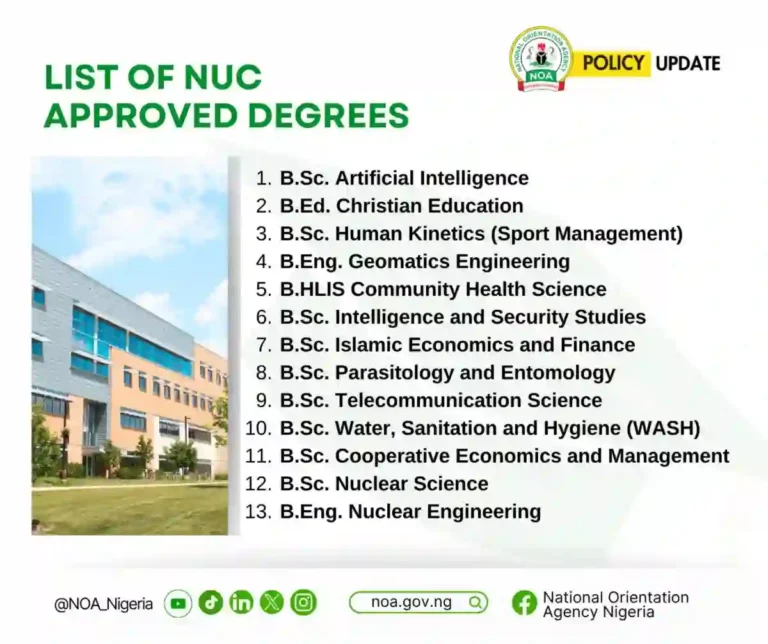
The National Universities Commission (NUC) has approved 13 new degree programmes to modernise Nigerian higher education and align it with international standards, a statement obtained by Nigeriastartupact on Thursday confirmed.

The new degree courses include Artificial Intelligence, Nuclear Engineering, Nuclear Science, Geomatics Engineering, Telecommunication Science, Community Health Science, Water Sanitation and Hygiene (WASH), Intelligence and Security Studies, Human Kinetics (Sport Management), Islamic Economics and Finance, Parasitology and Entomology, Cooperative Economics and Management, and Christian Education.

According to the NUC, the introduction of these programmes is part of the new Core Curriculum and Minimum Academic Standards (CCMAS) policy. “The programmes will commence once universities pass resource verification,” the statement said. The Commission explained that the approval is aimed at equipping graduates with 21st-century skills to boost Nigeria’s competitiveness in technology, science, and sustainable development.

TETFund confirms ongoing N50m Venture Grant for innovative students

0

The Federal Government has reaffirmed that the N50 million venture capital grant for outstanding students in Nigerian tertiary institutions is still on course.

It explained that the process of identifying and selecting qualified students has commenced across universities and polytechnics, emphasising that the initiative will enable institutions to showcase the ingenuity and problem-solving abilities of their students.

Executive Secretary of the Tertiary Education Trust Fund (TETFund), Arc. Sonny Echono, stated this in Abuja while hosting the Administrator and Chief Executive Officer of the Public Service Institute of Nigeria (PSIN), Barrister Imeh Okon.

According to Echono, each institution is expected to select students with promising and innovative ideas, while a national committee made up of experts from various fields will review the shortlisted candidates and make the final selections. He said all necessary arrangements for the take-off of the initiative have been completed, including the provision of the seed fund and the design of the selection modalities.

Echono noted that the move is part of the government’s effort to promote innovation, entrepreneurship, and job creation among young Nigerians through tertiary education funding. He stressed that the project aligns with TETFund’s mandate to support research and innovation in tertiary institutions, adding that the Fund will continue to collaborate with relevant agencies to ensure that students’ creative ideas are transformed into viable business ventures.

“There are students in our various TETFund beneficiary institutions who have demonstrated some creative abilities and come up with products, services, or solutions that they will need to take to the market to commercialise, to get buy-in from manufacturers and venture capitalists. The Federal Government will create a fund,” Echono said.

He explained that the venture capital fund will be managed by the Bank of Industry (BoI), noting that it will support product development from the idea stage to the point of commercialization. “That fund is going to be managed by the Bank of Industry. And when that happens, we’ll be able to help support development in terms of prototyping and even proof of concept, down to development of the initial product, to make it readily available for the private sector to adopt and commercialise by multiplication,” he added.

Echono confirmed that the fund is already in place and that all relevant meetings and arrangements have been concluded. “We have set the machinery in motion. The fund is in place. We have a seed fund that we have established, and that funding has been provided. We’ve held a series of meetings with all the parties. The modalities for selection are already being worked out and are happening at the level of the institutions because it is the institutions that know their students who have come up with ideas that have shown promise,” he said.

According to him, once the national committee completes the initial phase of assessment and makes its first selections, the successful beneficiaries will be officially announced. “By the time the committee comes up with the first set of selections, we will call the media, and the beneficiaries will come and receive their prizes,” Echono stated.

He explained that the amount to be awarded will depend on the nature and scale of each student’s innovation, but the maximum grant available will be N50 million. “It can be anything up to N50 million to be able to achieve that,” he said, reaffirming that the initiative is progressing as planned.

The Guardian reports that in July this year, the Minister of Education, Dr. Tunji Alausa, announced the Federal Government’s offer of a N50 million venture capital grant to outstanding students in Science, Technology, Engineering, Mathematics, and Medicine (STEMM) disciplines.

Tagged the Student Grant Venture Capital Initiative, the minister said the programme would provide up to N50 million in grants to high-achieving STEMM students in Nigerian universities, beginning from 300 Level. He explained that the initiative aims to reward creativity, innovation, and entrepreneurship among young Nigerians who show exceptional skills in their academic and research work.

Although the initiative was expected to be rolled out between September and October this year, The Guardian learnt that the final stage of evaluation and approval is still being concluded by the national committee in charge of the programme.

The fund, established through the Tertiary Education Trust Fund (TETFund) in partnership with the Bank of Industry (BoI), is chaired by the Chief Executive Officer of the Nigerian Economic Summit Group (NESG), Dr. Tayo Aduloju.

Sokoto to recruit 3,000 into neighborhood initiative, Sokoto marshall

The Sokoto State Government has announced plans to recruit additional personnel into the State Neighborhood Initiative and Sokoto Marshall as part of efforts to reduce unemployment, especially among youths.

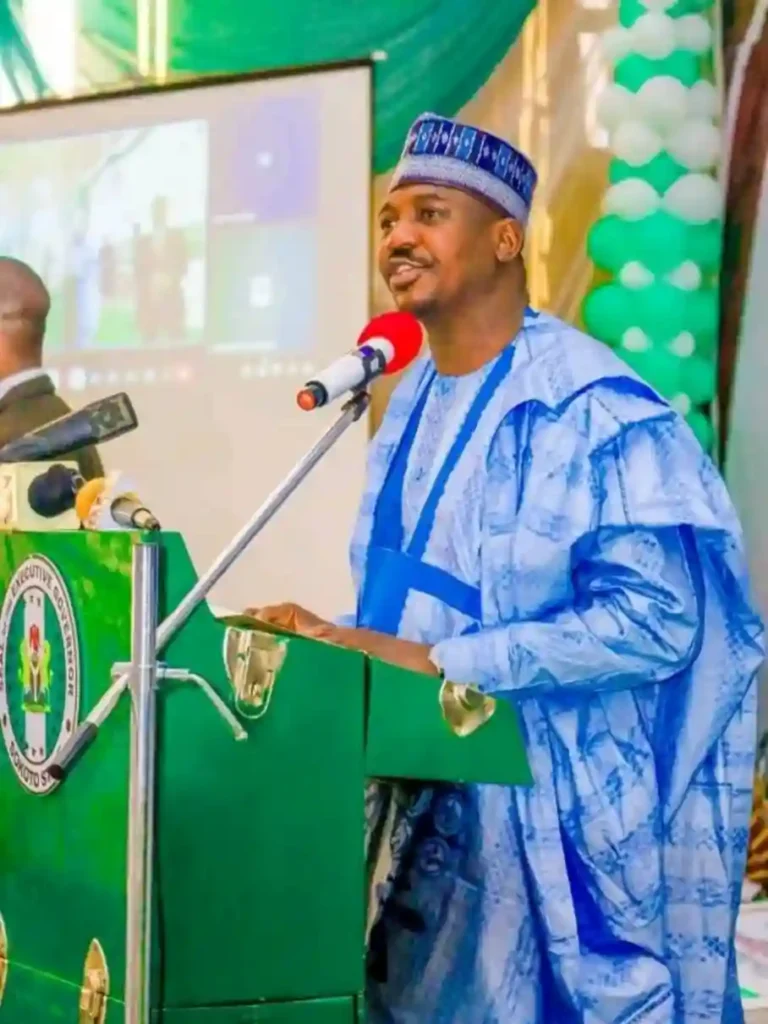
Governor Ahmad Aliyu made the announcement during the closing ceremony of the Sheikh Usman Bin Fodiyo Week held at the Kasarawa Conference Center, Sokoto. He said the recruitment drive will create more job opportunities, engage idle youths, and reduce rising cases of youth involvement in criminal activities.

“The initiative is designed to train our youths in different fields to support conventional security agencies, particularly in crowd management, fire control, and traffic regulation,” the Governor said.

The Neighborhood Initiative, first introduced by Governor Ahmad Aliyu during his tenure as Commissioner for Social Welfare in Wamakko’s administration, is one of the state’s major community security and youth empowerment projects.

Governor Aliyu explained that a committee has been inaugurated to oversee the recruitment of 3,000 qualified indigenes into the state workforce, reaffirming his government’s commitment to tackling youth unemployment and restiveness.

Speaking on the significance of the Sheikh Usman Bin Fodiyo Week, the Governor stated that his administration will ensure that the literary works of the leaders of the Sokoto Caliphate are digitized and made accessible for research and educational purposes. “A committee will be established to handle the project so that our heritage and intellectual resources can be preserved for generations to come,” he added.

The Governor further emphasized his administration’s resolve to preserve the legacies of the founders of the Caliphate, particularly in diplomacy, security, moral values, and societal reorientation.

Governor of Taraba State, Dr. Agbu Kefas, who was also present at the event, commended the organizers for their efforts in promoting the works and contributions of the founding fathers of the Sokoto Caliphate.

In his remarks, Sultan Muhammad Sa’ad Abubakar III noted that many works of the Caliphate scholars remain unpublished. He called for continuous efforts to preserve and share their intellectual contributions, stressing that “the Sultanate Council remains committed to upholding the ideals of the Caliphate.”

The Chairman of the occasion, the Etsu Nupe, Alhaji Yahaya Abubakar, described the Danfodiyo Week as an important platform that highlights the sacrifices and leadership of the Caliphate’s founders. He commended Governor Ahmad Aliyu for his support in ensuring the success of the event.

Earlier, the Chairman of the Planning Committee, Malam Lawal Mai Doki, said the Sheikh Usman Bin Fodiyo Week featured symposiums, quizzes, poetry presentations, and lectures.

A lecture titled “Sokoto Caliphate in Bilad Al-Sudan: State Formation, Statecraft, and State Fidelity in 19th Century Africa” was delivered by Dr. Usman Bugaje.

The ceremony ended with the presentation of awards to distinguished personalities and winners of the quiz and poetry competitions.

FG begins payment of N25,000 CCT RRR cash transfer to households

The National Cash Transfer Office (NCTO) has started sending N25,000 Conditional Cash Transfer (CCT) RRR payments to beneficiaries selected from the National Social Register (NSR) under the National Social Safety Nets Coordinating Office (NASSCO).

Household beneficiaries have started receiving credit alerts of 25,000 naira. The total conditional cash amount is N75,000 per household, paid in three tranches.

The N25,000 payment SMS sent on Thursday reads:
“Credit Amt:NGN25,000.00
Acc:009******577
Desc:099ZEXA253100U
CD/R-1363634748/
NATIONALC:NationalSocialSafe
Date: 06/11/2025″

Beneficiaries will no longer receive physical payments from their State Cash Transfer Units at the ward level. Previously, Nigeriastartupact.ng reported that the Federal Government had earlier announced that all N25,000 CCT payments will now be made digitally through bank accounts or mobile wallets. There will be no more physical cash disbursement, as all transfers are now made directly to bank accounts.

Households that have already received all three tranches, amounting to N75,000, will no longer be eligible for further payments. The Federal Government aims to ensure that the remaining 7 million households receive their payments before the end of 2025, which is fast approaching.

So far, 8.5 million households have received at least one tranche of ₦25,000, while others have received two or all three payments. The Minister of Finance and Coordinating Minister of the Economy, Wale Edun, confirmed that over 15 million households are being targeted for the ongoing disbursement.

Each beneficiary household is identified by their name and National Identity Number (NIN), with payments made digitally either to a bank account or mobile wallet.

The new N25,000 cash transfer is part of the ward-based development initiative, introduced by the Federal Government to channel funds directly to all 8,809 wards across 774 local government areas in Nigeria. The Federal Government also plans to expand the cash transfer programme further to reach more beneficiaries.

Nigeria, Lai Labode foundation to host African Global Fashion Games

The Federal Ministry of Arts, Culture, Tourism and Creative Economy has announced plans to collaborate with the Lai Labode Heritage Foundation to organise the maiden African Global Fashion Games (AGFG), described as a fashion ‘Olympics’ for the continent.

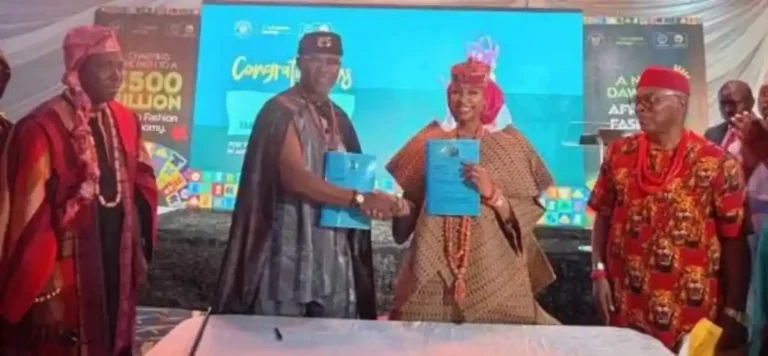
The announcement was made at an unveiling dinner and the signing of a Memorandum of Understanding (MoU) between the ministry and the foundation for the African Fashion Renaissance initiative, known as ‘Afroliganza’, held in Abuja.

The African Fashion Renaissance, also called ‘Afroliganza’, is a continental initiative aimed at uniting African nations through fashion, culture, and creative enterprise. According to the organisers, the AGFG will serve as the flagship programme of the Afroliganza initiative, bringing together national teams and global designers on one stage to showcase African creativity.

They said the event would create opportunities for competition, collaboration, and transactions that would boost Africa’s fashion economy and generate measurable trade and investment inflows into the continent through the creative sector.

Speaking during the event, Hannatu Musawa, Minister of Arts, Culture, Tourism and Creative Economy, who signed the MoU on behalf of the Federal Government, said Nigeria’s participation marked the country’s formal adoption of the Afroliganza vision.

“The African Global Fashion Games will be the first continental fashion competition and celebration of its kind,” Musawa said. “It is a convergence of innovation, heritage, and economic power as participating nations, designers, and youth innovators will compete not merely for prestige, but for the right to shape Africa’s creative identity and global image.”

She noted that through frameworks launched under Afroliganza and the Confederation of African Fashion (CAFA), Africa’s fashion sector is projected to exceed 500 billion dollars in value, with Nigeria positioned at the forefront of this transformation.

“Fashion is a universal language and Africa’s contribution to the world in fabric, colour, silhouette, and symbolism is already undeniable,” she said.

According to the minister, Africa currently exports textiles, cotton, apparel, and footwear valued at about 15.5 billion dollars annually, while imports stand at around 23.1 billion dollars. She also said global demand for African couture and textiles is growing by over 40 per cent, showing that the world is not only inspired by Africa but also ready to invest in it.

“Nigeria’s adoption of this vision signals a national commitment to place culture, fashion, heritage, and the creative economy at the heart of our engagement with Africa and the world,” Musawa said. “It aligns with our ministry’s strategic plan to expand Nigeria’s influence across the creative economy, not just within our borders, but across Africa and beyond.”

She added that Nigeria, as the first country to sign the CAFA charter, is turning its commitment into measurable action through the establishment of institutions, policies, and programmes that support fashion-driven development.

“Today we move from inspiration to ownership, from fragmented expression to formal diplomacy as fashion will now serve as a strategic instrument for building cultural ties, influencing global narratives, and asserting Africa’s creative sovereignty,” she added.

Musawa revealed that the ministry would soon establish the Nigerian Fashion Federation, a national coordinating body that will collaborate with state governments and other stakeholders to promote Nigerian fashion in line with the CAFA framework.

Dr Balogun Labode, pioneer of the African Fashion Renaissance, said the Afroliganza project aims to build a values-driven fashion economy that is rooted in African heritage, led by African institutions, and designed for global competitiveness.

He said a detailed calendar outlining activities leading up to the first AGFG in 2027 would be released soon. According to him, the African Union and other African countries are expected to back the project, with a secretariat already established in Lagos to coordinate its operations.

“All African countries that are expected to sign the charter will have their own fashion federations that will feed off the confederation of African fashion policies and protocols,” Labode explained. “The African Global Fashion Games is where you’re going to see a lot of competition as Africa comes together and connects the world. The competition will showcase the very best of African fashion and also connect us to money in the industry.”

He further disclosed that the African Global Fashion Games would be a 9-day biennial event, featuring a grand opening parade of nations, multiple runway shows, a trade fair, an industry summit, and an awards ceremony.

The event will be organised by the African Global Fashion Games Federation (AGFGF), a public-private body comprising a board, technical committees, and an advisory council.

Government officials, business leaders, entrepreneurs, fashion enthusiasts, and members of the diplomatic community were among the notable stakeholders present at the event.

FG recapitalises Bank of Agriculture with N1.5 trillion

0

The Federal Government has announced major reforms and financing initiatives to accelerate Nigeria’s journey toward food sovereignty and agricultural transformation. This includes the recapitalisation of the Bank of Agriculture (BOA) with ₦1.5 trillion and the creation of a ₦250 billion credit window to support smallholder farmers across the country.

Speaking at the 47th National Council on Agriculture and Food Security (NCAFS) in Kaduna, themed “Food Sovereignty and Food Security in an Era of Renewed Hope,” the Minister of Agriculture and Food Security, Abubakar Kyari, said the new financing plan marks “a decisive step in repositioning agricultural finance as the anchor of national food production.”

Kyari emphasized the government’s commitment to modernizing agriculture, noting that “Mr. President’s charge remains clear: our farmers must transition from hoes and cutlasses to tractors and harvesters. Food sufficiency is the first currency of national stability,” quoting President Bola Ahmed Tinubu.

The Minister explained that the government’s intervention agenda, which includes input delivery, mechanisation, post-harvest management, and market access, aligns with Nigeria Vision 2050, the National Development Plan (2021–2025), and the National Agricultural Technology and Innovation Policy (NATIP).

He revealed that the National Agricultural Growth Scheme-Agro-Pocket (NAGS-AP), supported by the African Development Bank, is expanding nationwide. According to Kyari, wheat production has increased from 15 states in 2023/24 to more states in the 2024/25 farming season, supported by progress in rainfed wheat cultivation in Plateau, Taraba, and Cross River states. “This innovation brings Nigeria closer to meeting national demand from within,” he said.

Addressing post-harvest losses estimated at $10 billion annually, the Minister disclosed the launch of the Nigeria Postharvest Systems Transformation Programme (NiPHaST) in partnership with the Alliance for a Green Revolution in Africa (AGRA). The programme focuses 85 percent of its interventions on smallholders through affordable storage technologies, 10 percent on cooperative-level processing hubs, and 5 percent on upgrading national silos through public-private partnerships.

Kyari also announced that the Bank of Agriculture, in collaboration with Heifer Nigeria, will implement the Renewed Hope National Agricultural Mechanisation Programme. The initiative will provide access to tractors, maintenance services, and training through six zonal mechanisation hubs to enhance productivity and youth engagement in agriculture.

In addition, the National Agricultural Development Fund (NADF) has been activated to expand investment in agricultural value chains, rural infrastructure, and agribusiness ventures to ensure long-term growth.

Minister of State for Agriculture and Food Security, Aliyu Sabi Abdullahi, stated that climate-smart agriculture is now central to Nigeria’s production strategy. “We are developing climate-resilient crops, integrated soil-crop systems and pest management strategies,” he said.

Abdullahi highlighted key initiatives such as the Dry Season Initiative covering 500,000 hectares, the “Every Home a Garden” campaign championed by First Lady Oluremi Tinubu, the Nigerian Farmers’ Soil Health Scheme, and the Renewed Hope Cooperative Reform and Revamp Programme. He said these programmes aim to improve inclusion, financing, and productivity, ultimately reducing food imports. “Our goal is simple—no Nigerian should go to bed hungry,” Abdullahi added.

Earlier, Marcus Ogunbiyi, Permanent Secretary of the ministry, described the Council as Nigeria’s foremost policy forum for agricultural coordination. He explained that food sovereignty “goes beyond availability; it is about our collective capacity to produce, process and distribute food sustainably.” Ogunbiyi emphasized the need for a resilient food system that empowers rural communities and sustains livelihoods.

The 47th NCAFS brought together federal and state government officials, development partners, and agribusiness stakeholders to create a unified framework for achieving agricultural self-sufficiency and ensuring food security nationwide.

FG releases N250bn fund to support farmers, cut food prices

0

The Federal Government has announced a N250 billion financing window for smallholder farmers across the country to enhance food production and reduce the cost of food commodities. The new fund, according to the government, is in addition to the N1.5 trillion recapitalisation of the Bank of Agriculture (BOA).

Minister of Agriculture and Food Security, Abubakar Kyari, disclosed this during the opening of the 47th National Council on Agriculture and Food Security in Kaduna State. He stated that the drop in food prices witnessed in recent months is a result of the government’s continuous investments and interventions in agricultural production, processing, and post-harvest systems.

Kyari explained that President Bola Tinubu’s administration remains focused on achieving food sovereignty by ensuring that Nigeria produces what it consumes while maintaining affordability and access for all households.

He said: “As we continue along this path, we are already beginning to witness a decline in food prices across several commodities, a reflection of ongoing targeted market interventions. While we are not yet where we want to be, this positive trend confirms that we are moving in the right direction.”

Highlighting the government’s efforts, the minister mentioned that the National Agricultural Growth Scheme-Agro-Pocket (NAGS-AP), supported by the African Development Bank (AfDB) and state governments, has significantly improved farmers’ access to quality agro-inputs. He added that the initiative has led to increased wheat production in both irrigated and newly introduced rainfed farming zones in states such as Plateau, Taraba, and Cross River.

Kyari further revealed that operations at the national strategic grain reserves in Zamfara, Katsina, Nasarawa, Adamawa, Niger, Osun, Edo, and Kwara States have been scaled up to stabilise supply and cushion market shortages.

He said: “To strengthen national food security and stabilise prices, we are enhancing efficiency across national silo operations to ensure timely interventions.”

The minister also noted that the government, in partnership with Heifer Nigeria, has launched a national agricultural mechanisation programme to support youth- and women-led mechanisation service centres in all six geopolitical zones.

“Mechanisation will become a national service that modernises production, raises yields, and creates sustainable rural employment,” he added.

Minister of State for Agriculture and Food Security, Sabi Abdullahi, emphasised the need for climate-smart agriculture to sustain productivity. “We must adopt climate-smart practices that increase crop yields while building resilience and investment in drought-tolerant crop varieties, integrated pest management, and the Nigerian Farmers’ Soil Health Scheme, which tailors fertiliser use to specific soil conditions,” he said.