Home Blog Page 332

Minister calls for innovative ideas to end Nigeria’s dairy importation

0

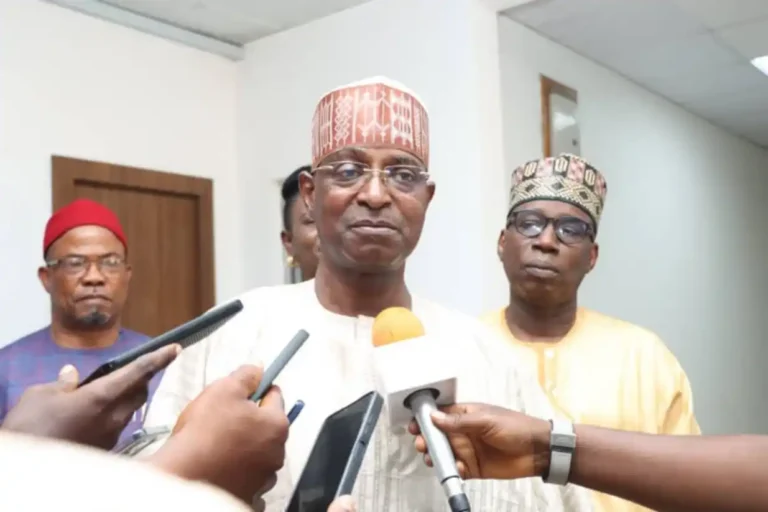
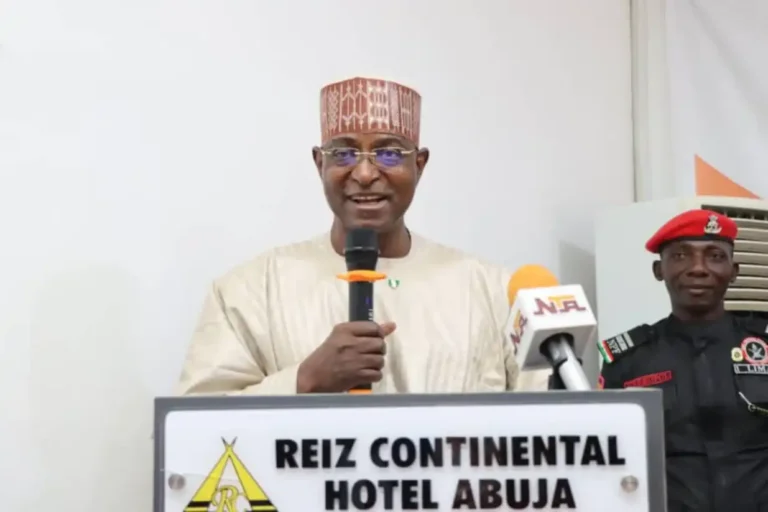
The Minister of Livestock Development, Idi Mukhtar Maiha, has urged all stakeholders in Nigeria’s dairy industry to develop innovative ideas that will end the country’s heavy dependence on dairy importation. He made this call during his keynote address at the National Dairy Policy Implementation Framework Validation Workshop held in Abuja on Tuesday, November 4th, 2025. The event was organised by the Ministry in collaboration with the Federal Ministry of Industry, Trade and Investment, Sahel Consulting Agriculture and Nutrition, and other relevant stakeholders.

Maiha encouraged participants to thoroughly examine the draft implementation framework, identify key obstacles, and propose practical solutions that will help Nigeria achieve self-sufficiency in dairy production. According to him, “Let us scrutinise the draft implementation framework, identify bottlenecks, and propose innovative solutions that will accelerate our journey to self-sufficiency. Let us leave this workshop with a clear, actionable roadmap that will ensure that within the shortest possible time, the milk consumed in every Nigerian home is proudly our own and sustainably sourced from our farms.”

The Minister further explained that the 1.5 billion US dollars Nigeria currently spends annually on dairy imports should be viewed as an opportunity for investment in the nation’s economic future. He stated that overcoming this challenge would unlock new economic growth, improve livelihoods, and build national resilience. “It is a challenge that, when overcome, will unlock unprecedented economic growth, improve the livelihoods of millions of Nigerians, and strengthen our national resilience,” he added.

In his goodwill message, the Minister of State for Industry, Trade and Investment, Senator John Owan Enoh, highlighted the importance of collaboration between government agencies, private sector players, farmers, academia, and development partners. He emphasized that such cooperation can unlock huge opportunities within the dairy value chain, create jobs, empower rural communities, and reduce import dependency.

Delivering her welcome address, the Permanent Secretary of the Federal Ministry of Livestock Development, Dr. Chinyere Ijeoma Akujobi, pointed out that the Nigerian dairy sector has faced long-standing issues such as low milk yield, poor breed quality, weak market linkages, and limited access to finance and modern technologies for smallholder farmers. Represented by the Director, Ruminants and Monogastric Division, Mr. Victor Egbon, she said Nigeria has the livestock population, human capacity, and determination to turn these challenges into opportunities. “What we have often lacked is a unified and results-driven approach to bring all stakeholders under one coordinated direction,” she stated.

Stakeholders at the event included representatives from Sahel Consulting Agriculture and Nutrition, CODARAN, GIZ, and other development partners.
Advertisement

Nigerian Army SSC 49/2026 application closes in one week

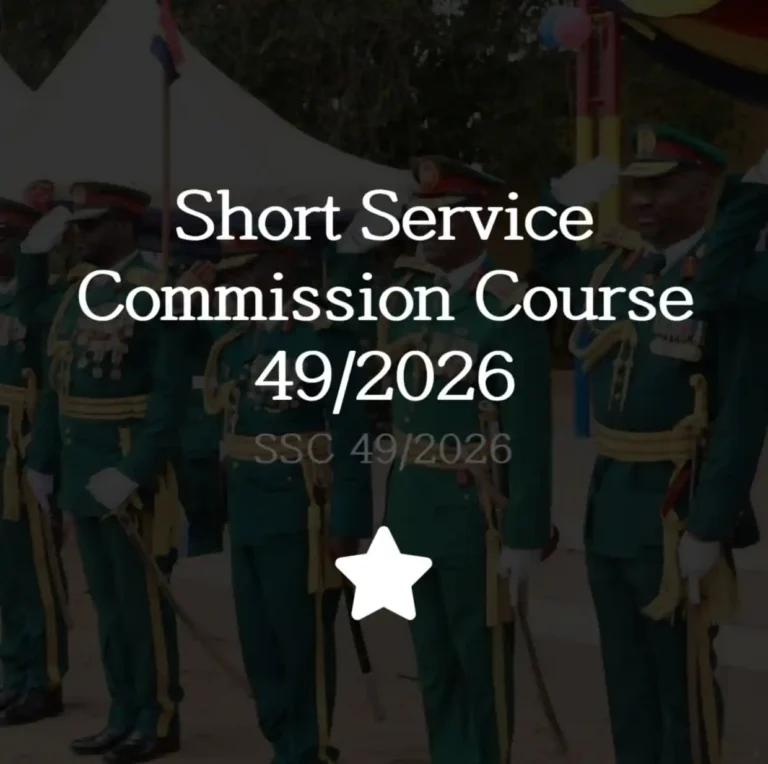
The Nigerian Army has announced that applications for the Short Service Combatant Course 49/2026 will close in one week, with the deadline fixed for midnight on Wednesday, 12 November. The online application portal, which opened on 9 October, has already attracted tens of thousands of entries. According to Colonel Aminu Bello, Acting Director of Army Public Relations, the number of valid submissions is expected to surpass last year’s figure of 48,000.

The Short Service Combatant Course offers a direct pathway for civilians to join the military through an intensive 44-week training programme held at the Nigerian Defence Academy in Jaji, Kaduna State. Successful candidates will be commissioned as lieutenants upon completion of the course, which runs for nine years with an option for a three-year extension.

Applicants are required to be Nigerian citizens aged between 22 and 28 years, possess a minimum of a bachelor’s degree with at least a second-class lower division, and meet the height standards of 1.68 metres for men and 1.65 metres for women. The army also emphasised that medical fitness and a clean police record are mandatory for all applicants.

Colonel Bello said the Nigerian Army is targeting the recruitment of 3,800 new officers under this cycle, an increase of 400 compared to the previous intake. He explained that the expansion aligns with ongoing operational needs in the northeast and northwest, where troops are actively engaged in counterterrorism and anti-banditry operations.

The recruitment exercise has been updated to promote inclusivity and fair representation. New policies introduced in 2022 reserve 15 percent of available slots for women and guarantee at least one candidate from every senatorial district in the country. “The policy ensures balance in regional participation and promotes diversity in the Nigerian Army,” Colonel Bello said.

The application portal experienced a temporary technical disruption on 3 November due to heavy user traffic but was restored within 12 hours. Since then, the platform has remained stable.

Screening of applicants is scheduled to begin on 24 November at 14 centres across Nigeria. The process will involve document verification, physical fitness assessments, and medical examinations. Candidates have been advised to print their acknowledgement slips from the recruitment website, as these serve as their examination invitations.

Colonel Bello reminded applicants to submit their forms before the deadline, noting that “there will be no extensions beyond 12 November.” He added that the server clock on the recruitment portal would determine the official closing time. The army reiterated that the recruitment process is free and transparent. Applicants are warned against paying intermediaries or unauthorised persons. All enquiries can be directed to the army’s official lines, 0817 926 9294 and 0810 995 9294, between 8 am and 6 pm daily.

Ondo disburses N350m bursary to 11,358 indigenous students

0

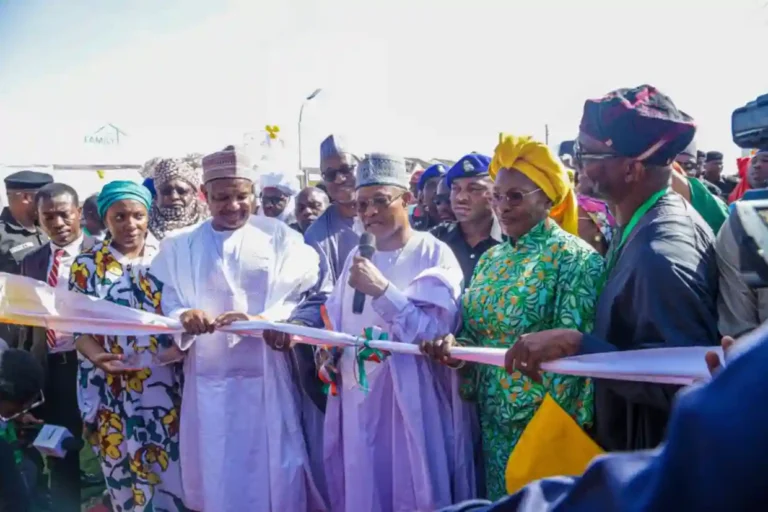
Ondo State Governor, Lucky Aiyedatiwa, has begun the disbursement of over three hundred and fifty million naira to indigenous students in tertiary institutions across Nigeria to ease the financial burden on students and their sponsors.

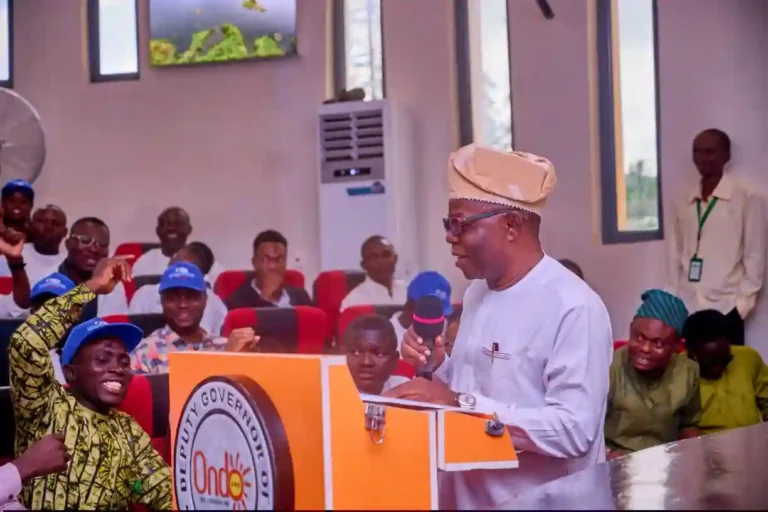
The initiative was officially launched on Tuesday in Akure, where Governor Aiyedatiwa described the scheme as a major step toward revitalizing education and motivating students to pursue academic excellence. Represented by his deputy, Olayide Adelami, the governor said his administration remains committed to educational advancement and human capital development in the state.

According to him, “The year 2025 has been a remarkable chapter in our educational journey, as our interventions have continued to transform lives, institutions and communities across Ondo State. In this sector alone, our administration has recorded significant strides through various programmes and projects.”

He added that the bursary, scholarship, and financial assistance programme, which will benefit 11,358 students, demonstrates his government’s deep concern for the welfare of students. “We recognise the challenges that many of our students face and through this initiative, we are determined to ensure that no child of Ondo State is denied education due to financial hardship. This is also an intentional policy of our administration in helping to minimise the financial burden of parents towards their children in various tertiary institutions,” the governor said.

He encouraged students to remain disciplined, honest, and hardworking while reaffirming his administration’s commitment to building a strong education system that empowers and supports every student.

Administrative Secretary of the State Scholarship Board, Funso Omoniyi, explained that the scheme is divided into five categories, including scholarship awards for outstanding students, financial assistance to law students in the Nigerian Law School, support for medical students undergoing clinical studies, and financial aid for physically challenged students.

Also speaking at the event, the Commissioner for Education, Science and Technology, Professor Igbekele Ajibefun, revealed that the state government has approved and released funds for several educational interventions, including the payment of WASSCE registration fees.

The National President of the National Association of Ondo State Students (NAOSS), Temitope Alade, expressed appreciation to the governor for his commitment to students’ welfare and advised students to maintain good conduct in their institutions.

Dignitaries present at the event included the Secretary to the State Government, Dr. Taiwo Fasoranti; Ondo State APC Chairman, Engr. Ade Adetimehin; Head of Service, Mr. Bayo Philip; Commissioner for Women Affairs and Social Development, Dr. Seun Osemaye; and Special Adviser on Health, Prof. Simidele Odimayo.

FG commissions 100 solar-powered homes for widows in Kaduna

The Federal Government, through the Family Homes Funds Limited (FHFL), has commissioned 100 energy-efficient two-bedroom homes with urban farming spaces in Rigachikun, Kaduna State. The project, executed under the FHFL Social Housing Programme, is specifically designed to support 100 widows who took the initiative to pool their land together and approach the government for assistance in building social housing.

A key feature of the project is its origin story, which highlights the determination and unity of the widows who partnered with FHFL to make the housing development a reality. Their collective effort has now resulted in sustainable homes, livelihood support, and a replicable model for inclusive community development.

“These homes represent far more than physical structures. They symbolize renewed hope and restored dignity, particularly for the 100 resilient women empowered through this initiative,” said Ademola Adebise, Chairman of Family Homes Funds Limited.

According to Adebise, FHFL has showcased a new model of social housing delivery in Nigeria that merges home ownership with skills training, livelihood support, and climate-smart construction. “This is not charity. It is an investment in strong women who will raise strong families and strong communities,” he added.

Each of the 100 homes was constructed using Expanded Polystyrene System (EPS) technology, which cuts costs and carbon emissions by up to 40% while ensuring durability and energy efficiency. The homes are also equipped with solar power systems to provide reliable electricity. Beneficiaries received livelihood training and access to cottage yards for food production and processing, aimed at boosting food security and income diversification.

Managing Director and Chief Executive Officer of FHFL, Abdulmuttalib Mukhtar, said the Rigachikun project demonstrates how inclusive collaboration can lead to real impact. “This project stands as clear evidence that when citizens take initiative and government responds with support, transformation happens. These 100 homes are not just walls and roofs, they are symbols of partnership, perseverance, and purpose,” Mukhtar stated.

Minister of Budget and Economic Planning, Senator Abubakar Atiku Bagudu, linked the initiative to President Bola Ahmed Tinubu’s Renewed Hope Agenda. He emphasized that growth must be inclusive and prosperity must reach every household. “Through initiatives like this amongst others, we are ensuring that government spending translates into tangible outcomes, roofs over heads, jobs for our women and youth, and dignity for our people,” Bagudu said.

Governor of Kaduna State, Senator Uba Sani, commended the project as a milestone in people-centred governance. “Our administration is proud to host this first-of-its-kind energy-efficient social housing project for widows. It reflects Kaduna State’s commitment to inclusive growth and innovation, and to ensuring that the most vulnerable are not left behind,” the Governor stated.

Other partners in the initiative include the National Agency for Science and Engineering Infrastructure (NASENI) and the Kaduna State Government. With over 500 jobs created during construction and 100 new families rehoused, the project stands as a strong example of the Renewed Hope Agenda turning policy into progress and progress into opportunity.

Ministry of Livestock, NADF partner on digital livestock system

0

The Federal Ministry of Livestock Development has announced plans to partner with the National Agricultural Development Fund (NADF) to build a digital public infrastructure that will transform Nigeria’s livestock industry. The Honourable Minister of Livestock Development, Idi Mukhtar Maiha, made this known when he received a delegation from the NADF at the Ministry’s headquarters in Abuja on Tuesday, November 4, 2025.

Maiha explained that the collaboration aims to create a strong digital platform that will enhance visibility and growth within the livestock sector, both locally and internationally. “We need to develop this infrastructure and put it in the public domain so that our customers, local, regional, and international will know who we are,” he said.

The Minister stated that the initiative will serve as a central hub for the livestock value chain, providing information about major stakeholders, ongoing programmes, compliance standards, and operational guidelines. He added that the project will also promote livestock investment opportunities and improve sectoral data management.

“We don’t have to reinvent the wheel. It’s no longer about moving around with sticks and animals; we have over 815 livestock markets across the country that need to be digitally mapped,” Maiha noted.

He emphasized that the Ministry is committed to digital transformation, ensuring that citizens can easily access accurate information about the livestock sector online. Maiha further mentioned that the partnership would also focus on developing a customized livestock transportation system and building capacity for women and youth engaged in livestock production.

In his remarks, the Executive Secretary of the National Agricultural Development Fund, Mohammed A. Ibrahim, reaffirmed the Fund’s readiness to support the initiative. “We are here to brainstorm and identify ways our agency can partner with the Ministry to achieve its goals. Digitisation within the agricultural sector is critical in today’s world, and we are ready to support this initiative,” Ibrahim said.

NJFP 2.0 sends rejection emails to unsuccessful applicants

0

Nigeria Jubilee Fellows Programme (NJFP) 2.0 has sent emails to some applicants informing them that their applications were not successful.

Applicants receiving this email were already at the stage where they expected to get their CBT date.

The email reads,

“Hello,

Dear candidate, after review, your NJFP application was not successful this round. We encourage you to reapply in the next cohort. Warm regards, NJFP Team.”

Those who received this email have likely failed to meet the programme’s requirements. To be eligible for the Nigeria Jubilee Fellows Programme, applicants must be Nigerians aged 30 years or younger and must have graduated not earlier than 2022 with a Bachelor’s Degree or Higher National Diploma (HND) in any discipline. Degree holders must have at least a Second-Class Lower (2.2), while HND holders are required to have a minimum of Upper Credit (3.00). Applicants must also have completed the National Youth Service Corps (NYSC) or possess an exemption certificate.

There is no need to create another email and apply again because applicants will still be using the same NIN and other documents, which means their applications will be rejected again.

Those who received this message are not qualified for NJFP 2.0 and must wait for the next cohort to try again.

Attached below is screenshot proof.

Ejigbo Council launches N150m mega empowerment initiative

0

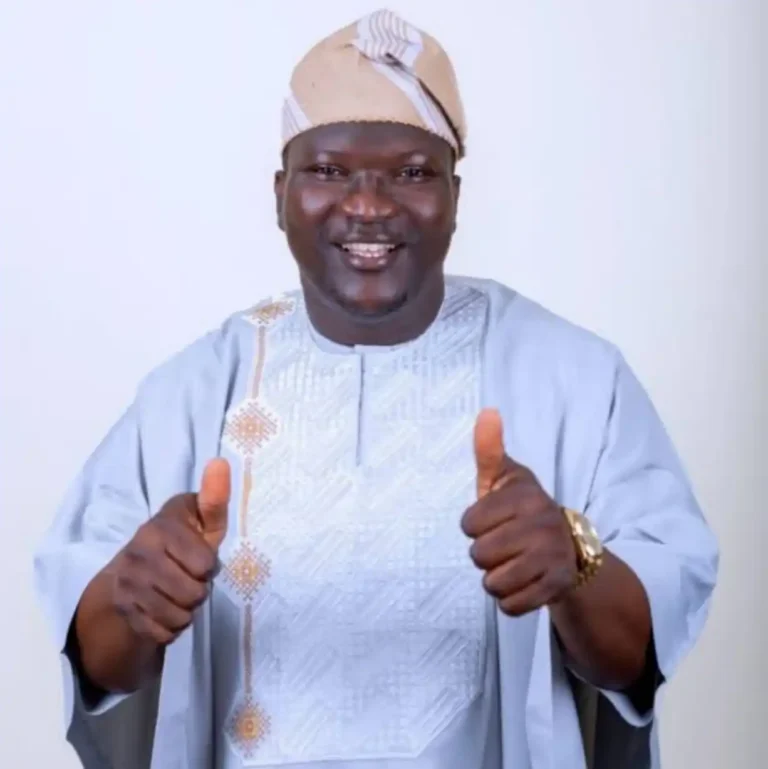
The Chairman of Ejigbo Local Council Development Area, Aare Taoheed Adebayo Taiwo (TAT), has officially launched the Mega Empowerment Initiative, a large-scale economic intervention aimed at supporting small businesses, uplifting vulnerable groups, and driving grassroots prosperity across the six political wards in the council.

Taiwo described the programme as “a defining chapter in our journey toward sustainable development, economic liberation, and inclusive governance,” assuring that no resident would be left behind in the pursuit of economic independence.

Under the empowerment scheme, 100 beneficiaries received N200,000 each in direct business support, while 10 young entrepreneurs between the ages of 18 and 30 were given N500,000 each through the Ejigbo Youth Startup Fund to establish innovative enterprises. The initiative also features mentorship and partnership opportunities facilitated by private-sector investors and business leaders to promote sustainable enterprise growth.

In addition, over 400 residents benefited from enterprise support, business tools, and capacity-building opportunities. More than 300 beneficiaries received items such as deep freezers, pepper grinding machines, vulcanising machines, hair dryers, ovens, sewing machines, POS terminals with startup funds, barbing clippers with generators, popcorn machines, cobbler machines, Nikon cameras, shawarma and grilling equipment, and other trade-support materials to enhance their productivity.

Taiwo explained that the initiative aligns with the economic development policy under his administration’s S.H.I.E.L.D Agenda, which focuses on creating jobs, supporting entrepreneurship, and fostering inclusive growth. He stated that beneficiaries were selected based on need, business capacity, and readiness to contribute to the economic growth of the community, noting that the goal is to “build a self-reliant and productive citizenry.”

The council chairman commended the leadership of President Bola Ahmed Tinubu, noting that the Renewed Hope and Idera Oluwa de Agenda have continued to inspire meaningful development at the grassroots level. He said the council’s programmes are designed to align with federal policies to ensure that national priorities are effectively implemented locally through people-centered initiatives.

All Progressives Congress (APC) Lagos State Chairman, Pastor Cornelius Ojelabi, also commended Taiwo for what he described as a “bold and people-oriented stride that reflects the true spirit of progressive governance.”

Ojelabi added that the Ejigbo Mega Empowerment Initiative demonstrates “responsible leadership at the grassroots,” emphasizing that Taiwo has translated the Renewed Hope philosophy into visible action through empowerment, infrastructural renewal, and social intervention programmes that directly impact residents.

He further stated that the President’s decision to increase council allocations has strengthened local governments, enabling them to deliver more visible development. Ojelabi noted that the Ejigbo empowerment programme is a direct example of how government funds are being utilized for the benefit of the people.

He urged beneficiaries to make good use of the equipment and funds provided, advising them not to sell the items. He warned that selling them would undermine the purpose of the initiative and make government efforts to promote economic independence ineffective.

FG invests N12bn in digital economy research, literacy programs

The Federal Government of Nigeria has announced plans to invest N12 billion in digital economy research projects, aiming to harness the benefits of digital transformation. The announcement was made during the opening ceremony of the 18th edition of the International Conference on Theory and Practices of Electronic Governance (ICEGOV), held in Abuja.

Dr. Bosun Tijani, the Minister of Communications and Digital Economy, made the statement at the four-day conference, which focused on the theme “Shaping the Future of Digital Governance Through Cooperation, Innovation, and Inclusion.” The event was organized by the National Information Technology Development Agency (NITDA).

During his address, Dr. Tijani emphasized the importance of conferences like ICEGOV in offering opportunities for countries to research emerging technologies while balancing them with policies that affect societies. He noted that Nigeria’s participation in ICEGOV 2024 highlighted the country’s growing commitment to the digital economy and assured the global community that the government’s efforts would continue to bear fruit.

“The Nigerian government is not just doing this as a show because immediately after ICEGOV last year, we funded over 55 research projects. At the minute, we are putting together about N12 billion to fund further research projects that are focused on the digital economy,” Tijani said.

He further explained that three research clusters would be established across six universities, focusing on critical areas of the digital economy. One cluster will focus on artificial intelligence, another on the pressing issue of connectivity in Nigeria, and the third on digital skills and literacy, especially considering the country’s large population.

Dr. Tijani stressed that digital technologies have become the backbone of modern societies. “Digital technologies are now the core of human activities,” he said. “Without them, societies remain underdeveloped. It’s important that these technologies are no longer just seen as economic tools, but as tools to reshape and govern society as well.”

Ms. Elsa Estevez, Chair of the ICEGOV Steering Committee, also addressed the theme of the conference, particularly the challenges posed by artificial intelligence and digital transformation. She highlighted the need for international cooperation to navigate the risks and benefits of these technologies.

“In the past years, we were profoundly affected by digitally driven innovations, and we often adapt them without much reflection,” Estevez noted. “Such innovations dramatically change the way we interact socially, work, and build our capacities. We need to ensure that innovations are not just technological, but human-centered and contribute to better societies.”

She also emphasized the importance of securing the public digital space. “For inclusion, governments and states need to listen and moderate discussions about public affairs, shape political agendas to respond to uncovered needs, and secure the digital space from fake speech, fake news, and political manipulation. Securing the public digital space requires regulation, education, and awareness, all based on sound information ethics.”

Malam Kashifu Inuwa, Director-General of NITDA, spoke about the government’s plans to integrate digital literacy into school curricula by 2026. He explained that the rapidly growing youthful population in Nigeria required tailored initiatives to ensure they keep pace with the country’s technological advancements.

“In Africa, we have a very young population. Our citizens are digitally native, and they are all online. Therefore, governments need to meet them where they are,” Inuwa said. “We have so many initiatives in Nigeria, including the digital literacy framework, where we are working on integrating digital literacy into our formal education system.”

Inuwa confirmed that, in collaboration with the Ministry of Education, the government has already received approval to integrate digital literacy and skills into Nigeria’s formal education system starting next year. Additionally, he revealed that measures were being put in place to ensure that public servants become digitally literate to improve service delivery in the public sector.

Nigeria seeks IMF support for fuel price modulation, fiscal stability

0

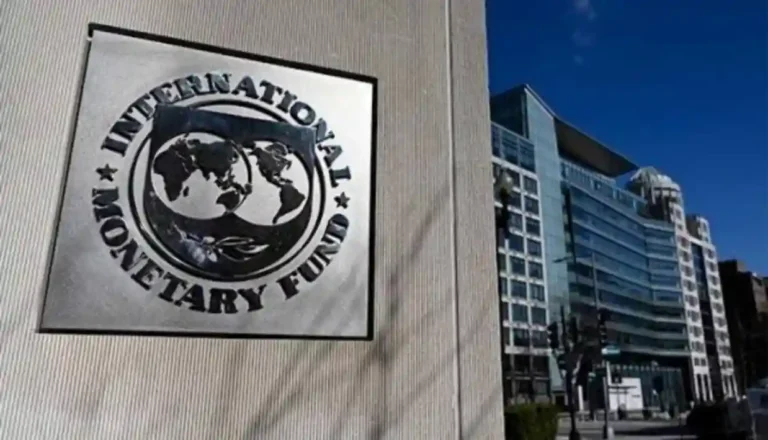
The Federal Government of Nigeria has requested technical support from the International Monetary Fund (IMF) to help create a transparent fuel price modulation framework. This new framework is intended to cushion domestic price shocks and bolster the country’s fiscal stability.

Dr. Emeka Vitalis Obi, the Permanent Secretary of the Ministry of Petroleum Resources, made this announcement in Abuja during a joint engagement with the Ministry and its regulatory bodies. The session included officials from the Nigerian Upstream Petroleum Regulatory Commission (NUPRC), the Nigerian Midstream and Downstream Petroleum Regulatory Authority (NMDPRA), and the IMF’s Fiscal Affairs Department (FAD) Technical Assistance Mission on Climate Policy.

Dr. Obi explained that the collaboration with the IMF is part of Nigeria’s ongoing efforts to strengthen its fiscal system and safeguard the country from the impacts of global energy market fluctuations. He stated, “The Federal Government is seeking the continued technical support of the IMF’s Fiscal Affairs Department in designing a transparent and resilient price modulation mechanism that will help cushion domestic price shocks, insulate markets from extreme global volatility, and preserve fiscal discipline.”

The Permanent Secretary emphasized that this initiative is crucial for maintaining economic discipline, especially in the aftermath of the COVID-19 pandemic. The IMF mission is seen as timely and strategic, aligning with government efforts to manage fiscal pressures linked to climate change and continue energy sector reforms.

Dr. Obi also reaffirmed that the removal of the general fuel subsidy was a necessary measure to restore fiscal stability. This policy shift will allow the government to redirect public spending toward critical areas such as infrastructure, social welfare, and sustainable energy development.

On Nigeria’s environmental initiatives, Dr. Obi highlighted the Nigeria Gas Flare Commercialisation Programme (NGFCP) and emerging carbon-credit frameworks. These efforts aim to eliminate routine gas flaring, reduce methane emissions, and promote the use of gas in power generation, fertilizer production, and Compressed Natural Gas (CNG) markets. “These initiatives align with Nigeria’s Nationally Determined Contributions (NDCs) under the Paris Agreement and global ESG standards,” he added.

He called for continued IMF partnership, both technical and financial, to enhance fiscal analysis, climate policy modeling, and carbon pricing strategies.

Mr. Diego Mesa, leader of the IMF Technical Team, praised the Ministry for providing a comprehensive overview of Nigeria’s energy and fiscal landscape. He noted that the mission would focus on fiscal reforms, sustainable development, and climate policy, with particular attention to fossil fuel and carbon taxation.

Officials from NUPRC and NMDPRA reiterated their commitment to eliminating gas flaring, refining tariff frameworks, and ensuring a balance between investor returns and consumer protection.

Lagos Water Corporation sends interview SMS to shortlisted applicants

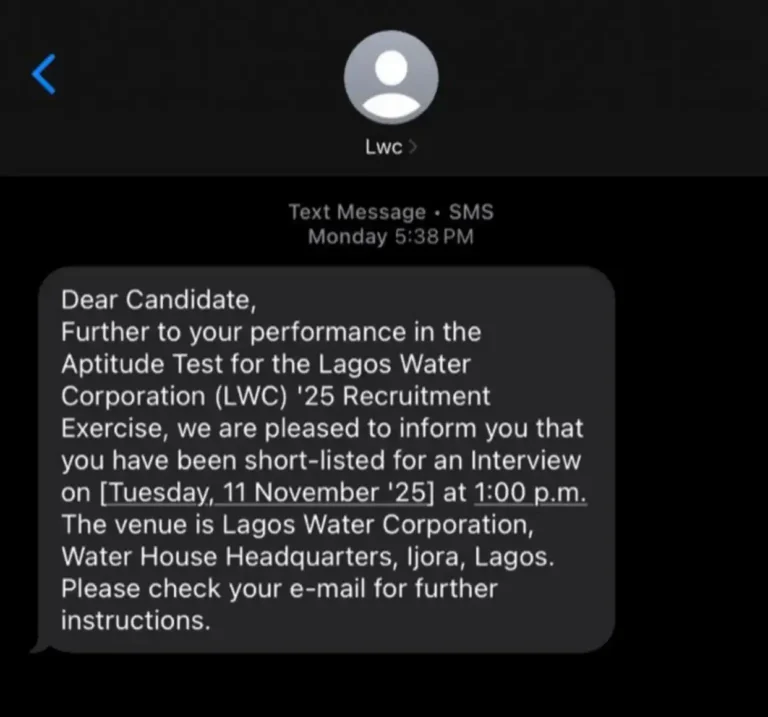
The Lagos Water Corporation (LWC) has sent SMS text messages to shortlisted applicants notifying them of the interview date and venue for the 2025 recruitment exercise. Candidates are also advised to check their email for further instructions.

The message reads, “Dear Candidate,

Further to your performance in the Aptitude Test for the Lagos Water Corporation (LWC) ’25 Recruitment Exercise, we are pleased to inform you that you have been short-listed for an Interview on [Tuesday, 11 November ’25] at 1:00 p.m. The venue is Lagos Water Corporation, Water House Headquarters, Ijora, Lagos.”

Shortlisted candidates are urged to confirm their details promptly.