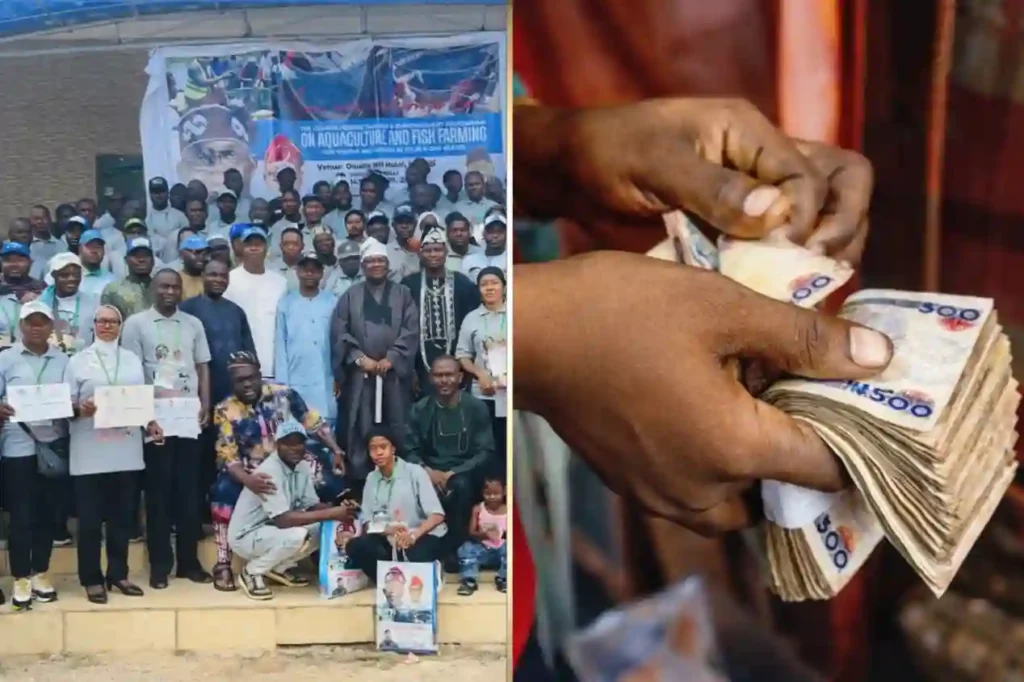
No fewer than 100 young people in Osun State have received hands-on training in fisheries alongside a combined ₦7.5 million in business grants, in a targeted intervention aimed at driving youth-led enterprise and job creation across the state.
 Follow us on Google News
The initiative, spearheaded by Femi Oyetola, son of the Minister of Marine and Blue Economy, Adegboyega Oyetola, drew participants from all 30 local government areas and the Modakeke Area Office. Beneficiaries underwent an intensive three-day aquaculture training in Iragbiji, designed to equip them with practical skills in fish farming, value chain development, and small business management.
Focus shifts to sustainable empowerment
Speaking during the programme, Oyetola said the intervention marks a shift from short-term support schemes to long-term economic empowerment for young people.
Represented by former Senior Special Assistant on Students’ Affairs and Social Mobilisation, Kehinde Ayantunji, he explained that previous outreach efforts had largely centred on relief distribution. However, the current model prioritises capacity building and access to startup capital.
According to him, the goal is to enable beneficiaries to establish viable businesses capable of generating income and creating additional employment within their communities.
“This initiative is about equipping young people with practical skills and financial backing to build sustainable ventures,” he said. “When youths are empowered productively, they become contributors to economic growth rather than dependents.”
Alignment with national economic agenda
Oyetola noted that the programme aligns with the policy direction of President Bola Ahmed Tinubu under the Renewed Hope Agenda, which places emphasis on inclusive growth, job creation, and grassroots development.
He stressed that empowering young Nigerians at the community level remains critical to addressing unemployment and stimulating local economies, particularly in sectors such as aquaculture where entry barriers are relatively low but growth potential is significant.
The initiative also reflects a broader recognition of fisheries and aquaculture as underutilised sectors capable of supporting food security, reducing import dependence, and expanding Nigeria’s non-oil economy.
Traditional leaders back initiative
Traditional rulers present at the event commended the programme, describing it as a practical response to rising youth unemployment and social challenges.
The Olororuwo of Ororuwo, Oba Kamorudeen Adeyanju, said targeted empowerment initiatives can help curb social vices by engaging young people in productive activities.
He noted that unemployment and idleness remain key drivers of insecurity and anti-social behaviour, adding that structured interventions like skills training and access to finance provide a sustainable pathway out of poverty.
Similarly, the Aragbiji of Iragbiji, Oba Abdulrasheed Olabomi, represented by his Olupona, Saheed Adeleke, urged beneficiaries to maximise the opportunity by applying the knowledge gained and investing the grants into viable ventures.
Opportunity for scale in agriculture
The programme underscores growing calls for more structured youth-focused investments in agriculture and fisheries, sectors widely seen as critical to Nigeria’s economic diversification.
With rising demand for fish and protein sources, aquaculture presents a scalable opportunity for young entrepreneurs, particularly when supported with technical training and seed funding.
For the beneficiaries, the combination of skills acquisition and financial support provides a foundation to launch small-scale enterprises, expand production, and potentially employ others—amplifying the impact beyond individual participants.
Stakeholders say sustaining such interventions and scaling them across states could play a significant role in reducing unemployment, strengthening food systems, and unlocking new economic opportunities for Nigeria’s growing youth population.