Home Blog Page 218

FG to Engage 5 Million Small-Holder Farmers in Agro 2.0 Scheme

0

The Federal Government has announced plans to engage five million small-holder farmers in the next phase of the Agro 2.0 scheme.

The Head of Strategy and Planning, National Agricultural Development Fund (NADF), Adebanke Fajana, disclosed this during the NADF-Farm Input Supply Programme roundtable engagement with processors held in Lagos.

Fajana said the NADF is working with the organised private sector, particularly processors, to reach small-holder farmers across the country. She explained that the collaboration aims to address challenges and lessons identified during the pilot phase of the initiative.

According to her, “We have a very robust system of monitoring and evaluation, where we have regional monitors, we have state monitors, which have been put on ground to go into the field to look at what the cultivation level is, what the input usage is, adoption of good agronomic practices, and a lot of other things to ensure that not only do we just dispense or make provisions for this input. We also ensure proper input utilization and good agronomic practices adoption for the end-users.”

Fajana noted that NADF is ensuring that the scheme’s implementation in its second phase is coordinated for greater efficiency and improved outcomes.

Also speaking, NADF Executive Secretary, Mohammed Ibrahim, assured farmers that the intervention on the supply of inputs would boost crop harvest and productivity.

Ibrahim, who was represented by the NADF Head of Corporate Services, Abiodun Sosanya, said the Fund is committed to strengthening Nigeria’s agricultural input supply system.

“As we reflect on the implementation of the first phase of this programme, the NADF remains firmly committed to evidence-based learning and continuous process improvement for optimal efficiency in the delivery of our mandate,” he said.

Ibrahim acknowledged that the pilot phase of the intervention encountered several challenges that affected planting cycles and yields. He said, “These challenges are real, and they underscore the complexity of implementing agricultural interventions such as the NADF-Farm Inputs Supply program.”

Despite those challenges, Ibrahim reaffirmed NADF’s commitment to work closely with processors to ensure accountability and continuous improvement in all interventions. He called on processors to actively engage with the Fund to achieve practical outcomes that will strengthen input systems, enhance agricultural productivity, and support national transformation goals.

“The NADF remains optimistic that your insights, experiences, and recommendations will play an important role in shaping a more efficient, transparent, and climate-responsive second phase of the program – ensuring better impact and sustainability,” he added.

The Chief Executive Officer of Vemac Farms Limited, Oyo State, Femi Ojelade, stressed the importance of collaboration among processors, smallholder farmers, and the government to improve food security in Nigeria.

He urged NADF to make sure processors receive inputs early enough before the farming season. “We understand it’s the first phase. But the second phase; they have to work assiduously to make sure that most processors actually get their input at least a month before the planting season,” Ojelade said.

Also, the Managing Director of Arog Bio Allied Agro Services Limited, Aroge Temitope, described the Agro 2.0 scheme as a major step toward strengthening the agricultural value chain.

He said, “So, for us, it’s a good project and it’s actually very supportive of food security and wealth creation in the rural areas.”

Temitope noted that the project came at a crucial time and has already helped his company access necessary inputs and support for its outgrower base. He said his company was able to cultivate for the 2025 and 2026 farming seasons by leveraging the NADF Agro 1.0 programme to secure enough cassava across three states – Ogun, Ondo, and Ekiti.

Advertisement

FG Backs Ranching After Inspecting Manchong Integrated Farms

0

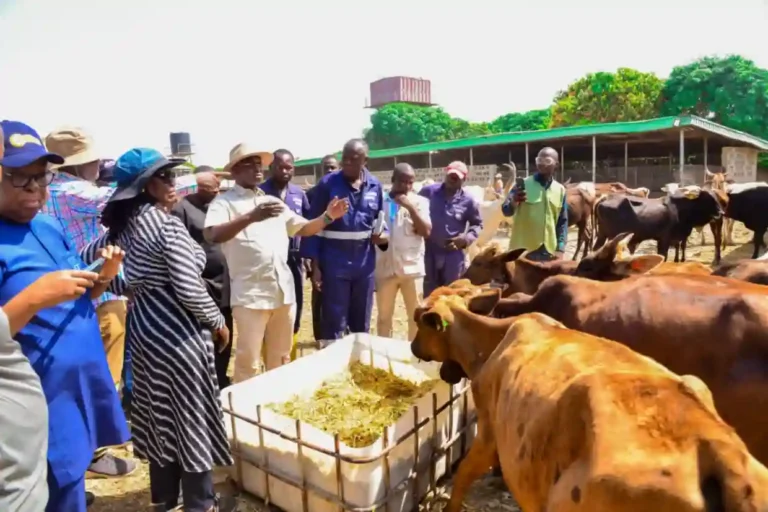
The federal government, through the Honourable Minister of Livestock Development, Idi Mukhtar Maiha, has described ranching as a viable, scalable, and already existing component of Nigeria’s livestock ecosystem, following an inspection tour of Manchong Integrated Farms Limited in Nasarawa State.

The Minister led a delegation to the farm on Thursday, 19 December 2025, and spoke after touring the expansive facility. He expressed satisfaction with what he called a practical demonstration of modern livestock production, feed and fodder development, and genetic resource management. He noted that despite the dry season, the farm maintains lush green pastures supported by a natural stream used for irrigation.

Mukhtar explained that the facility clearly shows how ranching works in practice. He said ranching involves confining animals within a defined space while ensuring adequate feed, water, and proper management. According to him, the farm sustains lush Mombasa, Napier, and Brachiaria grasses even in the dry season, houses over 300 cattle covering major beef and dairy breeds, and produces surplus feed every year.

He disclosed that the Federal Ministry of Livestock Development would partner with Manchong Integrated Farms on feed and fodder seed production, as well as genetic improvement initiatives. Mukhtar noted that the farm is already supplying fodder to states such as Jigawa and Yobe, adding that the model could be expanded nationwide. He said this could grow into a national fodder supermarket, allowing small scale livestock owners to order feed remotely.

On genetic improvement, the Minister said the farm would serve as a pilot centre for breeding programmes. He said, “For most of the genetic materials we intend to introduce into the country, we will first work with this farm to produce offsprings that can then be multiplied and propagated across Nigeria. This makes the farm a lighthouse and a pilot that has demonstrated beyond doubt that this can be done,” he stated.

Earlier, the owner of the farm, Hon. Yakubu Dogara, commended the Minister for adopting a hands on approach and engaging directly with farmers on the field rather than limiting policy discussions to conference halls. He said the farm was established to demonstrate that ranching is a practical solution to recurring farmer herder conflicts, particularly in northern Nigeria.

Dogara said, “We wanted to show our people that ranching is not a far fetched idea. If we replicate this model across Nigeria, we can address insecurity, promote peace, and unlock massive economic opportunities.”

He further highlighted the economic potential of the livestock sector, noting that the global dairy and beef market is valued at about $2.5 trillion, with northern Nigeria holding over 70 per cent of the nation’s livestock population. According to him, “Even if Nigeria captures just five to ten per cent of this market, that is about $25 billion annually. The potential is huge, but we must move from talk to investment.”

Also speaking during the visit, a livestock business partner to the Botswana Embassy in Abuja, Clinton Agbo, described Manchong Integrated Farms as an excellent centre suitable for international collaboration. He said, “This is my second visit here, including one with the Botswana High Commissioner. We see this farm as an ideal place to commence a pilot scheme. The High Commissioner views this as a Pan African effort where Botswana can support and Nigerians can lead, for the benefit of Africa.”

Apply: Brands Optimal 2026 Graduate Trainee Program

0

Brands Optimal Limited has opened its Graduate Trainee Program for 2026, with applications now open to qualified young graduates seeking full-time onsite roles. The company is one of Africa’s leading experiential marketing agencies, focusing on optimizing value for clients through strategic, reliable and measurable consumer engagement methods.

Its innovative approach helps brands build meaningful connections with target audiences, drive results and strengthen brand presence across markets. The graduate trainee program is designed to expose selected candidates to a dynamic work environment and a supportive, collaborative culture.

Successful applicants will receive a competitive salary and benefits, alongside access to training and career development opportunities aimed at long-term growth. Employment under the programme is full-time and onsite.

The requirements include an HND or Bachelor’s degree in Business Administration, Mass Communication, Accounting or a related field, with at least an Upper Credit or Second-Class Upper (2:1). Applicants must have recently concluded NYSC or have a maximum of one-year post-NYSC experience.

Other qualifications are excellent communication and interpersonal skills, strong analytical and problem-solving abilities, teamwork skills, and proficiency in Microsoft Office Suite including Excel, Word and PowerPoint. Previous internship experience with an experiential or advertising agency is an added advantage.

Successful candidates will be informed of further assessment stages leading to final selection and entry into the organisation.

The application closing date is December 31, 2025.

To apply, interested and Qualified applicants should apply via this link forms.gle/8N4f5zcuJvyPLiEFA.

Akpabio Says National Assembly Will Monitor 2026 Budget Spending

0

Senate President Godswill Akpabio has pledged that the National Assembly will work closely with the executive to ensure that every naira appropriated in the 2026 budget delivers tangible benefits to Nigerians.

Akpabio made the pledge while speaking during the presentation of the 2026 budget to a joint sitting of the National Assembly. He said legislative oversight would be strengthened to promote prudent spending, accountability and the effective implementation of government policies across ministries, departments and agencies.

According to him, the reform path adopted by the administration of President Bola Tinubu has been challenging but necessary. Akpabio noted that the decisions taken were in the long-term national interest, even though they attracted criticism, scepticism and opposition from various quarters.

The Senate President said the impact of the reforms is beginning to show through improved government revenues, greater discipline and transparency in public finance management, and increased investments in key sectors such as infrastructure, energy, agriculture and human capital.

He added that Nigeria is gradually regaining confidence both locally and internationally.

Akpabio also highlighted the performance of the 10th National Assembly, describing it as one of the most productive in the country’s history. He said the Senate, working with the House of Representatives, has passed a record number of bills addressing security, economic reforms, governance, judicial administration, electoral integrity, infrastructure development and social protection.

He noted that critical security sector legislation has been enacted to strengthen coordination among agencies and combat transnational crime. He added that economic and fiscal reforms have provided statutory backing for subsidy rationalisation, revenue mobilisation and improved accountability in the management of national resources.

The Senate President said governance, judicial and electoral reforms are also being pursued to strengthen democratic institutions and modernise court administration.

While commending the progress recorded so far, Akpabio acknowledged that challenges remain, including the rising cost of living, unemployment and persistent insecurity. He assured that the National Assembly would continue to work with the executive to strengthen legal and budgetary frameworks, support security agencies and address root causes.

Tinubu Targets Stronger Revenue and Better Spending in 2026

President Bola Ahmed Tinubu on Friday told the National Assembly that the 2026 budget will be driven by stronger revenue mobilisation, better spending discipline and strict accountability, as his administration moves from economic stabilisation to consolidation.

Presenting the N58.18 trillion 2026 Appropriation Bill to a joint sitting of the Senate and House of Representatives, Tinubu said the focus of the new fiscal year is to ensure that public funds are raised efficiently, spent with purpose and tracked transparently so Nigerians can see results.

He explained that lessons from previous budget cycles shaped the approach for 2026, especially around execution and fiscal discipline. According to the President, “2026 will be a year of stronger discipline in budget execution,” noting that specific directives have already been issued to key finance and budget officials to ensure strict implementation.

Tinubu disclosed that as at the third quarter of 2025, government revenue stood at ₦18.6 trillion, representing 61 percent of the target, while expenditure was ₦24.66 trillion, about 60 percent of what was planned. He added that ₦2.23 trillion was released for 2024 capital projects following the extension of their implementation timeline, while only ₦3.10 trillion, or 17.7 percent of the 2025 capital budget, had been released by Q3 due to the transition period.

He said the experience underscored the need to align spending with available resources and realistic timelines. “We will spend with purpose, manage debt with discipline, and pursue growth that is broad-based and sustainable,” Tinubu told lawmakers.

On revenue mobilisation, the President said improved performance is expected from the new National Tax Acts and ongoing reforms in the oil and gas sector. He stressed that the reforms are “designed not merely to raise revenue, but to drive transparency, efficiency, fairness, and long-term value in our fiscal architecture.”

Tinubu placed special emphasis on Government-Owned Enterprises, warning that leakages and underperformance will no longer be tolerated. “Heads of all GOEs are hereby directed to meet their assigned revenue targets,” he said, adding that revenue collection will be fully digitised through standardised e-collections, interoperable payment systems, automated reconciliation and real-time performance dashboards.

He explained that these measures will make compliance verifiable and remittances prompt, while revenue targets will form part of performance evaluations. “Nigeria can no longer afford leakages, inefficiencies, or underperformance in strategic agencies. Every institution must play its part,” he said.

The President also highlighted accountability on the spending side, saying government will prioritise projects that can be completed and felt by citizens. He said procurement discipline, monitoring and reporting will be strengthened so Nigerians can track how public money is used.

According to him, the 2026 budget deficit of ₦23.85 trillion, representing 4.28 percent of GDP, reflects a balance between supporting growth and maintaining fiscal sustainability. He added that the budget framework is anchored on realistic assumptions, including a conservative oil price benchmark and cautious revenue projections.

Tinubu said the administration’s broader goal is to rebuild trust between government and citizens through results. “This is how we will build trust: by matching our words with results, and our allocations with outcomes,” he told the National Assembly.

He assured Nigerians that the focus on better revenue mobilisation, better spending and better accountability is aimed at ensuring that public resources translate into improved living standards, as the country enters what he described as a phase of consolidation after difficult but necessary reforms.

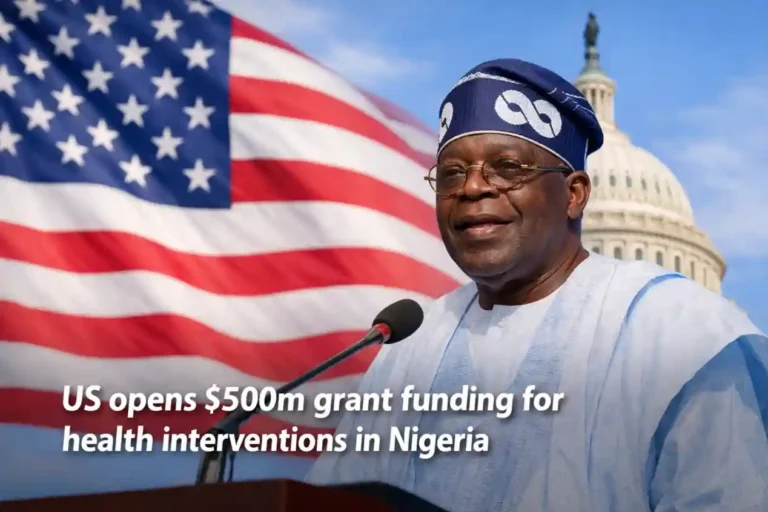
US opens $500m grant funding for health interventions in Nigeria

0

President Bola Ahmed Tinubu has disclosed that recent engagements with the Government of the United States have opened access to over US$500 million in grant funding for targeted health interventions across Nigeria. The disclosure was made on Friday while presenting the N58 trillion 2026 budget to a joint sitting of the National Assembly.

Speaking during the address, Tinubu said the funding opportunity reflects growing international confidence in Nigeria’s reform agenda and health sector plans. He linked the development to ongoing efforts to strengthen human capital and improve healthcare delivery nationwide.

“We also appreciate the support of international partners,” the President told lawmakers. “Recent high-level engagements with the Government of the United States have opened the door to over US$500 million in grant funding for targeted health interventions across Nigeria.”

According to Tinubu, the Federal Government welcomes the partnership and has given assurances that the funds will be used responsibly. “We welcome this partnership and assure Nigerians that these resources will be deployed transparently and effectively,” he said.

The President made the remarks while outlining key priorities in the 2026 budget, themed “Budget of Consolidation, Renewed Resilience and Shared Prosperity.” He noted that the budget was prepared against an improving global outlook but remains focused on addressing Nigeria’s domestic needs, especially in health, education, and social protection.

Tinubu explained that healthcare remains a major pillar of the administration’s human capital development strategy. Under the 2026 budget proposal, the health sector is allocated ₦2.48 trillion. He further disclosed that investment in healthcare represents 6 percent of the total budget size, net of liabilities.

“In healthcare, I am pleased to highlight that investment in healthcare is 6% of total budget size, net of liabilities,” the President said during the presentation.

He stressed that stronger healthcare systems are essential for productivity, economic growth, and improved living standards. According to him, a healthy population supports national development by reducing vulnerabilities and improving workforce efficiency.

The President also linked the external health grants to broader reforms carried out over the past two and a half years. He said the reforms, though challenging, were necessary to rebuild confidence, stabilise the economy, and create a foundation for inclusive growth.

Tinubu assured the National Assembly that the government will maintain discipline in budget execution and accountability in the use of funds, including international grants. He said Nigerians should expect measurable outcomes from health investments, as transparency and effective delivery remain central to the administration’s approach in 2026.

Lawmakers acknowledged the disclosure as part of discussions on sustainable national development.

Tinubu Proposes ₦3.52trn Education Allocation in 2026 Budget

0

President Bola Ahmed Tinubu has proposed an allocation of ₦3.52 trillion to education in the 2026 Federal Budget, placing human capital development at the centre of the government’s fiscal priorities.

The education allocation was disclosed on Friday when Tinubu presented the ₦58.18 trillion 2026 Appropriation Bill to a joint sitting of the National Assembly in Abuja. The session was attended by Vice President Kashim Shettima, cabinet members, governors, and other top government officials.

Addressing lawmakers, the President said the 2026 Budget was prepared “against an improving global outlook” but stressed that the focus remains on building a strong Nigerian economy that works for citizens. He explained that education funding forms a key part of the administration’s plan to translate economic recovery into better living standards.

Tinubu said the 2026 Budget is guided by the need to “strengthen human capital while protecting the vulnerable,” one of the four core objectives shaping government spending for the year. According to him, investment in people is critical to long-term growth and national competitiveness.

Under the sectoral breakdown of the budget, education received ₦3.52 trillion, placing it among the top priority areas alongside security, infrastructure, and health. Tinubu noted that these sectors are closely linked, adding that “without educated and healthy citizens, productivity will not rise.”

Speaking specifically on education, the President highlighted ongoing efforts to expand access to higher education through the Nigerian Education Loan Fund. He said the scheme has already supported over 418,000 students in partnership with 229 tertiary institutions across the country.

“No nation can grow beyond the quality of its people,” Tinubu said, explaining that sustained funding for education and skills development is essential for Nigeria’s future. He added that the education investment is designed to improve access, build skills, and prepare young Nigerians for a changing economy.

The President also tied education spending to broader economic reforms undertaken over the last two and a half years. He acknowledged that the reforms have been difficult, noting that “families and businesses have faced pressure,” but assured Nigerians that the sacrifices are purposeful.

According to Tinubu, the 2026 Budget aims to consolidate gains already made while turning recovery into shared prosperity. He said government will spend with discipline and ensure that allocations deliver real value to citizens.

The education allocation forms part of a broader fiscal framework that projects total revenue of ₦34.33 trillion and total expenditure of ₦58.18 trillion. Tinubu assured lawmakers that the budget would be implemented with stronger discipline, adding that he has directed relevant officials to ensure strict adherence to approved details and timelines.

He concluded that education investment remains central to building a more resilient, inclusive, and competitive Nigeria.

2026 Budget targets stability, investment, jobs, and human capital – Tinubu

0

President Bola Ahmed Tinubu on Friday presented a N58 trillion 2026 budget to a joint sitting of the National Assembly, stating that the fiscal plan is guided by a clear philosophy and four core objectives aimed at consolidating Nigeria’s ongoing reforms. Addressing lawmakers, Vice President Kashim Shettima, governors, cabinet members, and other political leaders, Tinubu said the 2026 Budget was prepared against what he described as “an improving global outlook,” while maintaining focus on Nigeria’s economic recovery.

The President said he appeared before the joint session in fulfilment of his constitutional duty to present the 2026 Appropriation Bill, describing the moment as significant in Nigeria’s reform journey. He said the administration had, over the last two and a half years, made deliberate choices to confront structural weaknesses, stabilise the economy, rebuild confidence, and lay the foundation for a more resilient and inclusive country.

“These reforms were necessary — and they have not been painless,” Tinubu said, acknowledging the pressure faced by families and businesses. He assured Nigerians that the sacrifices made were not in vain, adding that reform was essential for long-term stability and shared prosperity. According to him, the 2026 Budget is designed to consolidate gains already made and turn recovery into improved living standards.

Tinubu stated that the budget is themed “Budget of Consolidation, Renewed Resilience and Shared Prosperity,” noting that it reflects the government’s determination to lock in macroeconomic stability, deepen competitiveness, and ensure that growth results in better jobs, rising incomes, and improved quality of life across the federation.

Under the philosophy and objectives of the 2026 Budget, the President clearly outlined four guiding goals. “Mr. Chairman and fellow Nigerians, the 2026 Budget is guided by four clear objectives,” Tinubu said. He listed them as consolidating macroeconomic stability, improving the business and investment environment, promoting job-rich growth and reducing poverty, and strengthening human capital while protecting the vulnerable.

He added that the administration intends to approach spending and borrowing with discipline. “In short: we will spend with purpose, manage debt with discipline, and pursue growth that is broad-based — not narrow — and sustainable — not temporary,” Tinubu said.

The President noted that the budget philosophy builds on recent economic reforms and improving indicators, stressing that the task ahead is to consolidate gains so that stability translates into prosperity shared by Nigerians. He said the focus remains on ensuring that economic management supports confidence, productivity, and inclusion.

Tinubu also linked the budget philosophy to realism and prudence, noting that fiscal decisions must reflect national priorities. He said the figures presented in the budget represent more than accounting entries, describing them as a statement of intent to maintain fiscal sustainability, transparency, and value-for-money spending.

According to the President, the philosophy guiding the 2026 Budget aligns with the Renewed Hope Agenda and the need to balance stability with growth. He stressed that every naira spent or borrowed must deliver measurable public value, particularly in areas that support human capital, economic opportunity, and protection for vulnerable Nigerians.

Tinubu Says Nigeria’s Economy Grew by 3.98% in Q3 2025

0

President Bola Ahmed Tinubu has said Nigeria’s economy recorded stronger growth in the third quarter of 2025, pointing to early gains from ongoing reforms as he presented the 2026 Appropriation Bill to a joint sitting of the National Assembly.

Speaking on Friday while laying a proposed N58 trillion budget before lawmakers, Tinubu said the economy grew by 3.98% in Q3 2025, an improvement over the 3.86% recorded in Q3 2024. According to him, the figures show that recent policy decisions are beginning to produce measurable results.

“Our economy grew by 3.98% in Q3 2025, higher than the 3.86% recorded in Q3 2024,” the President said, noting that the performance reflects deliberate efforts to stabilise the economy and rebuild confidence.

Tinubu explained that the 2026 Budget was prepared against what he described as an improving global outlook, but stressed that the administration’s main focus remains strengthening Nigeria’s domestic economy. He said reforms introduced over the last two and a half years were aimed at addressing long-standing structural weaknesses and creating a more resilient economic base.

The President also highlighted progress in inflation management, saying inflation has moderated for eight consecutive months. He stated that headline inflation declined to 14.45% in November 2025 from 24.23% in March 2025, attributing the trend to stabilising food and energy prices, tighter monetary conditions, and improved supply responses.

“With stabilising food and energy prices, tighter monetary conditions, and improving supply responses, we expect the disinflationary trend to persist,” Tinubu said, adding that inflation is expected to decline further over the 2026 horizon, barring major supply shocks.

He said oil production has improved, supported by enhanced security, technology deployment, and sector reforms, while non-oil revenues have expanded through better tax administration rather than what he described as excessive taxation. According to him, these developments have helped boost government earnings and reduce pressure on public finances.

Tinubu also pointed to renewed investor confidence, saying it is reflected in increased capital inflows, renewed project financing, and stronger private-sector participation. He added that Nigeria’s external reserves rose to about US$47 billion as of 14 November 2025, a seven-year high, providing more than ten months of import cover and a stronger buffer against economic shocks.

“These outcomes are not accidental,” the President said. “They reflect difficult but deliberate policy choices.”

He said the focus for 2026 will be to consolidate these gains so that economic stability can translate into improved living standards for Nigerians. Tinubu described the proposed budget as a tool to turn recovery into broader prosperity, saying the government’s task is to ensure growth becomes inclusive and sustainable.

According to him, the improved economic indicators form the foundation of the 2026 fiscal plan, which he said is designed to deepen stability, strengthen resilience, and support long-term economic expansion across the country.

ITF urges artisans, technicians to enrol in SIWES and SUPA programmes

0

The Industrial Training Fund (ITF) has urged artisans, industrialists, and technicians across Nigeria to take advantage of its training programmes, including the Students Industrial Work Experience Scheme (SIWES), to strengthen workforce.

The Fund said its focus is on building Nigeria’s human capital and positioning the economy among the most competitive globally. According to ITF, “our commitment is unwavering: to develop Nigeria’s human capital and position the nation’s economy among the most competitive in the world.”

ITF stated that Nigeria can stand shoulder to shoulder with the best through investment in skills development. It explained that the agency exists to build a skilled and globally competitive workforce.

The Fund encouraged industrialists, artisans, and technicians to engage with its Area Offices nationwide and benefit from training programmes. It said SIWES “effectively bridges the gap between academic learning and industry requirements.”

ITF also highlighted the Skill-Up Artisans (SUPA) Programme, an initiative of President Bola Ahmed Tinubu, GCFR, under the Renewed Hope Agenda. The Fund said the programme upgrades artisans and technicians to meet international standards, adding that “enhanced skills translate to higher productivity, and higher productivity is the catalyst for sustainable economic growth.”

ITF stressed, “This is our mandate. This is our commitment. And this is the future we are building for Nigeria.”